
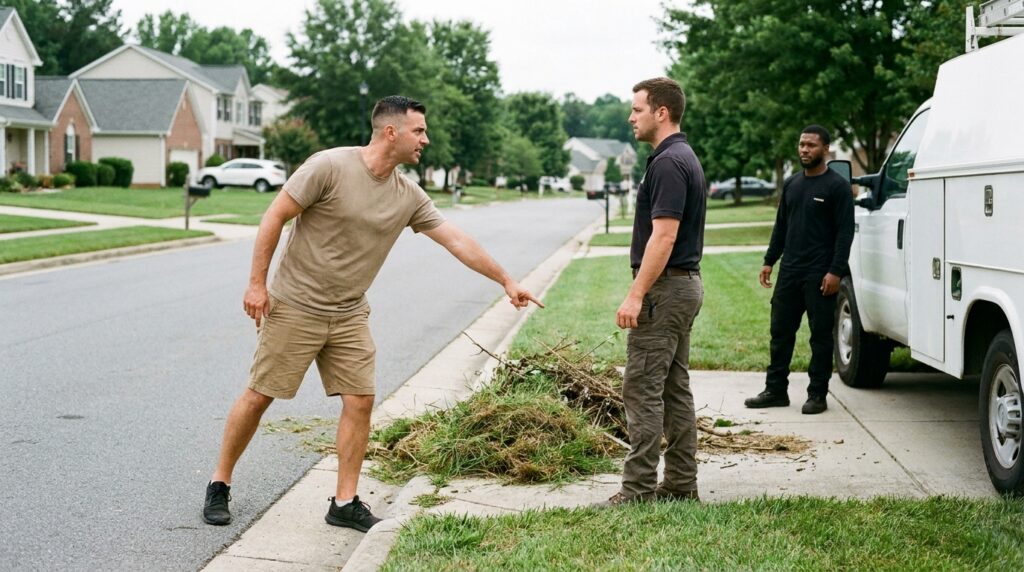
CHAPTER 5: THE ANCHOR INCIDENT
“Alright,” Jesse said, his face settling into the dusty gray lines of a man who worked for time, not pride. He gave a single, slow nod that cost him nothing. “I hear you.”
The Confronter’s jaw tightened, his hand dropping three inches until the corporate cease-and-desist paper brushed against his knee. The silence that followed was heavy, broken only by the rhythmic, mechanical heartbeat of the six-ton truck’s diesel engine and the faint, high-frequency hiss of the tow deck’s hydraulic fluid cooling in the sun. He had expected a shouting match, an explosive blue-collar refusal that he could log into his phone as an active threat to community safety. Instead, the flat compliance of Jesse’s voice left him standing on the edge of the parched lawn strip, his arm still rigidly extended over a pile of dead oak limbs.
“If you hear me, tell your man to unhook the frame,” the Confronter said, his voice dropping into a register that sounded like a dry file dragging across sheet iron. He didn’t look at the white utility van that had just coasted to a halt fifty feet behind the tow rig, its rusted muffler giving off a single, metallic tink as the engine cut out. “We’re already twenty minutes past the standard clearance window. Every quarter-hour this lane is blocked costs the association three hundred dollars in contractor delays.”
Jesse didn’t move from his position by the fender. He reached down slowly, his rough fingers tracing the coarse edge of the transport chain where it looped through the cast-iron storm grate. The links were already hot enough to blister skin, coated in a fine layer of pulverized limestone dust that had settled from the passing cement trucks on the state highway.
“The delay isn’t mine,” Jesse murmured. He leaned in slightly, his voice dropping below the rattle of the truck’s fuel injectors, carrying only far enough to hit the Confronter’s sunglasses. “The map on my hood has a public utility seal from eighty-four, mister. But the ledger entry from March has a private tax identification number. It’s registered to an office park off Route 9, listed under Vance Contracting. You want to tell me why an HOA board helper is running city infrastructure through an unbonded family shell company?”
The man in the tan t-shirt took half a step back, his heel catching on a thick surveyor’s string that had been pegged into the parched soil behind the grass line. The crisp white paper on his clipboard rattled, the zinc clip vibrating against the plastic board with a tiny, frantic chatter. He shifted his weight, his eyes darting toward the white van where the driver’s side door was now swinging open, revealing a man in an unbuttoned high-visibility vest that bore no county logo.
“The board handles its internal allocations through vetted subsidiaries,” the Confronter said, his voice rising as his shoulder pitched forward to block Jesse’s view of the van. “It’s entirely within the township’s development guidelines. Section 9 allows for private mitigation when municipal crews fail to clear the channel lines.”
“Section 9 requires a certified structural engineer’s signature and an open public bidding log,” Jesse said. He didn’t raise his voice, but he stepped forward, his bulk closing the gap until his sweat-streaked shoulder was less than twelve inches from the man’s clipboard. “Your brother-in-law doesn’t have an engineering stamp, friend. He has a three-ton dump truck with a leaking transmission and an expired county vendor license. You didn’t call the heavy tow to protect the drainage. You called it because our truck is sitting right on top of the silt trap his crew was paid five thousand dollars to excavate three weeks ago—the one that’s still choked with four feet of river gravel.”
Behind them, Miller let out a short, rhythmic grunt as he pulled the lever on the primary ratchet binder, the iron teeth clicking into place with a sound like a rifle bolt snapping home. The chain between the truck frame and the buried storm masonry hummed under the sudden mechanical load, the iron links aligning themselves into a straight, unyielding bar of gray metal across the asphalt.
The tow driver stepped away from his control panel entirely, his thick leather gloves dropping to his sides. He looked at the white van, then looked at the red grease-pencil notation Jesse had exposed on the truck’s hood. His face had gone hard, the professional indifference of a road worker replaced by the cold, transactional calculation of a man who knew exactly who paid for the fuel in his tank.
“This isn’t an obstruction sweep,” the driver muttered, his eyes locking onto the Confronter’s sunglasses. “This is a private boundary dispute. You told my dispatcher this was an abandoned commercial rig on common frontage. If I pull against a county drainage marker for a private sub-contractor, the sheriff’s department takes my rig before I reach the county line.”
“I signed the authorization!” the Confronter shouted, his face turning a dark, blotchy red under his chemical tan. He turned on the driver, his finger pointing wildly down at the concrete curb line. “The plat is filed! The association owns the easement down to the raw dirt!”
“The association owns the grass,” Jesse said, his hand dropping flat onto the blistered iron of his tailgate. “The state owns the flow. And right now, you’re standing in the middle of a federal clearway with a handful of forged corporate notices.”
The woman on the porch across the street didn’t move, but the smartphone in her hand stayed level, the glass lens catching the glare of the noon sun like a tiny, unblinking eye. From the back of the white van, the side panel door slid open with a loud, corrugated scrape, but the man who stepped out wasn’t carrying a shovel. He was holding a handheld radio, his face pale as he looked past the tow truck toward the outer throat of the cul-de-sac, where the distinctive, low-pitched whine of a county supervisor’s diesel wagon was just beginning to echo through the subdivision entrance.
Jesse didn’t turn to look at the highway. He kept his eyes on the Confronter, watching the man’s fingers slowly unlock from the zinc clip until the white paper began to flutter in the hot, dust-laden breeze coming off the asphalt.








