
CHAPTER 2: THE PAPER LAUNCH
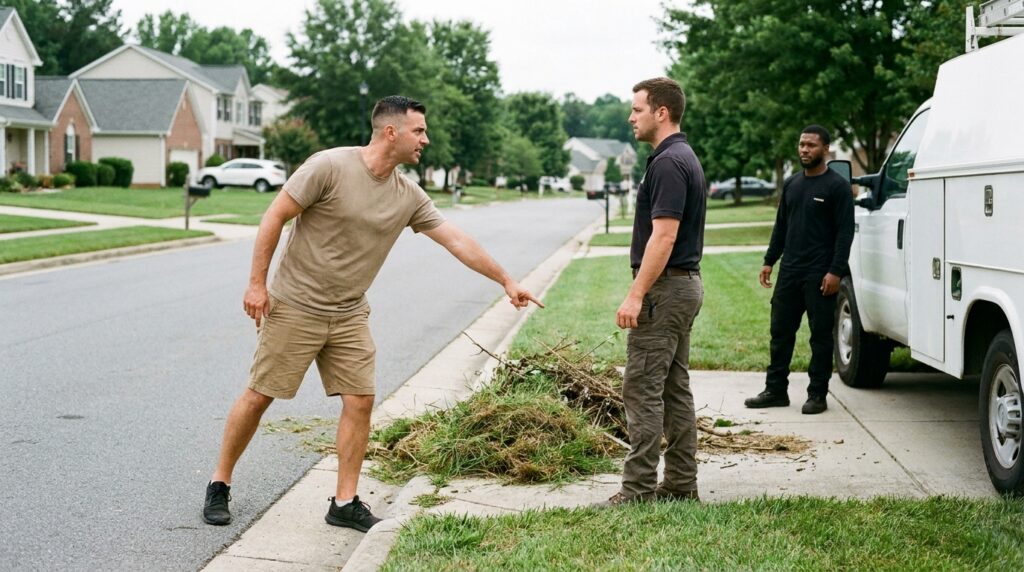
“You hear me, but you aren’t moving the rig,” the man said, his thumb tapping the edge of the zinc clip. The metal gave off a thin, metallic tink that caught the low hum of the truck’s diesel engine.
Jesse didn’t shift his gaze from the scratch on the concrete curb. The sun was directly overhead now, baking the asphalt until the smell of hot tar and old iron rose into the back of his throat. He reached down slowly, grabbed the handles of his rusted shears, and tossed them into the back of the flatbed. They landed with a heavy, discordant clang against the steel floorboards, right next to a pile of frayed nylon tie-downs.
“The truck stays until the pile is down to the dirt,” Jesse said. His voice didn’t rise. It had the flat, unhurried cadence of a machine that had been running all morning in the dust. “That’s the contract with the township. If you want the lane clear, you talk to the county yard in Westlake.”
The man in the tan t-shirt let out a dry, short laugh that didn’t reach his eyes. He took half a step backward, his expensive running shoes kicking up a spray of gray gravel from the edge of the lawn strip. He unclipped the top sheet of paper from his board, holding it out by the corner. The white stock was thick, uncreased, and bore a heavy, raised corporate seal that looked too crisp for a standard municipal notice.
“This is a formal cease-and-desist from the Oak Ridge Homeowners Association,” the man said, his voice dropping into a register meant to carry toward the nearest porch. “Section 4, Paragraph B. Unauthorized staging of commercial waste on common frontage. You’ve got five minutes before the heavy-duty tow from Miller’s Express gets called to clear this lane. I’ve already signed the authorization form.”
Jesse looked at the paper. He didn’t take it. The shadow of the sheet fell across the rusted iron hinge of the truck’s tailgate. In the lower margin, under the blue ink signature of the board president, there was a small, smudged fingerprint—not ink, but a greasy residue that smelled faintly of hydraulic fluid and recycled oil. It was the same grade of lubricant Jesse used on his own hydraulic lifts every three months.
From the cab, the passenger side door finally groaned open. Miller climbed down, his heavy work boots hitting the blacktop with a solid, fleshy impact that made the truck’s leaf springs squeak. He wasn’t carrying his tools. His hands were stuffed deep into the pockets of his grease-stained black canvas vest, his eyes squinting through the glare of the noon light.
“Jesse,” Miller said softly, his voice low enough to slide under the rumble of the exhaust. “Look at the planter behind him. The brick one with the dead ivy.”
Jesse didn’t turn his head, but his peripheral vision tracked the line of Miller’s shoulder. At the entrance of the subdivision, about ten yards back, a massive brick planter held the weathered cedar sign for Oak Ridge Estates. The mortar between the bottom two rows of brick had crumbled away, leaving a dark, jagged gap about three inches wide. Taped just inside that shadow, completely hidden from the street but visible from the high vantage of the truck’s cab, was a small black plastic box with a flexible wire antenna pointing straight down into the weeds. It was a commercial GPS transponder, its power light blinking a faint, regular red against the dark stone.
“You guys like to monitor the curb pretty close around here,” Jesse said, his tone casual, almost conversational, though his mind was already running the geometry of the street.
“We protect the infrastructure,” the Confronter replied, his clipboard snapping shut with a sharp crack. He stepped in line with the brick planter, his posture stiffening as if he were physically blocking the view of the mortar gap. “Every square inch of this development is accounted for. If you aren’t out of this cul-de-sac by twelve-fifteen, the fine hits your company registration before you reach the interstate.”
Jesse took a slow breath, the dry, alkaline dust of the roadside settling into his lungs. The weight of the morning’s labor was a dull ache across his shoulder blades, but his movements remained deliberate. He walked past the man, his shoulder brushing within an inch of the tan t-shirt, and stopped at the side of the truck bed. He reached over the rail, pulled the heavy black vinyl folder off the dashboard through the open window, and laid it flat against the hot metal of the hood.
The iron of the truck was hot enough to sting through his calluses. He flipped the cover open, revealing three years of laminated county easement maps, each one cross-referenced with the state’s agricultural drainage grid. The pages were yellowed at the margins, marked with grease pencil and the faint, circular stains of old coffee cups.
“This lane isn’t common frontage,” Jesse murmured, his finger tracing a thick, hatched line that bypasses the subdivision’s legal boundaries entirely. He looked back over his shoulder at the Confronter, whose fingers were now twitching against the edge of his clipboard. “The county laid this pipe in eighty-four. Before these houses were even staked out. This dirt doesn’t belong to your board, mister. It doesn’t even belong to the township.”
A curtain across the street snapped shut with a distinct plastic click. The dog in the garage had stopped barking, replaced by the faint, distant whine of an approaching diesel engine from the main highway—but it wasn’t the sound of a standard county inspector’s sedan. It was heavier. The deep, twin-axle growl of a commercial wrecker.
Jesse closed the folder, the magnetic clasp snapping home with a heavy thud. He didn’t look at the road. He looked straight at the Confronter’s sunglasses, watching his own reflection—dusty, sweat-streaked, and entirely unmoving—stare back at him from the dark lenses.
“Miller,” Jesse said, his voice dropping into the quiet center of the heat. “Get the chains out of the toolbox. We’re going to be here a while.”








