Chapter 9: The Score That Could Not Be Changed
By the following spring, the baseball field looked much as it always had.
The bleachers had been repainted.
Fresh dirt covered the infield.
The concession stand had a new refrigerator, and the school had replaced the damaged scoreboard controller with a more secure system.
The electronic controls were now kept in a locked enclosure accessible only to authorized staff.
A second scoring record remained mandatory at every varsity game.
The changes were practical rather than dramatic.
Fairhaven’s athletic department had learned from the incident and wanted to prevent another interruption.
Emily Carter had accepted the full-time administrative position she had applied for.
Her new responsibilities included scheduling, athletic records, and coordinating volunteers for school events.
She still helped with scorekeeping when needed.
The experience had shaken her confidence temporarily, but it had also strengthened her commitment to the work.
Margaret Ellis had made sure the hiring committee evaluated Emily on her qualifications and performance, not on the false allegations made during the championship.
Walter Bennett continued attending games.
He had become something of an unofficial mentor to several younger volunteers.
Sometimes he brought his late wife’s old thermos, filled with coffee, and sat near the scorekeeping station.
He liked seeing people take pride in small responsibilities.
Robert Whitmore had also changed.
He no longer tried to smooth over every disagreement in the family.
When Patricia became unreasonable, he addressed it directly.
Their marriage was not suddenly perfect.
Years of habits did not disappear because of one embarrassing afternoon.
But their conversations had become more honest.
Patricia had completed the reimbursement payments required by the school district.
The local authorities had resolved the property-damage matter through a restitution-based diversion agreement, which she completed without further incident.
Her one-year ban from district athletic events remained in effect.
She did not challenge it again.
Instead, she began attending a community counseling program focused on anger management and personal accountability.
At first, she disliked the sessions.
She found it uncomfortable to listen without interrupting.
She disliked being asked to describe her own choices rather than the behavior of others.
But gradually, she began recognizing a pattern.
Whenever she felt powerless, she tried to control someone else.
Whenever she feared embarrassment, she became aggressive.
Whenever Tyler struggled, she treated his difficulties as personal failures that reflected on her.
Understanding those habits did not erase the damage she had caused.
It did, however, give her a chance to stop repeating them.
Tyler graduated from Fairhaven High School in June.
He had accepted an offer to attend a small college in Ohio, where he would study business and join the baseball program.
The school valued his academic record, his defensive skills, and the recommendations from his coaches.
His mother’s conduct had not defined his future.
At graduation, Patricia sat beside Robert in the auditorium.
She wore a simple navy dress and kept her orange-red hair neatly styled.
She had chosen the outfit herself, without the glittering accessories that usually drew attention.
When Tyler’s name was announced, she stood and applauded.
She did not shout.
She did not demand that anyone notice her.
She simply watched her son cross the stage and receive his diploma.
Robert glanced at her.
She was crying.
Not because Tyler had won a trophy.
Not because he had defeated another student.
But because he was moving forward into a life of his own.
After the ceremony, Tyler found his parents near the entrance.
He hugged Robert first.
Then he turned toward Patricia.
She opened her arms cautiously.
Tyler stepped into them.
The embrace lasted only a few seconds, but it meant more to her than any public victory.
Later that summer, Fairhaven held a community appreciation event for its athletic volunteers.
Emily received recognition for her years of accurate recordkeeping and her professionalism during the previous championship.
Walter Bennett was honored for his decades of service to youth baseball.
Coach Donovan spoke briefly about sportsmanship.
He reminded the audience that young athletes learned from the adults around them, whether those adults intended to teach lessons or not.
Patricia did not attend because her event restriction was still in effect.
She read about the ceremony in the local newspaper the next morning.
For a moment, she felt the familiar sting of exclusion.
Then she saw Emily’s photograph.
The young woman stood beside Margaret Ellis, holding a small plaque.
Patricia studied the picture.
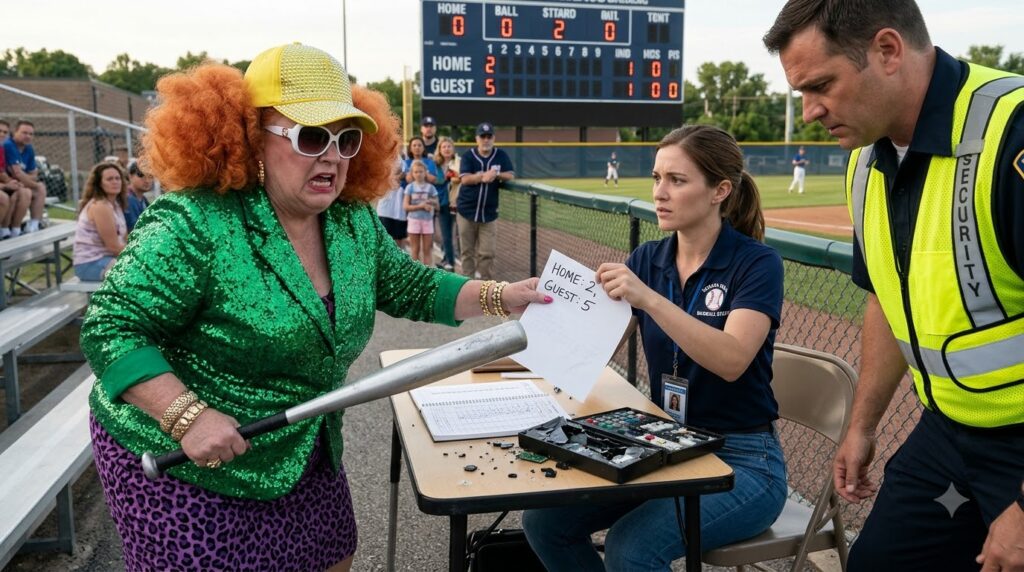
She remembered the afternoon when she had tried to take the score sheet from Emily’s hands.
She remembered believing that being louder and stronger would make her right.
Now she understood how mistaken she had been.
She clipped the article and placed it in a kitchen drawer.
Not as a reminder of humiliation.
As a reminder of the person she had wronged.
A few weeks later, Patricia received a short letter from the school district confirming that her restitution obligation had been satisfied.
The event ban would expire at the end of its original term.
The letter made no promises about the future.
It simply confirmed that she had completed what was required.
Patricia folded it carefully.
Then she called Tyler.
He was preparing to leave for college.
She asked whether he wanted her to attend his first home game when the time came.
Tyler paused.
He told her he would like that.
But he also asked her to promise something.
She must let the coaches coach.
She must let the umpires make their calls.
And she must let the scoreboard tell the truth, even when the numbers were disappointing.
Patricia smiled sadly.
She promised.
On a cool Saturday the following spring, she sat quietly beside Robert at Tyler’s college baseball game.
Their son’s team lost by two runs.
Tyler struck out once, made a clean defensive play, and drove in a run with a single.
When the final out was recorded, Patricia stood with the other spectators.
She applauded both teams.
Then she waited near the fence for Tyler.
He emerged carrying his equipment bag, tired and disappointed.
Patricia wanted to tell him what he could have done differently.
The words formed in her mind.
But she let them go.
Instead, she asked whether he was hungry.
Tyler laughed.
He was.
They walked toward the parking lot together, Robert carrying the extra equipment bag.
Behind them, the scoreboard still displayed the final result.
Patricia did not look back.
A year earlier, she had believed that changing a scoreboard could change reality.
She had smashed a controller, interrupted a championship, humiliated her son, and damaged the reputation of an honest young woman.
The consequences had been real.
So had the effort required to make amends.
But the most important lesson had come from something simple.
A score was only a record of what happened on the field.
It was not a measure of a family’s worth.
It was not proof that a parent had succeeded or failed.
And it was certainly not something that could be rewritten through anger.
As Tyler opened the car door, he turned toward his mother.
“Thanks for coming, Mom.”
Patricia smiled.
“Wouldn’t have missed it.”
For once, there was nothing else she needed to say.
The game was over.
The score was final.
And that was perfectly all right.