Chapter 2: The Mother Who Could Never Accept Losing
Patricia Whitmore had spent most of her adult life believing that rules were useful only when they benefited her family.
She had not always been so openly confrontational.
Twenty years earlier, she had been a successful sales manager at a regional furniture company. She was persuasive, energetic, and determined to get what she wanted. Her husband, Robert, admired her confidence when they first married.
Over time, however, that confidence hardened into a need to control nearly everything around her.
Patricia argued with restaurant managers over seating arrangements. She challenged teachers who gave Tyler anything less than an A. She once demanded that a youth soccer league replay an entire match because her son had slipped while attempting a penalty kick.
Robert, who worked as an electrician, had learned to choose his battles.
Their marriage survived, but their household gradually organized itself around avoiding Patricia’s anger.
Tyler had grown up inside that arrangement.
At seventeen, he was a talented athlete with quick hands, a strong throwing arm, and a quiet personality that contrasted sharply with his mother’s.
He loved baseball because the field gave him something his home rarely offered: clear expectations.
A ball was fair or foul. A runner was safe or out. A team won by scoring more runs.
The game did not care who had the loudest parent.
That afternoon’s championship mattered enormously to him.
Fairhaven had not reached the county final in eleven years. Tyler had played on the same team as several of his friends since elementary school, and their coach, Michael Donovan, had spent the entire season reminding them that a championship was earned through patience and teamwork.
Tyler also hoped to play baseball at a small college.
A regional scout had attended two of his games earlier that spring, and his coach had encouraged him to focus on consistent performance rather than impressing anyone with dramatic plays.
Patricia interpreted the scout’s interest differently.
To her, Tyler’s success was proof that she had been right about everything.
She had purchased expensive equipment, paid for private lessons, and driven him to countless practices.
She reminded him of those sacrifices often.
When Fairhaven fell behind Westbrook 5–2, Patricia became increasingly agitated.
She complained about the home plate umpire. She accused Westbrook’s pitcher of deliberately distracting Tyler. She loudly criticized Fairhaven’s coach for refusing to change the batting order.
Several spectators moved away from her section.
Robert, sitting two rows behind his wife, tried to calm her.
She dismissed him with a wave.
Then Tyler committed a throwing error in the fifth inning.
It did not directly cost Fairhaven a run, but Patricia reacted as though the entire stadium had witnessed a personal attack against her family.
She stood up and shouted instructions across the field.
Tyler kept his eyes on the dirt.
He recognized that voice.
He had heard it at basketball games, school ceremonies, and even his middle school graduation.
The more embarrassed he became, the louder she seemed to grow.
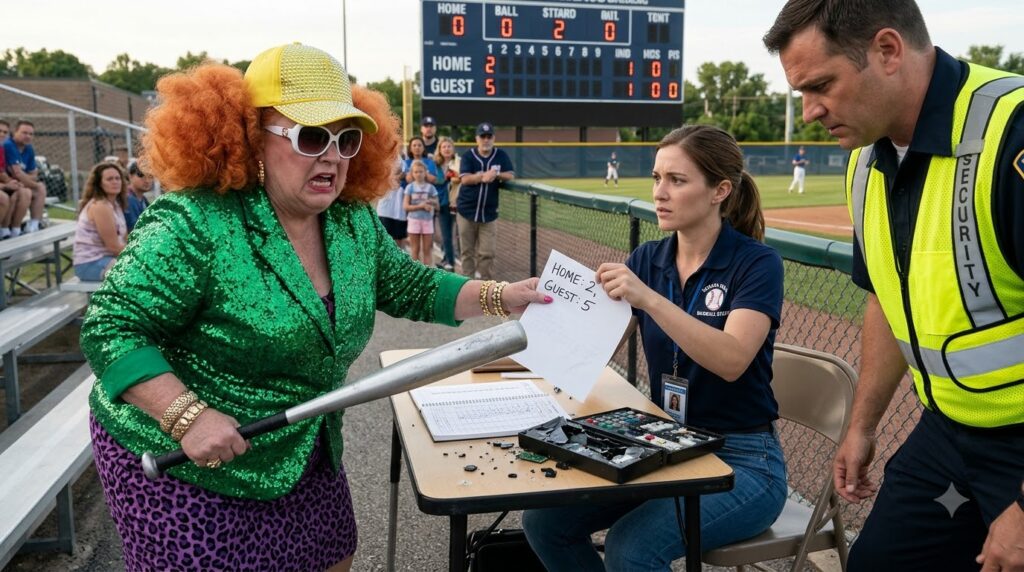
When the sixth inning began, Patricia noticed Emily working alone at the scorekeeping station.
She also noticed the controller sitting near the edge of the desk.
To Patricia, the scoreboard had become a symbol of humiliation.
Those glowing numbers told every spectator that her son’s team was losing.
She wanted them changed.
Her first attempt was almost casual.
She approached Emily and suggested that the guest score looked incorrect.
Emily checked her book and explained that Westbrook had five runs.
Patricia argued that one of the runs should not count because of a disputed play earlier in the game.
Emily told her that the umpire’s ruling stood.
The conversation ended there.
Or it should have.
A few minutes later, Emily stepped toward the fence to confirm a substitution with the assistant coach.
Patricia saw her opportunity.
She moved behind the table, touched the controller, and changed the guest score to zero.
It was a reckless act, but she convinced herself it was merely correcting an injustice.
When Emily returned and discovered the altered display, Patricia refused to move away.
Emily reached for the controller.
Patricia saw the aluminum bat.
The decision that followed took only seconds.
By the time she realized what she had done, the controller was destroyed, security was approaching, and dozens of people were staring at her.
But even then, Patricia did not think about the teenagers whose championship she had interrupted.
She thought about how to escape blame.
As Daniel escorted her away from the desk, she began insisting that Emily had mishandled the equipment.
She claimed the scorekeeper had been deliberately favoring Westbrook.
Then she made an accusation that caused several nearby spectators to turn.
Emily, she announced, had been changing scores all season.
It was a serious allegation against a young woman who had volunteered hundreds of hours to the school district.
And Patricia had no evidence.
What she did not know was that the scorekeeping station had another witness.
A camera mounted beneath the bleacher roof had recorded the entire afternoon.