Chapter 4: A Son’s Worst Afternoon
Tyler Whitmore had imagined his final high school championship hundreds of times.
In those daydreams, he made a difficult defensive play, drove in the winning run, and celebrated with teammates who had become his closest friends.
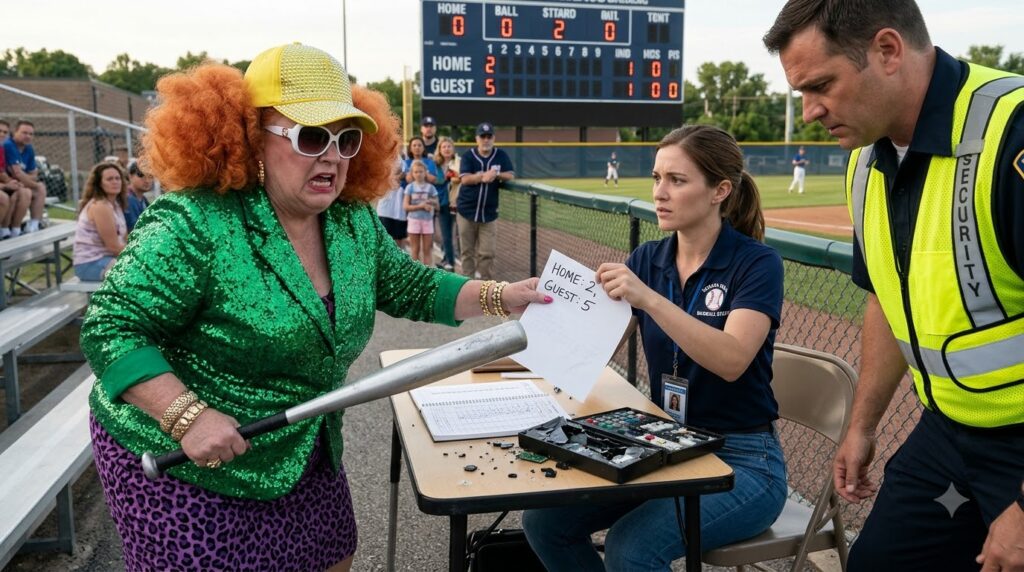
He never imagined standing beside the dugout while his mother was escorted away from the scorekeeping station.
Yet that was where he found himself.
The crowd had resumed talking, but Tyler could feel people looking at him.
Some expressions were sympathetic.
Others were curious.
A few were openly judgmental.
He hated all of them.
His teammate Marcus Hill approached quietly.
Marcus was Fairhaven’s catcher and Tyler’s best friend since third grade.
They had played together through rainy spring practices, summer tournaments, and disappointing seasons when winning three games felt like an achievement.
Marcus did not mention Patricia.
He simply handed Tyler his glove.
Coach Donovan had told the players to prepare for the game to resume.
That ordinary gesture helped more than Marcus realized.
Tyler took the glove and walked toward the field.
But his mind remained near the bleachers.
He remembered being nine years old when his mother argued with a Little League umpire so aggressively that the game had been suspended.
He remembered being twelve when she demanded that a coach apologize publicly for leaving him out of the starting lineup.
He remembered his freshman year, when she confronted another player’s father over a disputed tournament selection.
Each incident had ended with the same explanation.
She was protecting him.
She was fighting for his future.
She was doing what any good mother would do.
Tyler had believed those explanations when he was younger.
Now he was no longer sure.
At the scorekeeping station, Margaret and the coaches finalized the arrangements for resuming play.
The official score remained Westbrook 5, Fairhaven 2.
There were two outs in the bottom of the sixth inning, with a Fairhaven runner on first base.
The umpires reviewed the interruption and confirmed that no play had occurred during the disturbance.
The game would continue from exactly where it had stopped.
Patricia, however, was not permitted to remain at the field.
Daniel explained that her destructive behavior violated school event rules and that she would have to leave the premises.
Patricia protested.
She insisted she had purchased a ticket.
She reminded Daniel that her family had donated money to the athletic booster club.
She threatened to contact the superintendent.
Daniel remained calm.
The decision stood.
Robert offered to drive her home.
Patricia refused at first, insisting that she would not leave before Tyler’s game ended.
Then she noticed several spectators holding phones.
The possibility that recordings of her behavior might circulate online finally changed her mind.
She walked toward the parking lot, still complaining.
Robert followed several steps behind.
Before getting into the car, he turned toward the field.
Tyler was standing near second base, looking down at his glove.
Robert raised one hand.
Tyler saw him.
For a moment, father and son simply looked at each other across the distance.
Then Tyler nodded.
It was a small acknowledgment, but Robert understood.
His son needed him to stop the situation from getting worse.
Robert opened the passenger door.
Patricia climbed in without looking back.
As the car pulled away, the stadium announcer informed spectators that the game would resume with the official score confirmed by both teams.
The portable whiteboard displayed the correct numbers.
A modest round of applause followed.
Then the players returned to their positions.
The first pitch after the interruption was a called strike.
The second was fouled into the stands.
The third produced a routine ground ball to shortstop.
Tyler fielded it cleanly and threw to first.
The inning ended.
For the first time in nearly half an hour, the game felt normal.
But Tyler’s afternoon was far from over.
In the top of the seventh, Westbrook loaded the bases with one out.
A sharp ground ball came toward Tyler.
He moved to his left, fielded it, and stepped on second base for the force out.
Then he threw to first.
Double play.
The Fairhaven crowd erupted.
Tyler barely reacted.
He jogged toward the dugout, knowing his team still trailed by three runs.
In the bottom of the seventh, Fairhaven mounted a rally.
A leadoff walk was followed by a single.
Then Marcus drove a line drive into right field, scoring one run.
The score became 5–3.
A sacrifice fly brought another runner home.
5–4.
With two outs and a runner on second, Tyler stepped to the plate.
The crowd rose.
He could hear his teammates calling encouragement.
He could also see the empty seat where his mother had been sitting.
For a moment, he felt an unexpected sense of relief.
There would be no shouted instructions.
No demands.
No voice telling him that failure was unacceptable.
Only the pitcher, the ball, and the opportunity in front of him.
Tyler worked the count to two balls and two strikes.
The next pitch was a fastball on the outside corner.
He swung.
The ball shot toward deep right-center field.
The crowd surged to its feet.
For one breathtaking second, it looked as though Tyler might drive in the tying run.
Then Westbrook’s center fielder sprinted across the grass and made a diving catch.
The game was over.
Westbrook had won the championship 5–4.
Tyler stood near first base, staring at the outfielder holding the ball.
He had come within a few feet of changing the outcome.
Then he turned toward his dugout.
His teammates were disappointed, but they were already moving toward the field to congratulate Westbrook.
Coach Donovan had taught them to do that after every game.
Tyler joined them.
He shook hands with the opposing players, including the center fielder who had caught his final hit.
The young man told him it had been a great swing.
Tyler thanked him.
He meant it.
The championship had been lost fairly.
That mattered.
But when Tyler returned to the dugout, Coach Donovan asked him to stay behind for a moment.
The coach had received a call from the athletic director.
And there was something Tyler needed to know before he went home.