Chapter 7: When the Truth Reached Everyone
Patricia watched the video on her phone at the kitchen table.
The clip lasted eleven seconds.
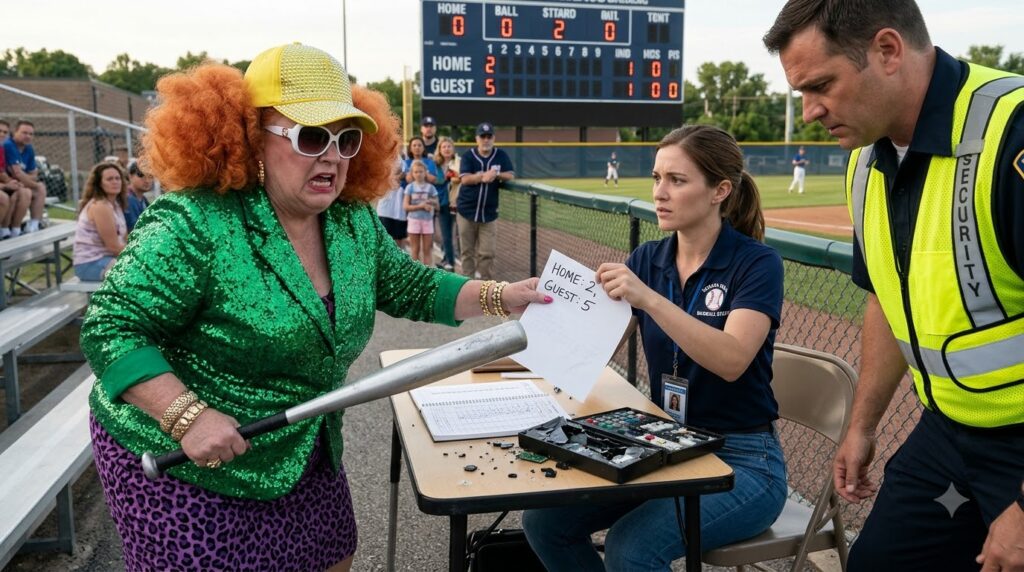
It began with her raising the aluminum bat.
Then came the impact.
Plastic fragments scattered.
Her voice rang out clearly.
“Try fixing the score now!”
The camera shook as someone in the bleachers reacted.
The recording ended with Emily holding the backup score sheet.
Patricia replayed it three times.
She disliked the angle.
She disliked the sound of her own voice.
Most of all, she disliked how unmistakable her actions looked.
There was no visible provocation.
No equipment malfunction.
No evidence that Emily had attacked her or threatened her.
Only Patricia, a bat, and a destroyed controller.
By noon, several people had sent Robert the video.
One was a coworker.
Another was his older sister, Linda, who lived in Columbus.
Linda’s message was brief.
She wanted to know whether Tyler was all right.
Robert appreciated the question.
Most people seemed interested only in Patricia.
Few had considered what the incident might mean for their son.
Patricia spent much of the morning reading comments.
Some were cruel.
Others were fair but harsh.
Several former Little League parents recalled earlier incidents involving her behavior.
One described a tournament where Patricia had argued with an umpire for twenty minutes.
Another remembered her demanding that a volunteer coach resign.
Patricia insisted that people were exaggerating.
Robert did not respond.
He had seen enough over the years to recognize the pattern.
At school, Tyler faced a different kind of attention.
Several classmates had watched the video.
A few tried to make jokes.
Others asked whether his mother had been arrested.
Tyler answered as little as possible.
During lunch, he sat with Marcus and two other teammates.
They discussed the championship, the final inning, and the diving catch that had ended the game.
Nobody mentioned Patricia.
Tyler was grateful.
After school, Coach Donovan asked him to stop by the athletic office.
The coach had received a message from the college scout who had previously attended Fairhaven games.
The scout had heard about the incident but wanted Tyler to know that his baseball evaluation was based on his own performance and character.
He had reviewed Tyler’s season statistics and still wanted to speak with him about possible opportunities.
Tyler felt a weight lift from his chest.
For the first time since the championship, he allowed himself to imagine a future beyond the embarrassment.
Meanwhile, the school district completed its initial review.
The security footage confirmed the unauthorized scoreboard manipulation and deliberate destruction of equipment.
The district documented the replacement cost of the controller, related equipment, and necessary labor.
The total was $2,480.
The school had insurance, but the athletic director explained that the deductible and administrative costs made a claim impractical.
The district intended to seek reimbursement from Patricia.
It also imposed a one-year ban on her attendance at district athletic events, subject to an appeal process.
Margaret informed Robert and Patricia in writing.
The letter was firm but measured.
It stated the documented facts, explained the relevant policies, and outlined the consequences.
It did not insult Patricia.
It did not speculate about her personality.
It simply held her responsible for her conduct.
Patricia was furious.
She wanted Robert to help her challenge the decision.
She suggested hiring an attorney.
She insisted that the school was making an example of her.
Robert read the letter carefully.
Then he placed it on the table.
He told her that the family would pay for the damage.
Patricia objected.
Robert explained that he would not spend their savings fighting evidence that clearly showed what had happened.
He also told her that Tyler needed peace at home.
The conversation became heated.
Patricia accused Robert of abandoning her.
Robert answered that refusing to excuse destructive behavior was not abandonment.
It was responsibility.
That evening, Tyler came downstairs while his parents were sitting in the living room.
He had heard enough of the discussion to understand what was happening.
He stood near the doorway, still wearing his Fairhaven baseball sweatshirt.
Then he spoke.
He told his mother that he loved her.
He also told her that he had been embarrassed by her behavior for years.
He described the pressure he felt whenever she shouted at coaches or challenged officials.
He explained that he had sometimes dreaded games because he feared what she might do.
Patricia opened her mouth to interrupt.
Robert gently raised a hand.
Tyler continued.
He told her that he wanted to play baseball because he loved the game, not because every victory proved something about their family.
Then he said the words Patricia had never expected to hear.
“I need you to let me lose sometimes.”
The room fell silent.
Patricia looked at her son.
For years, she had told herself that her fierce protection made him feel safe.
Now he was telling her the opposite.
He had felt trapped.
Tyler waited for an answer.
Patricia looked away.
For once, she could not find a way to turn the conversation into an argument about someone else’s mistakes.
And the silence that followed was more painful than any accusation.