Chapter 8: The Price of Making Things Right
The district scheduled an administrative meeting two weeks after the championship.
Patricia was invited to attend with a representative if she wished.
Robert accompanied her.
Margaret Ellis chaired the meeting, joined by Athletic Director Frank Miller and a district administrator.
Emily Carter attended for the portion concerning the scorekeeping incident.
Daniel Brooks provided a written security report.
The atmosphere was formal but not hostile.
Margaret began by explaining that the purpose of the meeting was to review the documented conduct, the resulting damage, and the district’s response.
Patricia had prepared several pages of notes.
She intended to argue that the school had failed to supervise the scorekeeping station properly.
She also planned to complain about the public attention she had received.
But when the security recording played, her notes remained untouched.
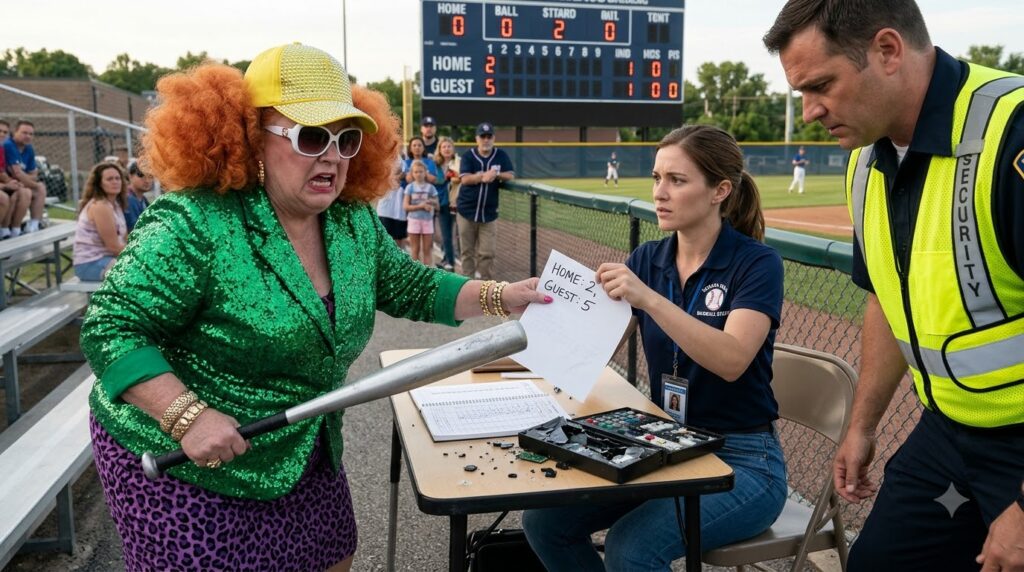
The video showed the entire sequence.
She watched herself approach the controller.
She watched herself change the displayed score.
She watched Emily return.
Then she watched herself lift the bat.
The first strike made Patricia flinch.
The second made her lower her eyes.
For several moments after the recording ended, nobody spoke.
Margaret then reviewed the official scorebook and backup sheet.
Both confirmed that Westbrook had been leading 5–2 at the time of the disruption.
The championship’s final result, 5–4, was supported by the records maintained by both teams.
There was no evidence of scorekeeping misconduct.
Emily had followed proper procedures.
Patricia looked across the table at the young woman.
Emily sat upright, her hands folded in front of her.
She looked tired but composed.
Patricia suddenly remembered how she had accused Emily of cheating in front of the crowd.
She remembered the young woman’s face.
At the time, Patricia had interpreted Emily’s refusal to surrender the score sheet as disrespect.
Now, watching the recording, she saw something different.
Emily had been protecting her work.
And Patricia had tried to destroy it.
Margaret explained that the district would maintain the one-year athletic-event ban and seek reimbursement for the documented equipment costs.
The district had also referred the property-damage incident to local authorities.
Any decision about criminal charges would be handled separately.
Patricia listened.
She had expected to feel outraged.
Instead, she felt exposed.
For years, she had treated confrontations as contests that could be won through persistence.
This meeting was different.
The facts did not change when she raised her voice.
The recording did not become less clear when she disagreed.
The scorebook did not alter its numbers to protect her pride.
Robert reached for her hand beneath the table.
She allowed him to hold it.
When Margaret asked whether Patricia wished to respond, she looked toward Emily.
Her first attempt at speaking failed.
She cleared her throat.
Then she acknowledged that she had changed the scoreboard and destroyed the controller.
She said she had been angry about the game and had allowed that anger to control her behavior.
She also admitted that her accusation against Emily had been false.
The words were difficult.
Patricia was not accustomed to admitting wrongdoing without adding an excuse.
But she managed to finish.
She apologized to Emily.
Emily listened without smiling.
Then she thanked Patricia for acknowledging the truth.
She did not offer immediate forgiveness.
She did not pretend the experience had been harmless.
She simply accepted the apology as a beginning.
Margaret concluded the meeting by confirming the district’s decisions.
Patricia signed an acknowledgment of the athletic-event restriction and agreed to a reimbursement plan for the equipment.
The separate legal review remained pending.
Outside the administration building, Robert and Patricia walked toward their car.
The afternoon was bright and unusually warm.
For a while, neither spoke.
Then Patricia asked whether Tyler would ever stop being embarrassed by her.
Robert considered the question.
He told her that trust would take time to rebuild.
He also told her that rebuilding it was possible.
But she would have to change how she behaved, not merely how she explained her behavior afterward.
Patricia nodded.
That evening, she approached Tyler in the backyard.
He was practicing ground balls against a rebound net.
She stood several feet away and watched.
Normally, she would have corrected his stance or offered advice.
This time, she remained quiet.
When Tyler finished, she told him about the meeting.
She explained that she had admitted what she had done and agreed to pay for the damage.
Tyler listened.
Then he asked whether she still believed the school had treated her unfairly.
Patricia hesitated.
The old answer rose automatically.
She could have complained about the video, the ban, or the spectators who had mocked her.
Instead, she shook her head.
“No,” she said. “I was wrong.”
Tyler looked surprised.
Then he nodded.
It was not a dramatic reconciliation.
There were no tears or embraces.
But when Patricia turned to go inside, Tyler asked whether she wanted to help collect the baseballs.
She stopped.
Then she walked toward the scattered balls lying in the grass.
For the first time in years, she helped her son practice without telling him how to play.