Chapter 6: What the Camera Really Showed
The official investigation moved more slowly than the internet.
Northlake Novelty Services sent a technician to inspect the damaged machine.
The technician found that the front safety-glass assembly needed replacement and that fragments had entered the lower display compartment.
The touchscreen remained functional, but the machine required additional testing before it could return to service.
The distributor documented the repair costs and provided its findings to the investigating officer.
Meanwhile, the mall’s security team completed a review of the footage.
There were three relevant recordings.
The first showed Emily approaching the machine, paying for the collectible, and removing the package from the dispensing compartment.
The second showed Patricia arriving afterward.
The third captured the confrontation from the arcade entrance.
Together, the recordings established a clear sequence.
Emily purchased the final figurine.
Patricia demanded it.
Emily refused.
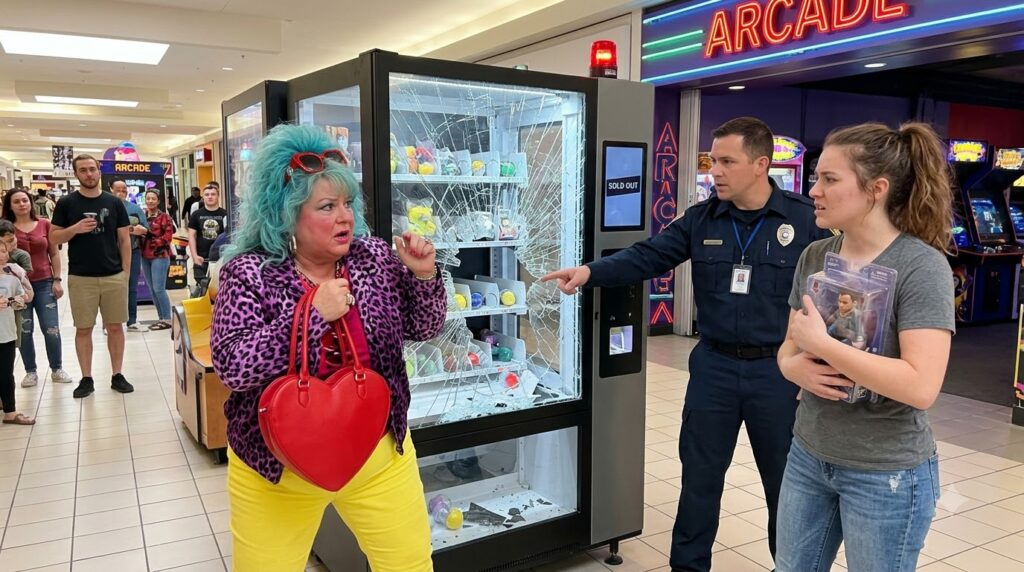
Patricia struck the machine twice.
Then she offered Emily cash.
When Emily refused again, Patricia hit the side panel and activated the alarm.
There was no evidence that Emily had stolen anything.
There was no evidence that the machine had been damaged before Patricia struck it.
And there was no evidence that Emily had threatened Patricia.
Officer Mitchell contacted both women to explain the next steps.
Emily was relieved to learn that the evidence supported her account.
Patricia was informed that the matter had been referred for review and that she would receive further instructions through the appropriate legal process.
The officer also documented the misleading online allegations.
That afternoon, Patricia received a letter from an attorney representing Northlake Novelty Services.
The company requested reimbursement for the documented property damage and related expenses.
Patricia read the letter three times.
The amount was more than she had expected.
For a woman accustomed to solving inconveniences with money, the financial demand was unpleasant but manageable.
What frightened her was the possibility of public accountability.
She had spent years cultivating an image of herself as a responsible community leader.
Now a security recording contradicted the story she had told.
Patricia called Charles.
Her husband was working in the garage, restoring an old wooden rocking chair that had belonged to his father.
He listened while she explained the letter.
Then he asked whether the company’s account was accurate.
Patricia stared at the kitchen wall.
“Mostly.”
Charles set down his tools.
“Patricia.”
She hated the way he said her name when he was disappointed.
He wasn’t angry.
That was worse.
“You broke something that didn’t belong to you,” he said. “You blamed someone who hadn’t done anything wrong. And now you want me to help make it disappear.”
Patricia protested that she had been embarrassed.
Charles replied that embarrassment was not the same as injustice.
Then he said something that stayed with her long after the call ended.
“You keep telling everyone they should respect you. But respect isn’t something you can demand after you’ve frightened somebody.”
Patricia ended the conversation without answering.
That evening, she sat in her living room beneath a large portrait taken on her twentieth wedding anniversary.
She remembered when she and Charles had first moved to Briarwood.
Their daughter was six.
Their mortgage was larger than they liked.
Patricia had worked hard to build a comfortable life.
Somewhere along the way, she had begun treating that comfort as proof that her judgment mattered more than other people’s.
She opened the neighborhood group.
The comments beneath her original post had changed.
Several residents were asking why the photograph showed broken glass.
Others wanted to know whether the HOA had any involvement in the incident.
Helen Parker had posted a reminder that association communication channels were intended for neighborhood business, not personal disputes.
Patricia considered writing another explanation.
She typed three paragraphs.
Deleted them.
Typed a fourth.
Then stopped.
For the first time, she could see how her words might look to someone who didn’t already agree with her.
Across town, Emily received a call from Linda Morales.
The mall had reviewed the misleading public posts and was preparing a factual statement about the incident, without disclosing unnecessary personal information.
Emily asked whether that would end the harassment.
Linda didn’t promise it would.
But she told Emily something important.
“The truth may not travel as quickly as a rumor. That doesn’t make it any less true.”
Emily thanked her.
Then she looked at the small wrapped box on her bedroom dresser.
Her grandmother’s birthday was only three days away.
She had spent nearly a week defending the right to give someone a present.
Now she wanted to remember why she had bought it in the first place.