Chapter 4: A Lie Travels Faster Than the Truth
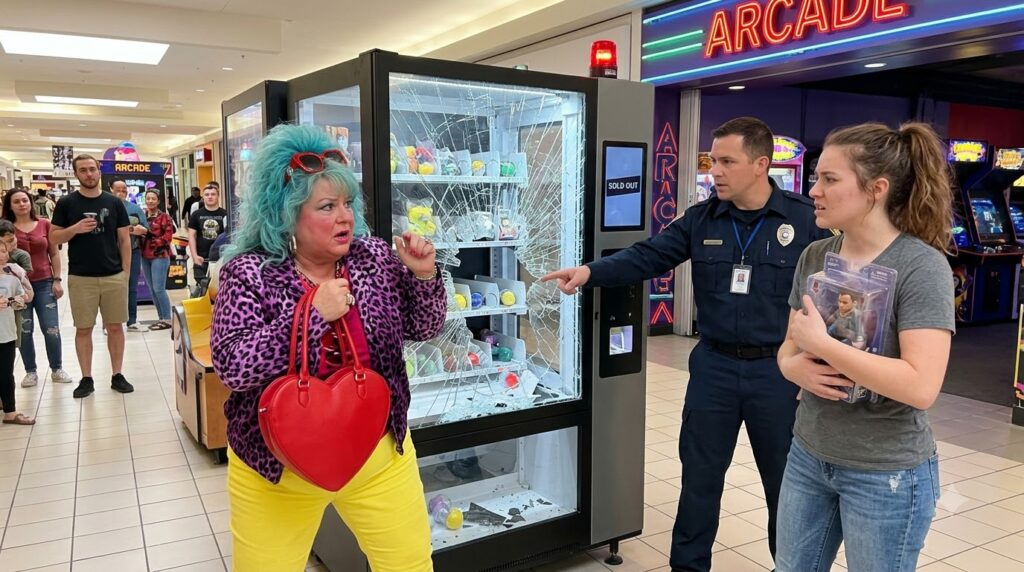
By Sunday morning, Emily’s photograph had been shared hundreds of times.
The original post came from an account called Wisconsin Shopping Watch.
It showed Emily standing near the arcade entrance with the Winter Garden Girl package in her hands.
The accompanying caption claimed that a young shopper had taken advantage of an older customer during a dispute over a rare collectible.
There was no mention of Patricia smashing the machine.
No mention of the security alarm.
No mention of the completed purchase.
Emily had never experienced anything like it.
At twenty-two, she was accustomed to ordinary social media disagreements. But seeing strangers criticize her character was different.
Some comments called her selfish.
Others accused her of disrespecting older people.
One person suggested that her employer should be informed.
Emily’s stomach tightened when she read that.
She worked at a small dental office where many patients had been coming for decades. She loved the job and hoped to enter a dental hygiene program the following year.
The possibility that someone might contact her employer frightened her more than the insults.
Her mother, Susan, found her sitting at the kitchen table with her phone facedown.
Emily explained what had happened.
Susan listened quietly.
Then she asked one question.
“Do you still have your receipt?”
Emily nodded.
“Then keep it. And don’t argue with strangers online.”
Susan had spent twenty-six years working as a hospital billing coordinator. She knew that complicated problems rarely improved when people reacted in anger.
Together, they saved screenshots of the posts and messages.
Emily also contacted Linda Morales at the mall.
Linda confirmed that the security footage had been preserved.
She could not release it directly to Emily while the investigation remained active, but she assured her that the original recording had been secured.
That helped.
Not enough.
By Monday afternoon, Emily’s supervisor had received an anonymous email.
The message accused Emily of dishonest behavior and suggested that the dental office should reconsider employing her.
Her supervisor, Dr. Nathan Reed, called Emily into his office.
Emily entered expecting the worst.
Instead, he placed the email on his desk.
“I wanted you to know this came in,” he said.
Emily explained the situation.
Dr. Reed listened, then asked whether the mall or police had contacted her about wrongdoing.
“No. They confirmed I bought it.”
“Then that’s what matters here.”
He assured her that an unsupported accusation would not determine her employment.
Emily nearly cried.
For the first time in two days, she felt someone had given her room to breathe.
But the online attention had already reached her grandmother.
Margaret Carter did not use social media often.
She preferred phone calls, handwritten cards, and the occasional photograph of her great-nephew’s baseball games.
A neighbor, however, had seen Emily’s picture and called to ask whether everything was all right.
Margaret immediately telephoned Susan.
By the time Emily arrived at her grandmother’s house that evening, Margaret knew most of the story.
The older woman sat in her favorite armchair beside the glass cabinet.
She looked smaller than Emily remembered.
Not physically, exactly.
More as though worry had settled across her shoulders.
Emily sat beside her.
“I’m sorry, Grandma.”
Margaret took her hand.
“What are you apologizing for?”
“For all this trouble.”
Margaret looked toward the cabinet of figurines.
Then she turned back to Emily.
“Your grandfather used to say that a person’s character shows most clearly when someone tries to take something from them.”
Emily managed a faint smile.
“He said that?”
“Usually when somebody borrowed his tools and forgot to return them.”
They both laughed.
The laughter eased something in Emily’s chest.
Then Margaret grew serious.
“You don’t owe that woman your gift. And you don’t owe strangers an explanation of your worth.”
Emily leaned against her grandmother’s shoulder.
For a few minutes, the internet, the mall, and Patricia Whitmore seemed far away.
But across town, Helen Parker was making a discovery that would bring the entire situation back into the open.
The photograph used in the online accusation had been taken from an angle inside the arcade.
Helen recognized the angle.
She had seen another photograph from almost the same position.
It had appeared in Patricia’s private neighborhood post.
And the timing suggested that the misleading story had not spread by accident.