Chapter 5: The Neighbor Who Started Asking Questions
Helen Parker had spent thirty-four years teaching children how to distinguish facts from assumptions.
Retirement hadn’t changed that habit.
When she saw Patricia’s neighborhood post, she didn’t immediately accuse anyone of lying.
She asked questions.
First, she contacted Brookfield Commons and asked whether an incident had occurred at the arcade.
The mall confirmed that security had responded to property damage, but declined to identify the people involved.
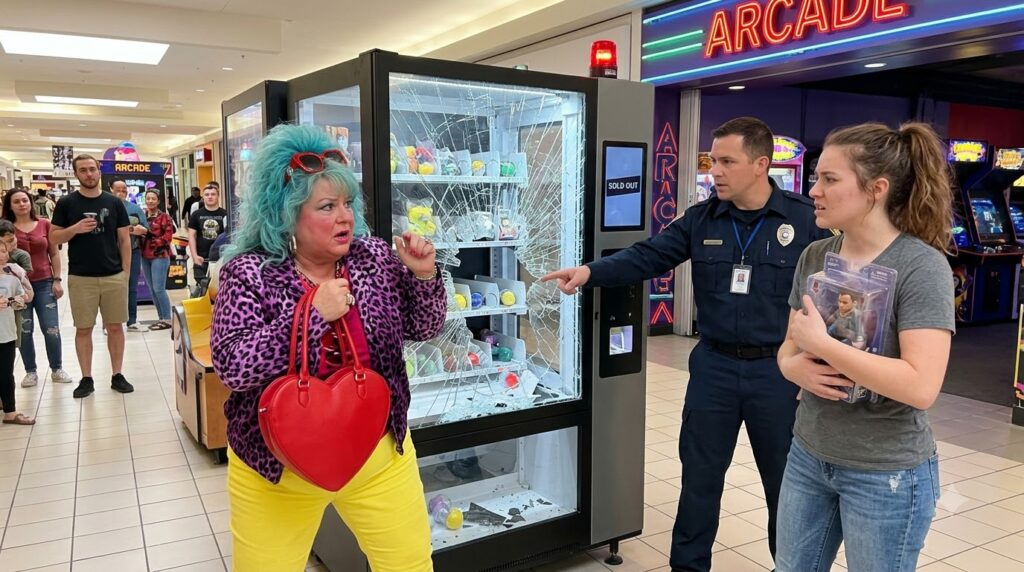
Next, Helen examined the publicly shared photograph.
She noticed that the image had been cropped.
A reflection in the vending machine’s metal frame showed broken glass on the floor.
Yet the caption described only a dispute over a purchase.
Helen found that troubling.
She had known Patricia for years.
They had served together on the neighborhood landscaping committee before Patricia became president.
Helen remembered the earlier Patricia: energetic, determined, sometimes difficult, but capable of genuine generosity.
She also remembered the gradual change.
The warning letters.
The public embarrassment of residents who questioned HOA decisions.
The assumption that being president entitled Patricia to control other people’s choices.
Helen had challenged those practices during the previous year’s annual meeting.
Patricia responded by removing her from the landscaping committee.
Since then, their relationship had remained polite but distant.
On Tuesday, Helen called Patricia.
She asked whether the mall incident involved a damaged vending machine.
Patricia sounded irritated.
“It was a misunderstanding.”
Helen asked whether Patricia had struck the machine.
A long silence followed.
Then Patricia said, “You don’t understand what happened.”
Helen waited.
Patricia began describing Emily as rude and disrespectful.
She insisted that the collectible should have been hers.
She claimed the machine’s glass was fragile.
But she never answered the question directly.
After the call, Helen made a decision.
She would not help spread an accusation she could not verify.
She posted a brief message in the neighborhood group asking members to avoid sharing photographs or personal allegations about people who were not part of their community.
She also requested that the HOA board clarify whether Patricia’s comments represented an official association position.
The response was immediate.
Two board members contacted Helen privately.
They had concerns of their own.
For months, Patricia had used the association’s mailing list to distribute personal complaints. She had also authorized small administrative expenses without clearly documenting their purpose.
The board had never formally challenged her.
Now they wondered whether her conduct outside the neighborhood might reflect a broader problem.
Helen urged them to focus on records rather than rumors.
Together, they requested copies of the association’s recent meeting minutes, expense approvals, and communication policies.
They discovered that several decisions had been described as unanimous even though one or more board members had objected.
The discrepancies were not proof of financial wrongdoing.
But they showed that the board’s records needed correction.
A special meeting was scheduled.
Patricia received the notice Wednesday morning.
She was furious.
She called the meeting an attempt to undermine her leadership.
Then she blamed Helen.
But Helen wasn’t the only person reconsidering Patricia’s behavior.
Her daughter, Rebecca, had seen the online story.
Rebecca had also received a message from an old college friend who worked at Brookfield Commons.
The friend had not witnessed the incident, but knew that the mall was investigating serious property damage.
Rebecca called her mother.
This time, Patricia answered.
Rebecca asked whether she had broken a vending machine.
Patricia launched into a long explanation about rude shoppers and unfair treatment.
Rebecca interrupted gently.
“Mom, did you hit the machine?”
Patricia went silent.
Rebecca waited.
Finally, Patricia admitted that she had struck it with her handbag.
“Twice?” Rebecca asked.
Patricia didn’t answer.
Rebecca closed her eyes.
She thought about the birthday party planned for her daughter.
She thought about the apologies her mother had refused to make.
And she thought about how often Patricia turned a simple mistake into a battle everyone else was expected to fight.
“I don’t want you bringing that toy to the party,” Rebecca said.
Patricia stiffened.
“I was trying to do something nice.”
“I know. But a gift doesn’t fix everything.”
Patricia felt the familiar urge to argue.
Instead, she heard her daughter say something she had never said so plainly before.
“I need you to stop treating people like they’re obstacles between you and what you want.”
The call ended shortly afterward.
Patricia sat alone in her enormous kitchen.
For the first time, the missing collectible seemed less important than the people who no longer wanted to hear her excuses.