Chapter 8: What Justice Looked Like
The settlement meeting took place in a conference room with beige walls, a long polished table, and a pitcher of water nobody seemed interested in drinking.
Daniel attended with Samuel.
Patricia arrived with Caroline Pierce.
She wore a dark blue suit instead of her usual bright colors.
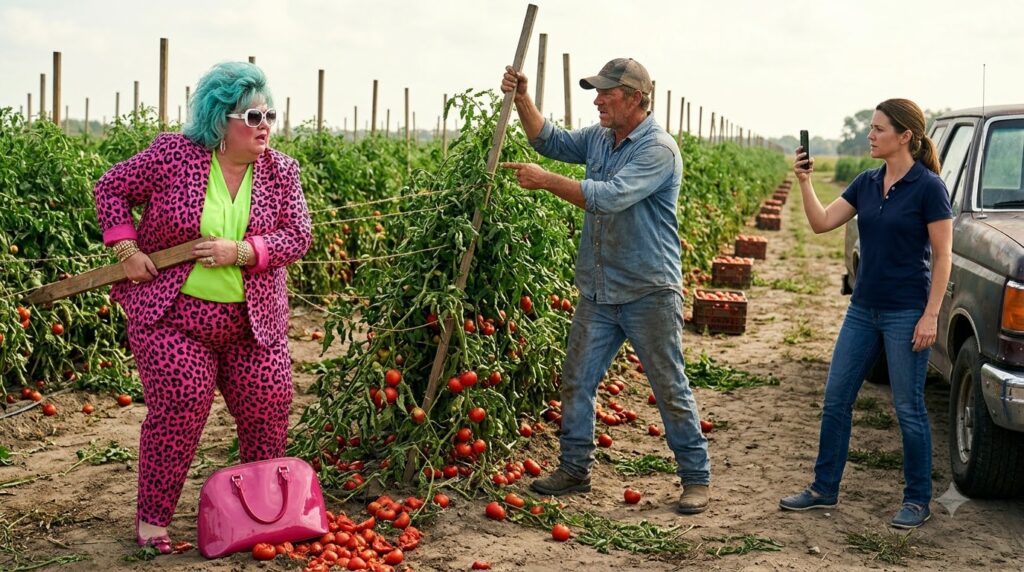
Her turquoise hair had been pulled into a restrained style.
She looked uncomfortable.
Daniel didn’t mistake that discomfort for remorse.
He had learned that people could regret consequences without regretting their actions.
The negotiations were difficult.
Patricia initially challenged the value of the damaged plants.
Samuel presented photographs, harvest estimates, labor records, and documentation of the repairs.
The parties discussed the direct crop loss, reasonable restoration expenses, and other documented costs.
They also addressed the communications sent to buyers.
Samuel insisted that correcting the record was essential.
Money alone would not restore Daniel’s reputation.
After several sessions, the parties reached an agreement.
Patricia’s company would pay a negotiated settlement covering the documented farm damage and specified related expenses.
The agreement required corrective notices to identified recipients of the unsupported allegations.
Whitcomb Produce Holdings would stop using Mercer Family Farms’ name or imagery in its promotional materials without authorization.
Patricia also agreed not to enter the farm without permission or contact Daniel directly about future business.
The settlement resolved the specified civil claims between the parties.
It did not control the sheriff’s independent review of the property-damage incident.
Daniel understood that distinction.
He wasn’t trying to purchase a particular outcome from law enforcement.
He wanted the truth documented and the civil dispute settled fairly.
The sheriff’s office eventually referred the matter for review. After considering the evidence and circumstances, the authorities resolved the property-damage case through the applicable local process, with Patricia accepting responsibility for the damage and complying with the resulting requirements.
There was no dramatic courtroom confrontation.
No television cameras.
No cheering crowd.
Just a formal record of accountability.
For Daniel, that was enough.
The settlement payment arrived several weeks later.
Ellen deposited it into the farm’s business account.
They used part of the money to cover repairs and expenses directly associated with the incident.
The rest helped rebuild their operating reserve.
The larger financial turning point came from Gulf Coast Fresh.
The distributor’s seasonal agreement provided a dependable outlet for a significant portion of the harvest.
It wasn’t a guarantee that every future season would be profitable.
Farming never offered guarantees.
But it gave Daniel breathing room.
The cooperative discussions also continued.
Several growers formed a voluntary purchasing and marketing group.
They negotiated better prices for certain packaging supplies and coordinated transportation where practical.
Each farmer retained ownership and control of their operation.
Walter Briggs worked with independent counsel to review his contract with Whitcomb Produce Holdings.
His situation took longer to resolve.
But he eventually negotiated a workable exit from the arrangement and began rebuilding relationships with other buyers.
Linda Hayes left Patricia’s company.
Her decision wasn’t easy.
She worried about finding another job at her age.
Then Rebecca heard that a regional produce distributor needed someone with experience managing inventory and customer accounts.
Linda applied.
She interviewed.
She was hired.
The position paid slightly more than her previous job and offered a steadier schedule.
When Daniel heard the news, he called to congratulate her.
Linda laughed softly.
“I thought doing the right thing was going to cost me everything.”
Daniel looked across his office toward the harvest records.
“Sometimes it costs something,” he said. “But that doesn’t mean it costs everything.”
Victor Lane also moved on.
He found a position with a transportation company serving agricultural customers.
He rarely discussed Patricia afterward.
He preferred to let his work speak for itself.
As for Patricia, her business continued operating, but her relationships with several suppliers had changed.
Some growers chose not to work with her.
Others required clearer terms and stronger documentation.
Her company introduced new review procedures for supplier communications and promotional claims.
Whether Patricia personally learned humility was harder to determine.
Daniel didn’t spend much time wondering.
He had crops to harvest.
Workers to pay.
A family to care for.
And one more promise to keep.
On the anniversary of his father’s death, he planned to repair the old wooden farm sign.
The same sign Thomas Mercer had painted by hand.
Daniel wanted it standing straight before the next harvest season began.