Chapter 7: The Records Nobody Expected
Victor Lane had worked for Whitcomb Produce Holdings for eight years.
He wasn’t a sentimental man.
He believed businesses needed profits, firm contracts, and disciplined management.
But he also believed there was a difference between negotiating hard and deliberately harming someone.
That difference had become impossible to ignore.
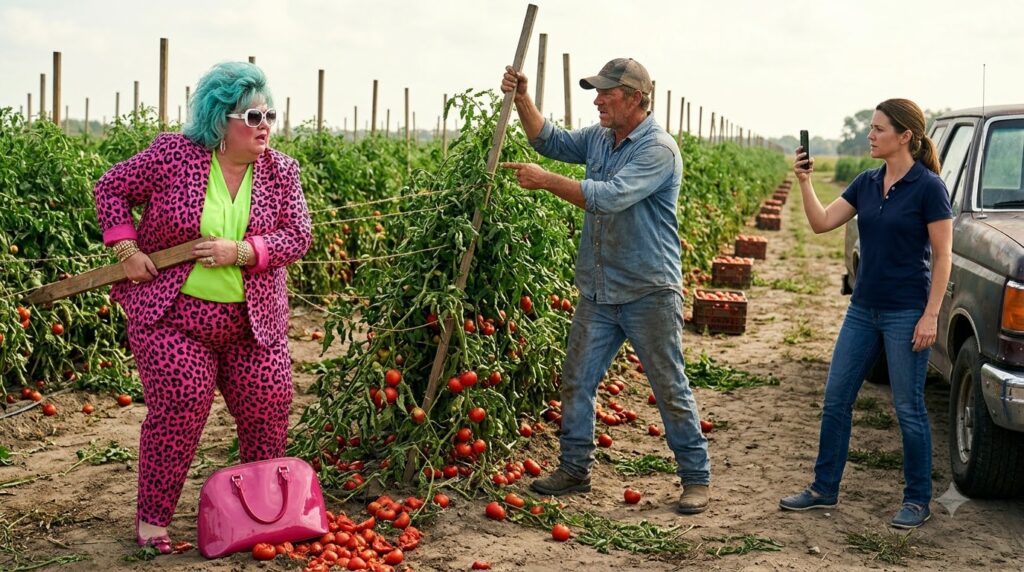
Victor had seen the video from Mercer Family Farms.
Patricia had shown it to him while complaining that Rebecca Collins had humiliated her.
She insisted the recording was misleading.
Victor watched it without commenting.
The images were clear.
Patricia pulled the stake.
The plants collapsed.
The tomatoes fell.
Her threat was audible.
Victor understood that the video alone could create serious problems for the company.
But he was more concerned about what happened afterward.
He had been copied on internal messages discussing the complaints sent to distributors.
Some messages referred to using photographs from the damaged tomato row.
Others discussed applying commercial pressure until Daniel reconsidered Patricia’s offer.
Victor had objected.
His concerns were dismissed.
When Patricia instructed him to prepare another misleading promotional campaign, he refused.
The argument that followed ended with Patricia removing him from several responsibilities.
Victor went home that evening and reviewed his options.
He had a mortgage.
His youngest daughter was in college.
He couldn’t afford to make a careless decision.
But he also knew that continuing to participate in conduct he believed was improper could put his own reputation at risk.
He consulted an attorney about his obligations and the proper way to preserve and disclose relevant records.
Then he contacted Samuel Brooks.
The conversation was cautious.
Victor did not claim that every accusation against Patricia was true.
He explained that he had firsthand knowledge of certain communications and business decisions.
He was willing to cooperate through appropriate legal channels.
Samuel listened.
He arranged for the information to be reviewed without encouraging Victor to access records he wasn’t authorized to obtain.
The documents Victor could lawfully provide, together with records later obtained through formal processes, helped establish a clearer timeline.
Patricia had discussed pressuring Daniel before visiting the farm.
After the confrontation, internal communications addressed using the incident to undermine his credibility.
The promotional materials had been prepared despite concerns about their accuracy.
The evidence did not automatically prove every possible legal claim.
But it significantly strengthened Daniel’s position.
Samuel contacted Patricia’s attorney.
By then, Patricia had hired legal counsel of her own.
Her lawyer was a composed woman named Caroline Pierce, who immediately recognized that the dispute needed to be handled seriously.
Caroline reviewed the video.
She reviewed the correspondence.
She requested the company’s relevant internal records.
Then she met privately with Patricia.
The meeting lasted almost three hours.
Patricia emerged looking furious.
Caroline had explained that continuing the dispute could become expensive and damaging.
The company faced potential civil exposure over the crop damage and documented commercial interference.
The sheriff’s office was still reviewing the original property-damage report.
And the misleading advertising raised additional concerns.
Patricia wanted to attack Daniel’s credibility.
Caroline advised against making unsupported allegations.
Patricia wanted to claim the video had been manipulated.
Caroline explained that such a claim would require evidence.
Patricia wanted to sue Linda and Victor for disloyalty.
Caroline warned her not to retaliate without a legitimate legal basis.
For once, Patricia was surrounded by people who would not simply agree with her.
Meanwhile, Daniel faced his own difficult decision.
Samuel explained that he could pursue litigation over the documented losses and related claims.
A lawsuit might establish accountability.
But it could also consume time, money, and emotional energy.
Daniel thought about the months he had already lost to worry.
He thought about Ellen sitting awake with financial statements.
He thought about Hannah trying to manage customers while protecting her father.
And he thought about his mother, who had lived long enough to see the farm survive droughts, storms, and debt.
He didn’t want the rest of his life to revolve around Patricia Whitcomb.
He wanted a fair resolution.
That meant compensation for proven losses, correction of false statements, and enforceable boundaries protecting the farm.
Samuel began settlement discussions.
At first, Patricia refused.
Then Gulf Coast Fresh completed its inspection.
Rebecca called Daniel with the result.
The farm had met the distributor’s quality and traceability requirements.
Gulf Coast Fresh was prepared to proceed with a substantial seasonal purchase agreement.
Daniel sat down on a wooden crate.
He had been holding his breath for weeks without realizing it.
Rebecca wasn’t finished.
She explained that the distributor had also reviewed the complaints concerning the farm.
The inspection records and supporting documentation did not substantiate the allegations.
Daniel thanked her.
After ending the call, he walked outside.
The afternoon sun was low over the fields.
Harvest workers were loading cartons into a refrigerated truck.
The farm was still operating.
And for the first time since Patricia arrived, Daniel knew he no longer needed her business.