Chapter 8: What the Desert Kept
Nearly a year after the branch fell, Eleanor Brooks returned to Joshua Tree National Park.
The morning was cool, with a pale blue sky stretching above the mountains.
Margaret accompanied her, carrying a small backpack and two bottles of water.
They followed the familiar pathway toward the old Joshua tree.
Eleanor walked more slowly than she once had.
Her knees ached on uneven ground, and she occasionally stopped to rest.
But she insisted on making the trip.
The tree was still standing.
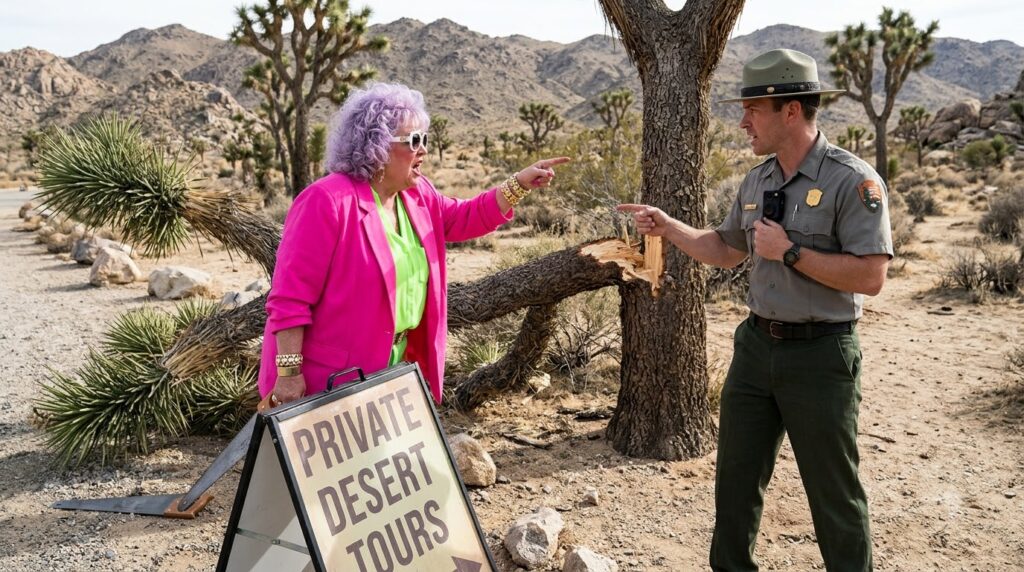
Its damaged branch junction remained visible, a lasting mark where the limb had been removed.
The injury had not magically disappeared.
Samuel Reed’s monitoring had shown that the tree remained alive, though its long-term response to the damage would continue to be observed.
Eleanor stood before it for several minutes.
She did not pretend that everything had been restored.
Some losses were permanent.
A broken branch could not be reattached.
A damaged reputation could not be repaired simply by announcing that an accusation was false.
A business partnership could not return to its original innocence once trust had been broken.
But the desert had taught her that survival and restoration were not always the same thing.
Sometimes living things continued despite the scars they carried.
Margaret removed an old photograph from her bag.
It showed Thomas standing beside the tree, one hand resting on his hiking stick, smiling broadly at the camera.
Eleanor laughed softly.
“He always insisted on wearing that terrible hat.”
Margaret smiled.
“He said it made him look like an explorer.”
“He looked like a man who’d forgotten where he parked.”
They laughed together.
It was the kind of laughter Eleanor had missed most since Thomas died.
Not loud or dramatic.
Just the easy warmth of sharing a memory with someone who understood.
Farther along the pathway, they encountered Daniel Mercer.
He was speaking with a family about desert wildlife.
When he recognized Eleanor, he approached.
They exchanged greetings.
Daniel thanked her again for coming forward.
Eleanor shook her head.
“You were doing your job. I was simply telling the truth.”
He told her that he and his family were doing well.
Lily had begun considering college programs in environmental science.
Rebecca was planning a family camping trip when their schedules allowed.
Life, after months of disruption, had returned to something resembling normal.
Eleanor was glad.
She had worried about the toll the accusations had taken on him.
Before they parted, Daniel glanced toward the damaged tree.
“People still stop to admire it,” he said.
Eleanor followed his gaze.
A young boy stood nearby, staring at the unusual shape of its branches.
His grandfather was explaining why Joshua trees were important to the desert landscape.
The boy listened, then looked toward the damaged section.
“What happened there?” he asked.
The grandfather explained that someone had hurt the tree.
The boy frowned.
“Why would somebody do that?”
The grandfather paused.
“Sometimes people forget that something doesn’t have to belong to them to deserve respect.”
Eleanor felt her throat tighten.
She had spent months wondering whether speaking up had been worth the trouble.
Now, hearing that simple explanation, she knew the answer.
Not because Karen had been punished.
Not because the recordings had proved her right.
But because the incident had become an opportunity for others to understand why shared places mattered.
Later, Eleanor and Margaret sat on a bench overlooking the desert.
They ate sandwiches and watched the sunlight move across the rocks.
Eleanor thought about Karen.
She had heard that the tour business had closed and that Melissa was rebuilding her finances.
Karen had largely disappeared from public discussion after the proceedings.
Eleanor did not know whether she regretted her actions.
She hoped so.
But she had stopped needing to know.
The outcome no longer depended on Karen’s willingness to admit what everyone else had seen.
The record was clear.
The principal legal matter had been resolved.
Daniel’s conduct had been supported by the evidence.
Melissa had taken responsibility for addressing the problems she discovered.
And Eleanor had refused to be intimidated into silence.
As the afternoon warmed, Margaret asked whether her mother was ready to leave.
“Just another minute,” Eleanor said.
She looked once more toward the Joshua tree.
Thomas had loved that tree because it endured in a difficult place.
He used to say that the desert rewarded people who paid attention.
For years, Eleanor had thought he meant noticing small flowers, distant birds, and the shapes of clouds.
Now she understood that the lesson went further.
Paying attention also meant noticing when someone was being treated unfairly.
It meant recognizing when a person tried to turn anger into authority.
It meant understanding that silence could sometimes allow a falsehood to grow.
And it meant remembering that ordinary people had a role in protecting what belonged to everyone.
Eleanor rose carefully from the bench.
Margaret offered her arm.
Together, they walked back toward the parking area.
Behind them, the old Joshua tree stood against the mountains, its uneven branches reaching into the clear desert sky.
It would never look exactly as it had before.
But it was still there.
Still providing shelter.
Still inspiring curiosity.
Still part of a landscape no single person had the right to claim.
Karen Whitmore had believed that a tree was an obstacle because it stood between her advertisement and a potential customer.
Daniel Mercer had seen a protected living resource.
Melissa Grant had eventually recognized the cost of dishonesty.
And Eleanor Brooks had seen something that reminded her of the man she loved.
The same tree had meant different things to different people.
But one truth had remained unchanged.
The right to enjoy something does not give anyone the right to destroy it.
As Eleanor reached the car, she looked back one final time.
A gentle breeze moved through the desert.
The tree stood quietly beneath the afternoon sun.
And for Eleanor, that was enough.