Chapter 4: The Story Karen Wanted Everyone to Believe
The video spread faster than Karen expected.
Her acquaintance had posted it with an emotional description of a hardworking woman supposedly mistreated by federal employees.
Within hours, the clip appeared on several community pages.
People argued in the comments.
Some expressed sympathy for Karen.
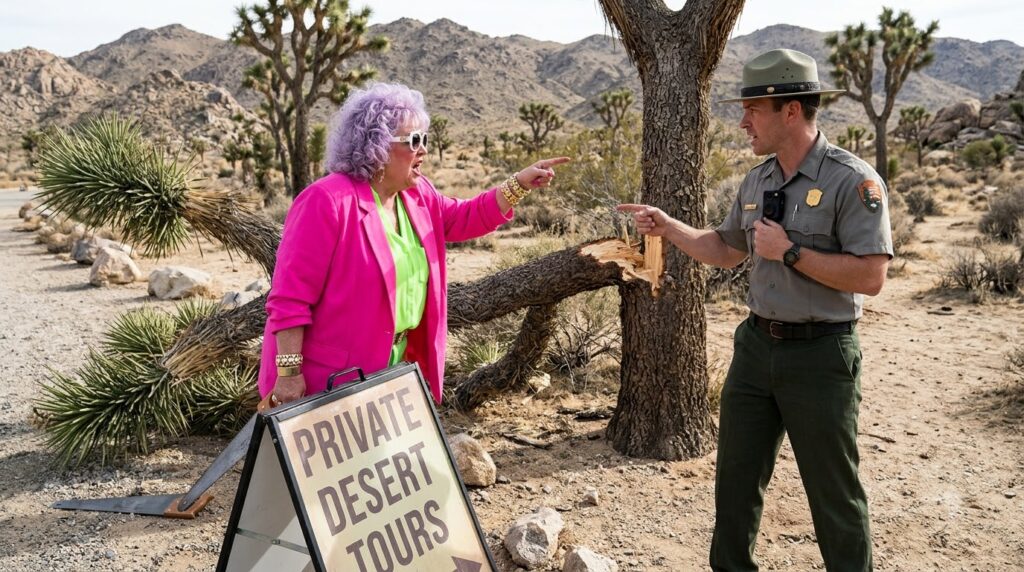
Others questioned why she had placed an advertising sign beside a protected tree.
A few asked what had caused the branch to fall.
Karen answered those questions selectively.
She insisted that Daniel had approached her aggressively and that his actions had somehow caused the damage.
When someone mentioned the saw, she claimed it had been used earlier to repair a wooden support on her sign.
The explanation made little sense.
But Karen repeated it with confidence.
She had learned that a simple accusation, delivered loudly enough, could sometimes become more memorable than a complicated truth.
The next morning, Daniel arrived at work to find several messages awaiting him.
Some were routine inquiries from supervisors reviewing the incident.
Others came from strangers who had found his name online.
A few accused him of abusing his authority.
One message demanded that he be fired.
Daniel read the messages in silence.
He had served the public for fourteen years. He had helped lost hikers, assisted injured visitors, responded to dangerous weather conditions, and spent countless hours explaining why fragile landscapes needed protection.
He understood that public employees could be criticized.
He also understood the importance of accountability.
But being falsely accused of something he had not done was different from receiving a complaint about a legitimate decision.
His wife, Rebecca, noticed his troubled expression over breakfast.
She worked as a nurse at a local medical clinic and knew the exhaustion that came from caring for people who were sometimes frightened, angry, or unreasonable.
“Does your supervisor have the recording?” she asked.
“Yes.”
“Then let the process work.”
Daniel nodded.
Still, he worried.
Their daughter, Lily, was sixteen. She had recently started driving and was proud that her father worked in a national park.
Daniel did not want her discovering cruel comments about him from strangers.
He did not want his family drawn into a dispute that should have ended with a straightforward report.
At the park office, Patricia Alvarez had already begun reviewing the evidence.
Daniel’s body camera showed his approach, Karen’s final sawing strokes, the branch falling onto the sign, and her immediate accusation.
Eleanor’s phone recording provided an even earlier view.
The two videos supported each other.
Photographs of the saw, tree, and damaged sign matched the sequence.
There was no indication that Daniel had touched Karen’s advertisement before it collapsed.
Patricia forwarded the relevant materials through official channels and documented the false accusations.
She also instructed staff not to engage in public arguments about an active matter.
That was difficult for Daniel.
He wanted to defend himself.
He wanted to tell the people attacking him that they were being misled.
But he knew that releasing evidence or discussing an ongoing investigation without authorization could create additional problems.
So he continued working.
He greeted visitors.
He answered questions.
He checked trails.
And he waited.
Meanwhile, Karen’s business partner, Melissa Grant, began receiving calls.
Melissa was fifty-four, a former travel coordinator who had invested her retirement savings in Whitmore Desert Experiences.
She had believed Karen’s promises of a thriving business built around responsible tourism.
Now customers were asking whether the company had been involved in damaging protected vegetation.
Melissa called Karen.
Karen assured her that the allegations were ridiculous.
Then Melissa asked a question Karen had not anticipated.
“Why were you carrying a saw?”
Karen paused.
“I already explained that.”
“Not to me.”
Karen grew defensive.
She claimed the tool belonged to a maintenance worker.
Melissa reminded her that the company had no maintenance worker.
The conversation ended badly.
That afternoon, Melissa drove to the park office.
She did not demand access to confidential evidence.
She simply asked how to submit information about the company’s operations and whether commercial activity near the pathway had been authorized.
The answers troubled her.
Karen had repeatedly assured Melissa that all necessary permissions were in place.
Melissa now had reason to question that assurance.
She returned home and opened the company’s financial records.
Several expenses appeared under the description “park access and promotion.”
Melissa had assumed they represented legitimate business fees.
But the supporting receipts were missing.
She began searching through emails.
By midnight, she had discovered something far more troubling than the destroyed sign.
Karen had been collecting money from customers for services the company might not have been authorized to provide.
And Melissa’s name appeared on documents she had never signed.