Chapter 2: The Woman Who Knew How to Make Trouble
Karen Whitmore had spent most of her adult life believing that confidence could overcome inconvenient facts.
At sixty-two, she had developed a particular talent for turning disagreements into public confrontations.
She could make a restaurant manager apologize for a meal she had finished. She could persuade a store employee to accept a return without a receipt. She had once forced a neighborhood association to hold an emergency meeting because someone parked a recreational vehicle where it spoiled her view.
Her friends called her determined.
Former employees used less flattering descriptions.
Karen preferred to think of herself as a woman who refused to be pushed around.
Her tour business had not been particularly successful. She had invested heavily in advertising, hired two part-time drivers, and purchased an aging passenger van with a mountain landscape painted along its sides.
But customers were inconsistent, expenses were rising, and several online reviews complained that the advertised experience did not match what visitors received.
Karen blamed everyone except herself.
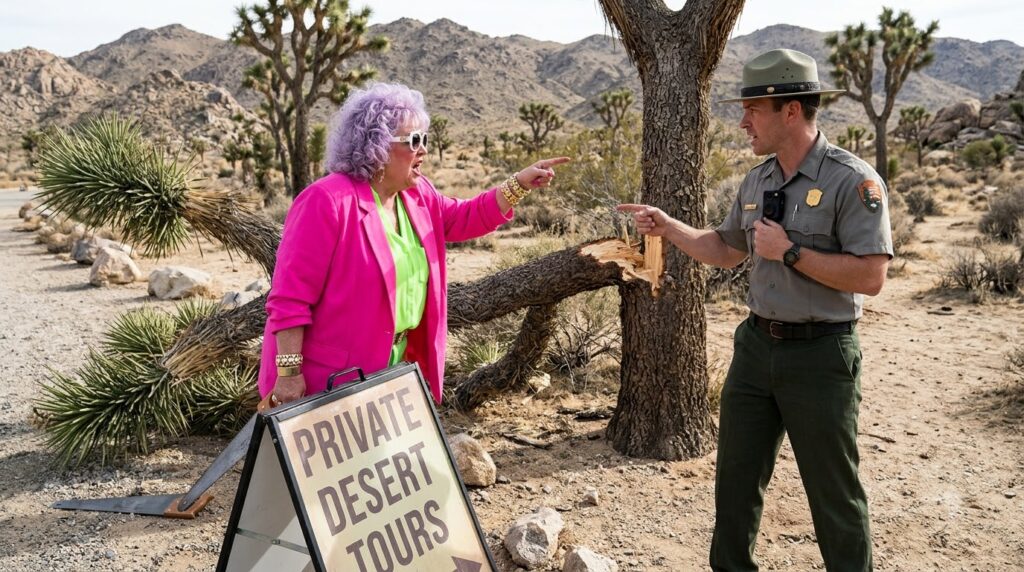
When her tour sign failed to attract enough attention, she blamed the Joshua tree.
When park officials told her the sign could not remain in that location, she blamed government bureaucracy.
And when the falling branch destroyed the sign, she blamed Daniel Mercer.
By the time a second ranger arrived, Karen had already called her business partner, her attorney’s office, and a local acquaintance who operated a popular community social-media page.
Her account was dramatic.
According to Karen, an aggressive federal ranger had damaged her property, threatened her business, and attempted to silence her when she objected.
She omitted the hand saw.
She omitted the fresh cut.
She omitted the fallen branch.
Most importantly, she omitted the body camera.
Daniel’s supervisor, Ranger Patricia Alvarez, arrived in a park vehicle shortly afterward.
Patricia was fifty-six, experienced, and known among her colleagues for remaining calm when other people lost control.
She listened while Karen delivered a lengthy accusation.
Karen gestured toward the damaged advertisement.
“This man has cost me hundreds of dollars. I expect compensation, a written apology, and his immediate suspension.”
Patricia asked several questions.
Had Karen been operating a commercial business on park property?
Had she received prior warnings about the sign?
Why was a hand saw lying beside the damaged tree?
Karen answered the first question vaguely, ignored the second, and became indignant at the third.
“Are you suggesting I did something wrong?”
Patricia looked toward the tree.
“I’m trying to establish what happened.”
Karen folded her arms and demanded a lawyer.
Patricia explained that she was free to seek legal advice. The rangers would continue documenting the incident and handling any suspected violations through the appropriate process.
Nearby, Eleanor Brooks had finally approached.
She waited until Patricia finished speaking.
“Excuse me,” Eleanor said quietly. “I saw what happened.”
Karen turned.
For the first time since Daniel arrived, she seemed genuinely startled.
Eleanor was a small woman with silver hair, sensible walking shoes, and a faded blue sun hat. She carried a canvas tote bag decorated with a photograph of a desert sunset.
Karen dismissed her with a glance.
“This is official business, sweetheart.”
Eleanor did not raise her voice.
“I believe the ranger should hear what I saw.”
Patricia guided Eleanor a short distance away to take her statement.
Karen watched them with growing irritation.
She had expected the situation to become a contest between her word and the ranger’s.
An elderly witness complicated that plan.
Still, Karen reassured herself that memories were unreliable. People misunderstood things. Older people sometimes confused details.
And even if Eleanor had seen something, Karen believed she could make enough noise to discredit her.
What Karen did not know was that Eleanor had spent thirty-two years working as a public-school librarian.
She had developed a lifelong habit of paying attention to details.
She remembered the color of Karen’s saw handle.
She remembered the order in which the branch and sign had fallen.
She remembered Karen throwing the saw away only after spotting Daniel.
And she had something better than memory.
Eleanor opened her phone and showed Patricia the recording.
The video began before the first stroke of the saw.
Patricia watched without speaking.
Then she asked Eleanor whether she would be willing to provide the original recording as evidence.
“Of course,” Eleanor replied.
Across the pathway, Karen noticed the two women looking at the screen.
She could not hear their conversation.
But she saw Patricia’s expression become noticeably more serious.
For the first time that afternoon, Karen began to understand that the problem might be larger than a damaged advertisement.
She had not merely lost an argument.
She had left behind evidence.