Chapter 3: A Tree With a History
The Joshua tree stood near a visitor pathway where generations of travelers had stopped to admire the desert.
It was not the largest tree in the park.
Its trunk leaned slightly to the east, and its branches formed an irregular silhouette against the mountains.
But it had become a familiar landmark to people who returned year after year.
Among them was Eleanor Brooks.
Her husband, Thomas, had first brought her to Joshua Tree on their twenty-fifth wedding anniversary.
Thomas had been a high-school science teacher with a passion for geology and desert ecology. He loved explaining how living things survived in places that appeared, at first glance, almost empty.
Eleanor had initially considered the desert too hot, too dry, and too quiet.
Then Thomas showed her what to look for.
The shadows moving across the rocks.
The tiny flowers appearing after winter rain.
The birds sheltering among branches that seemed too awkward to provide much protection.
And the Joshua trees themselves, standing like strange guardians over the desert.
Thomas had particularly loved the tree beside the pathway.
He called it the Old Dancer because its crooked limbs reminded him of someone moving with outstretched arms.
Every spring, they photographed themselves beside it.
When Thomas died of a heart attack six years earlier, Eleanor continued visiting.
She did not believe the tree belonged to her husband or that nature existed to preserve human memories.
But standing beside it helped her remember the patient way Thomas had taught her to see the world.
That afternoon, she had arrived carrying a small photograph from their last trip together.
She had planned to sit quietly, look at the mountains, and enjoy the peace.
Instead, she had heard metal scraping against living wood.
At first, she thought a maintenance crew might be working nearby.
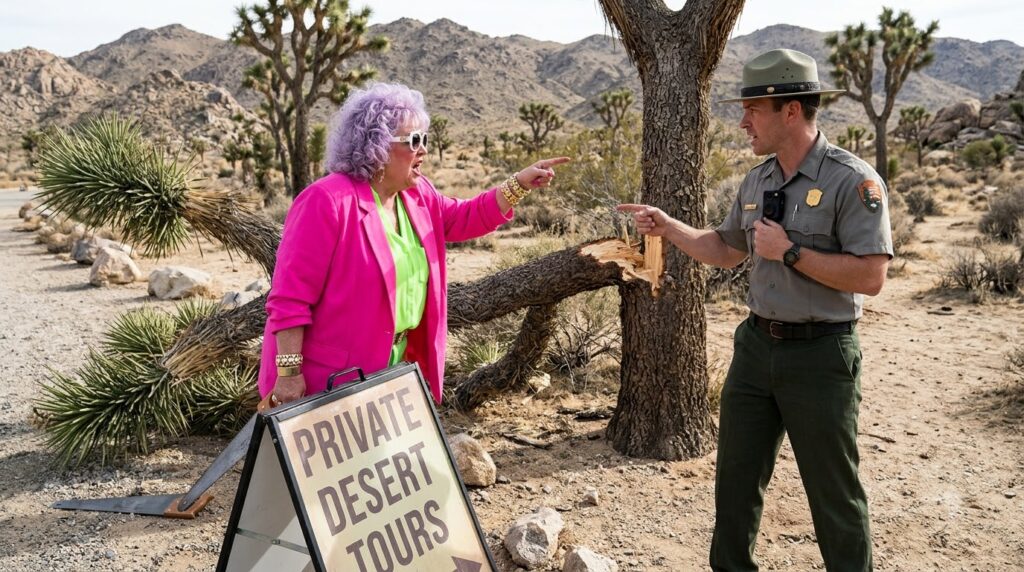
Then she saw Karen.
The woman’s bright pink clothing was impossible to miss.
Eleanor watched her position the saw against the branch.
She considered calling out, but the first strokes came quickly, and she was uncertain whether approaching an angry stranger holding a sharp tool would be wise.
So she began recording and moved toward a safer position.
She had hoped someone from the park service would arrive before the damage was complete.
Daniel came only seconds too late.
Now, as Patricia reviewed the recording, Eleanor felt a sadness she had not expected.
The broken branch was not merely a reminder of Thomas.
It was evidence of how easily one person’s impatience could harm something shared by thousands.
Patricia thanked Eleanor and assured her that the incident would be investigated.
A park resource specialist arrived later that afternoon to examine the tree.
His name was Samuel Reed, a forty-nine-year-old ecologist who had spent much of his career studying desert vegetation.
He inspected the damaged branch junction, photographed the wound, and recorded measurements.
Joshua trees, he explained to the assembled staff, were not ordinary hardwood trees. Their unusual structure and growth patterns made them vulnerable to damage that could affect future growth.
A mature specimen could not simply replace a large branch overnight.
The consequences would require monitoring.
Karen overheard part of the discussion.
She laughed dismissively.
“It’s a branch. Trees grow branches.”
Samuel turned toward her.
“Some do. That doesn’t mean every injury is harmless.”
Karen rolled her eyes.
“You’re all acting like I knocked down a national monument.”
Samuel did not argue.
He continued documenting the damage.
His restraint irritated Karen more than anger would have.
She wanted someone to shout.
She wanted someone to say something careless that she could repeat later.
Instead, the people around her remained focused on evidence.
By late afternoon, park personnel had collected statements, photographed the scene, and secured the saw as evidence through the appropriate procedures.
Karen received documentation concerning the suspected violations and instructions about further proceedings.
She was also told that any commercial activities in the park required compliance with applicable park rules and authorization.
She responded by announcing that she would sue everyone involved.
Then she marched toward the parking area.
As she passed Eleanor, she stopped.
“You should be ashamed of yourself,” Karen snapped. “Getting involved in something that doesn’t concern you.”
Eleanor looked at her for a long moment.
Then she answered softly.
“Public places concern all of us.”
Karen walked away without another word.
That evening, Eleanor returned to her small rental cottage and called her daughter, Margaret.
She told her what had happened.
Margaret listened, then asked whether Eleanor was frightened.
“A little,” Eleanor admitted.
She had expected the story to end there.
But while they were talking, Margaret found a video circulating online.
It showed Karen standing beside her ruined sign, accusing a federal ranger of harassment.
The recording had been carefully cropped.
The saw was nowhere in sight.
The damaged tree was barely visible.
And the caption claimed that an innocent small-business owner had been bullied by park authorities.
By bedtime, thousands of people had seen it.