Chapter 7: The Meeting That Changed Willow Creek
Monday evening, the Willow Creek clubhouse parking lot filled earlier than usual.
Residents arrived carrying folders, notebooks, and printed emails.
Some had heard about the wedding-cake incident.
Others came because they were tired of receiving unexplained fines.
A few simply wanted to understand why their once-peaceful neighborhood had become so divided.
Inside, folding chairs lined the meeting room.
Karen Whitmore stood near the front table.
She wore a bright fuchsia jacket, black trousers, and oversized gold earrings.
Her copper-red hair had been styled into a carefully arranged bouffant.
She looked confident.
Then she noticed the crowd.
Nearly sixty residents had come.
The association’s regular hearings usually attracted fewer than ten.
Karen’s expression tightened.
Robert entered with Michael and Helen.
Sarah followed a few steps behind.
She had insisted on attending.
Her wedding was over.
Now she wanted to stand beside her father.
Karen opened the meeting with a formal announcement about maintaining neighborhood standards.
She spoke for several minutes about responsibility, cooperation, and respect for association authority.
Robert listened quietly.
When his case was called, he approached the front table.
Karen began reading the list of violations.
Before she finished, Michael asked whether the association could identify the specific provisions authorizing each charge.
Karen frowned.
She pointed toward a stack of papers.
Michael had copies of the same documents.
He calmly explained that several cited rules did not appear in the governing materials provided to homeowners.
Helen then raised the issue of board approval.
She asked whether the association had documentation establishing a quorum when the enforcement changes were adopted.
The treasurer, a quiet man named William Price, looked uncomfortable.
He checked the minutes.
Then he checked them again.
Karen interrupted.
“These are technicalities.”
William looked up.
“They’re our procedures.”
The room fell silent.
Karen turned toward him.
“William, we discussed this.”
“We discussed it,” he replied. “That doesn’t mean we voted on it properly.”
A murmur moved through the audience.
Robert remained standing.
He did not raise his voice.
He described the fines he had received, the unanswered hearing requests, and the threat to remove Linda’s rose trellis.
He explained what the garden meant to him.
He did not ask for special treatment.
He asked for the same fair process every homeowner deserved.
Then Sarah stepped forward.
She placed the bakery incident report on the table.
Karen stiffened.
“This has nothing to do with the HOA.”
Sarah looked at her.
“You brought the HOA into it when you threatened my father over what happened at the bakery.”
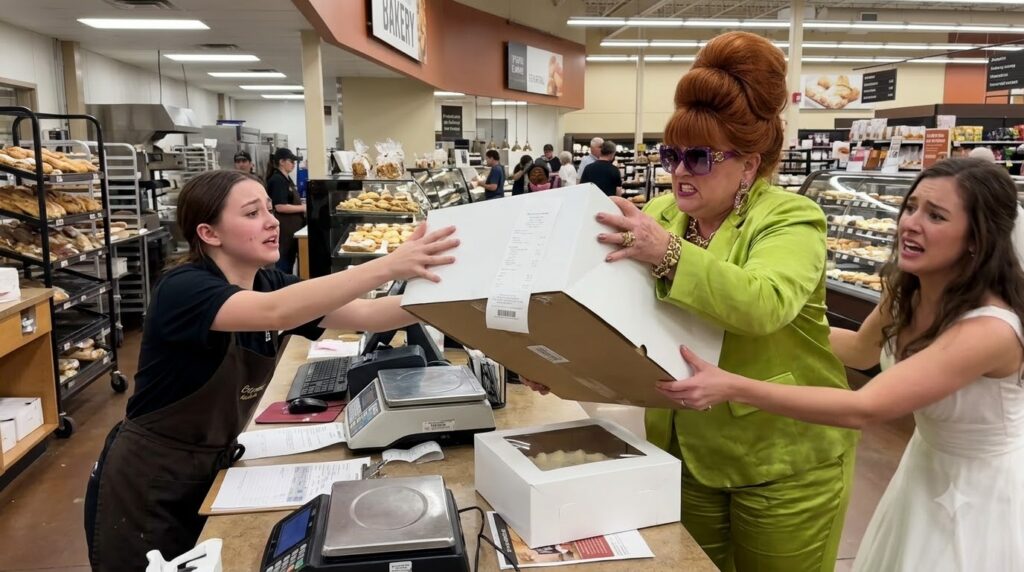
She explained the attempted cake swap, the damaged wedding cake, and Karen’s claim that Robert’s family had a history of violating community rules.
Karen denied deliberately taking the cake.
She claimed the boxes had been confused during a stressful interaction.
Sarah did not argue.
Instead, she handed William a letter from bakery manager Thomas Reed.
The letter stated that the store had preserved surveillance footage and obtained a witness statement.
It also confirmed that Karen’s purchase was for the smaller birthday cake.
Helen stood.
“I was there.”
Karen turned sharply.
Helen described watching Karen read Sarah’s name on the wedding-cake receipt before attempting to take the box.
Several residents exchanged looks.
Karen insisted Helen had misunderstood.
Then William spoke.
“I think we should pause this hearing.”
Karen objected.
But another board member, Denise Harper, agreed with him.
Denise was a retired accountant who had joined the board because she wanted to improve neighborhood budgeting.
She had grown increasingly uncomfortable with Karen’s handling of enforcement decisions.
Denise proposed postponing Robert’s case until the board could review the documentation independently.
William supported the motion.
A third member agreed.
Karen stared at them.
For the first time since becoming president, she could not control the room simply by speaking louder.
The board voted to suspend action on Robert’s disputed fines pending review.
Denise also proposed a special board meeting to examine the enforcement procedures and financial records.
The motion passed.
Residents began applauding.
Karen struck the table with her palm.
“This is completely inappropriate!”
William looked at her.
“No, Karen. What’s inappropriate is asking people to pay fines we can’t properly explain.”
The applause grew louder.
Robert did not celebrate.
He simply sat down beside Sarah.
She squeezed his hand.
But the meeting was not finished.
Denise opened a separate folder.
She had requested financial records from the association’s management company earlier that afternoon.
Among the documents was a payment authorization that raised a question none of them had expected.
The HOA had reimbursed Karen for a private event expense.
The description read: Community Hospitality — Special Celebration.
The amount was $850.
The same amount as Sarah’s wedding cake.