Chapter 1: The Plank That Changed Everything
The wooden plank struck Thomas Bennett across both shins with a sickening thud.
For one terrible second, the 67-year-old disabled Army veteran couldn’t breathe. His wheelchair jerked backward, its metal frame rattling against the concrete walkway. Pain shot through his damaged right leg, sharp enough to bring back memories he had spent nearly thirty years trying to bury.
“AAAH! MY LEG!”
Thomas doubled forward, clutching his knee.
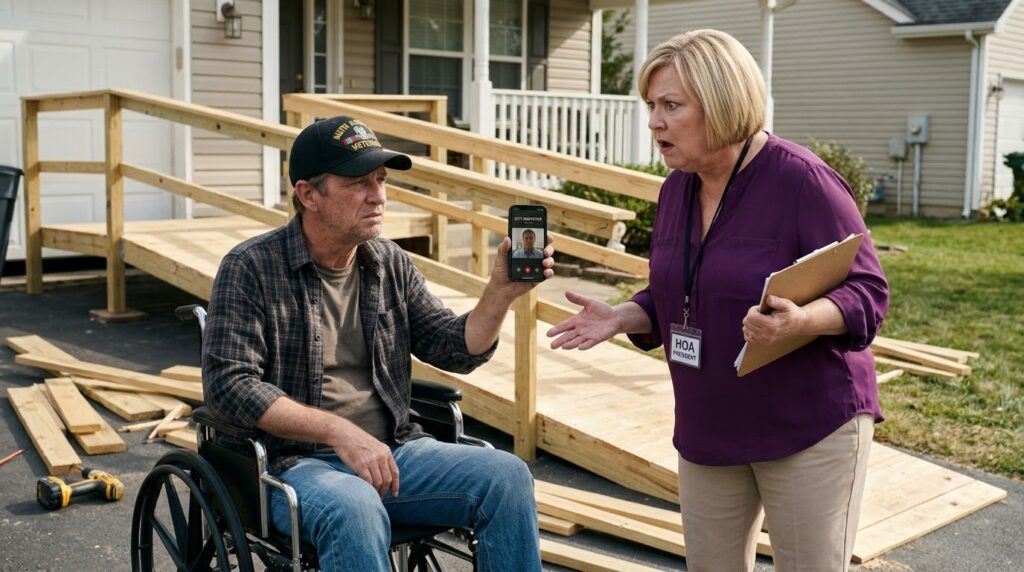
Standing over him was Patricia Caldwell, the sixty-year-old president of the Willow Creek Homeowners Association.
Her short blonde bob barely moved in the afternoon breeze. She wore a purple blouse, neatly pressed beige trousers, and a laminated HOA president badge pinned prominently above her chest.
She looked down at the injured veteran without the slightest trace of concern.
Instead, she appeared satisfied.
Three seconds earlier, Patricia had ripped the heavy plank from the unfinished wheelchair ramp beside Thomas’s front porch.
Now she planted one beige shoe firmly on the fallen board.
“I’m the HOA president!” she shouted, waving a clipboard inches from his face. “Nothing gets built without MY permission!”
Thomas stared at her.
He had survived an explosion overseas, eighteen months of rehabilitation, and decades of chronic pain. Yet nothing had prepared him for being physically attacked in his own driveway by a woman who supposedly represented his neighbors.
“You hurt me,” he managed. “I’m calling the inspector.”
Patricia threw her head back and laughed.
“Call whoever you want. This neighborhood has rules.”
Thomas slowly raised his smartphone.
The screen displayed an active video call.
On the other end was Daniel Mercer, a city building inspector who had been reviewing the ramp installation remotely when Patricia arrived.
His expression was unmistakable.
“Ma’am,” Daniel said firmly, “I saw you attack him.”
Patricia stopped laughing.
Her eyes widened. Her mouth opened, but no words came out.
For the first time that afternoon, the woman who controlled Willow Creek’s architectural approval committee seemed to understand that her authority might not protect her.
Thomas held the phone steady despite the trembling in his hands.
Daniel had been discussing the ramp’s landing dimensions with Thomas when Patricia’s white SUV pulled into the driveway. Thomas had set the phone against a flowerpot, camera facing the construction area, so Daniel could see the work.
The inspector had watched everything.
Including the moment Patricia picked up the plank.
Including the moment she threw it.
And including her laughter afterward.
Daniel told Thomas that emergency services should be called immediately. He also explained that the video call was not automatically being recorded, but he had witnessed the assault and would provide a statement.
Patricia suddenly stepped away from the plank.
“That was an accident,” she said.
Thomas looked at the board lying beside his wheelchair.
It had traveled nearly six feet through the air.
An accident.
The word felt almost insulting.
Patricia glanced toward the neighboring houses, apparently checking whether anyone else had seen what happened.
Across the street, the curtains in Margaret Ellis’s living room moved.
Margaret was seventy-two, a retired elementary school principal who had lived in Willow Creek longer than almost anyone.
She had been watching from her front window.
And she had her own phone in her hand.
Patricia noticed the movement and immediately straightened her blouse.
“This ramp is a violation,” she announced, as though repeating the accusation might erase what had just happened. “I have the authority to stop unauthorized construction.”
Thomas said nothing.
He was thinking about his wife.
Eleanor had died fourteen months earlier after forty-one years of marriage. During her final months, she had worried constantly about his mobility.
She had wanted him to install a proper ramp before winter.
He had promised.
But after her funeral, the house had become unbearably quiet. The ramp remained a drawing on the kitchen table, another unfinished project in a life suddenly filled with empty spaces.
It wasn’t until his daughter, Rebecca, visited that spring that he finally agreed to move forward.
Now, looking at the unfinished structure beside his porch, Thomas felt something more painful than the injury.
He felt humiliated.
He had served his country. He had worked hard, paid his bills, maintained his property, and treated his neighbors with respect.
He had never asked Willow Creek for special treatment.
He had asked only for a safe way into his own home.
Patricia reached down to retrieve her clipboard.
“You’ll receive a formal violation notice,” she said.
Before Thomas could answer, Margaret Ellis appeared at the edge of the driveway.
She was wearing gardening gloves and carrying her phone.
“Patricia,” Margaret said quietly, “you need to leave.”
Patricia turned sharply.
“This is HOA business.”
“No,” Margaret replied. “This stopped being HOA business when you threw that board.”
For a moment, neither woman moved.
Then Margaret looked at Thomas.
“I called 911. They’re coming.”
Patricia’s face drained of color.
She hurried toward her SUV, but Margaret raised her phone.
“And Patricia?”
The HOA president stopped.
“I recorded what happened.”
Patricia stared at her.
Across the street, a police siren began to rise.
Thomas looked from Margaret to the inspector still visible on his phone.
He had thought the worst part of the afternoon was the pain in his legs.
He didn’t yet know that the attack would expose something much larger than one woman’s temper.
Something hidden inside Willow Creek’s HOA records for years.