Chapter 2: The Ramp Eleanor Wanted
By the time the ambulance arrived, Patricia Caldwell had disappeared into her house three streets away.
Thomas sat in his wheelchair beneath the shade of his front porch while two paramedics examined his legs.
His right shin was swelling. The old surgical scars around his knee had turned angry red, and every attempt to move his foot sent pain through the joint.
The paramedics recommended taking him to the hospital.
Thomas resisted at first.
He had spent enough of his life in hospitals.
But Margaret gently reminded him that Eleanor would have insisted.
That settled the matter.
As the paramedics prepared to transport him, a police officer named Sarah Whitcomb approached.
Officer Whitcomb was in her early forties, with a calm manner and the practiced patience of someone who had spent years responding to difficult situations.
She asked Thomas to describe what happened.
He told her plainly.
There was no embellishment, no angry speech, and no attempt to make himself sound heroic.
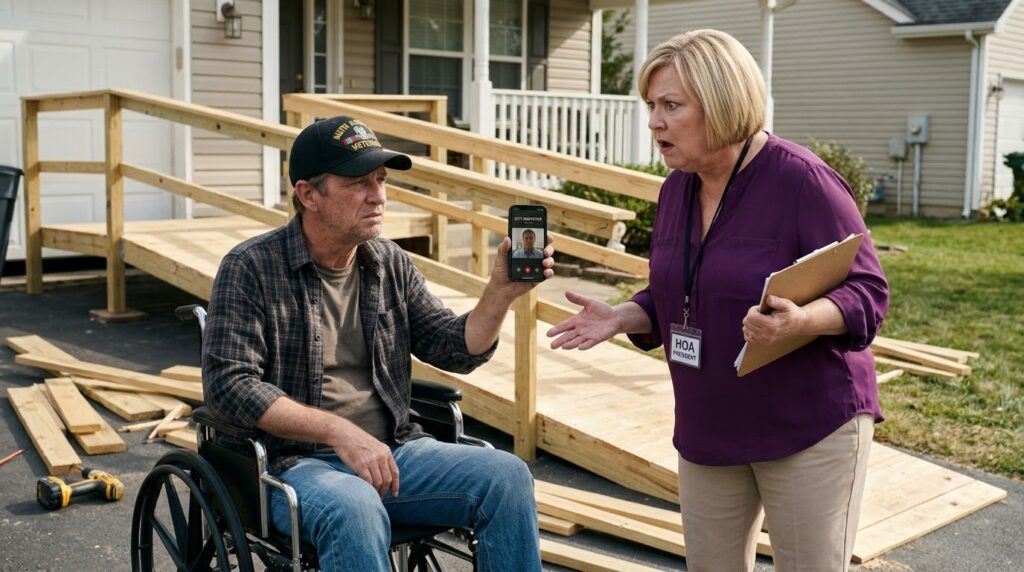
Patricia had arrived demanding that he stop building the ramp. Thomas had explained that the city had approved the plans and that his contractor had submitted the necessary documents.
Patricia had accused him of disrespecting the HOA.
Then she had grabbed the plank.
Officer Whitcomb photographed the board, the unfinished ramp, and the marks on Thomas’s legs.
Margaret offered her video.
The officer watched it once, then asked to watch it again.
Her expression hardened.
She saved the evidence through the department’s approved procedure and took Margaret’s contact information.
Thomas also provided Daniel Mercer’s name and telephone number.
Before the ambulance doors closed, Thomas looked toward his house.
The front porch had been painted pale blue because Eleanor loved that color. Two white rocking chairs still sat beneath the window, although only one had been used since her death.
He hated leaving the house unattended.
Margaret seemed to understand.
“I’ll keep an eye on everything,” she promised.
At the hospital, X-rays showed no new fracture, but the physician diagnosed a painful contusion and recommended further evaluation if Thomas’s mobility worsened.
For someone with his medical history, even an injury without a broken bone could create serious problems.
Thomas listened carefully.
He had learned long ago that ignoring pain didn’t make a person stronger.
It merely made recovery harder.
That evening, Rebecca Bennett arrived at the hospital.
At forty-two, she had inherited her mother’s dark eyes and her father’s stubborn determination.
She worked as an accountant in a neighboring town and had been in the middle of a client meeting when Margaret called.
Rebecca entered the room carrying her father’s favorite gray sweatshirt.
She looked at his bandaged leg.
Then at his wheelchair.
Then at his face.
“Dad, what happened?”
Thomas told her.
He watched her expression change from concern to disbelief, then to quiet fury.
Rebecca had known Patricia Caldwell for years.
Everyone in Willow Creek knew Patricia.
She was the woman who measured lawn heights, photographed improperly parked cars, and once threatened a retired firefighter with a fine because his porch flagpole extended six inches beyond the approved height.
But attacking a disabled veteran was something else entirely.
Rebecca pulled a chair beside the bed.
“Why didn’t you call me when she first started giving you trouble?”
Thomas looked away.
Because he didn’t want to be a burden.
Because Rebecca had her own life.
Because asking for help had never come naturally to him.
And because, deep down, he still believed he should be able to handle a disagreement about his own home.
Instead of explaining all that, he said, “I thought it would work itself out.”
Rebecca reached for his hand.
“Dad, you’re allowed to need help.”
The words reminded him painfully of Eleanor.
She used to say almost the same thing.
Later that night, Rebecca drove to the house to collect her father’s medication and a few personal belongings.
On the kitchen table, she found a folder labeled RAMP PROJECT.
Inside were contractor estimates, city drawings, photographs, and correspondence with the HOA.
Rebecca sat down and began reading.
The first request had been submitted eight weeks earlier.
Thomas had explained that his mobility had declined and that the existing porch steps were becoming unsafe.
He had included a letter from his physician supporting the need for accessible entry.
The city had approved the proposed construction, subject to ordinary inspections.
The HOA, however, had responded with repeated objections.
First, the ramp was supposedly too visible from the street.
Then its handrails were the wrong color.
Then the wooden surface was considered inconsistent with Willow Creek’s architectural character.
Each time Thomas or his contractor responded, another objection appeared.
Rebecca found one particularly troubling email.
Patricia had written that approving Thomas’s ramp would encourage other homeowners to request “undesirable structural exceptions.”
Rebecca read that sentence three times.
She knew that housing disability-accommodation rules could limit what an HOA was allowed to demand, although she would need legal advice about the specifics.
But there was something else.
Attached to the correspondence was a document titled ARCHITECTURAL REVIEW POLICY—REVISED.
It carried Patricia Caldwell’s signature.
The revision appeared to give the HOA president sole authority to reject exterior accessibility modifications.
Rebecca searched the folder for evidence that the board had formally adopted the change.
She found none.
Then she noticed the date.
The policy had supposedly been approved on March 18.
But according to the HOA newsletter sitting beside it, the March board meeting had been canceled because of severe weather.
Rebecca slowly set down the paper.
Her father had been fighting a rule that might never have been properly approved.
And Patricia Caldwell had been enforcing it as though it were law.