Chapter 5: The Money Behind the Rules
Richard Sloan had served as Willow Creek’s treasurer for three years.
A retired bank manager, he was meticulous, soft-spoken, and generally uncomfortable with confrontation.
For months, he had suspected that something was wrong with the association’s finances.
He had asked Patricia for supporting invoices related to architectural enforcement expenses.
Some arrived late.
Others never arrived at all.
He had been told that the president was authorized to approve routine administrative costs without a full board vote.
Richard initially accepted that explanation.
But as the expenses increased, he began keeping copies of the documents he could access.
At the community meeting, he placed several statements on the table.
They showed payments to a company called Caldwell Property Compliance Services.
Rebecca immediately recognized the surname.
Richard explained that the business was owned by Patricia’s nephew, Brandon Caldwell.
According to the available records, the company had received thousands of dollars for architectural inspections, violation documentation, and compliance consulting.
Richard wasn’t claiming that every payment was improper.
The company might have performed legitimate services.
But he could find no complete record of competitive bids, clear conflict-of-interest disclosures, or board approval for several transactions.
More troubling, some invoices described inspections at homes where owners said no inspection had occurred.
One invoice referenced Thomas’s property.
It charged the association for an accessibility modification compliance review.
The date was two weeks before Thomas had submitted his ramp application.
Rebecca stared at the document.
“That doesn’t make sense.”
Richard agreed.
He had already requested the original supporting records.
Patricia had refused to provide them directly, claiming they were confidential administrative materials.
Helen Brooks examined the documents and urged everyone to proceed carefully.
Financial irregularities required verification.
Invoices could contain clerical errors. A relative’s business relationship did not automatically establish wrongdoing.
But the records justified a formal independent review.
The homeowners agreed.
Over the next week, Margaret and Richard gathered the signatures required under Willow Creek’s bylaws to request a special membership meeting.
The purpose was to consider an independent financial audit and changes to the board’s leadership.
Patricia responded angrily.
She sent an association-wide email accusing a small group of residents of spreading misinformation and attempting to undermine property values.
She described the dispute over Thomas’s ramp as a campaign of personal harassment against her.
The message didn’t mention the video.
It didn’t mention Thomas’s hospital visit.
And it didn’t mention Caldwell Property Compliance Services.
Rebecca printed the email and placed it in the growing evidence folder.
Meanwhile, Thomas was struggling.
His physical recovery was slower than expected.
Although his injury had not caused a new fracture, the swelling and pain made transferring from his wheelchair more difficult.
His physician recommended additional therapy and close monitoring.
Thomas hated needing assistance.
Rebecca had begun visiting every morning before work and returning most evenings.
He worried about the strain on her.
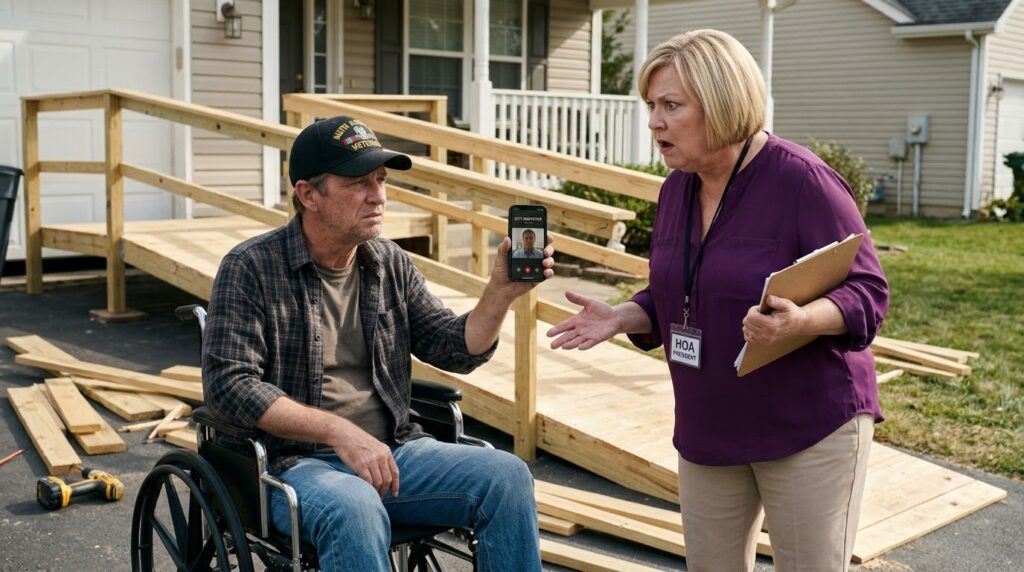
One afternoon, she found him sitting alone beside the unfinished ramp.
His tools were neatly arranged on a small workbench.
Eleanor’s favorite rosebush was blooming near the porch.
Thomas was holding an old photograph.
It showed him and Eleanor on their wedding day.
He was twenty-six, standing tall in his dress uniform.
She wore a simple white gown and an enormous smile.
Rebecca sat beside him.
“Mom would be proud of you,” she said.
Thomas looked at the picture.
“Your mother never cared much about winning arguments.”
Rebecca smiled faintly.
“No. She cared about doing the right thing.”
Thomas nodded.
“That was usually harder.”
He explained that after returning from military service, he had spent years learning to live with the consequences of his injuries.
He had learned to accept pain.
He had learned to adapt.
What he had never fully learned was how to accept being treated as though his disability made him inconvenient.
Patricia’s attack had reopened that wound.
Not because he was frightened of her.
But because she had looked at a man in a wheelchair and decided his dignity mattered less than her authority.
Rebecca squeezed his shoulder.
“We’re not going to let her decide what you deserve.”
The next morning, Helen called.
The HOA’s attorney had agreed to pause enforcement of the ramp removal notice while the dispute was reviewed.
It was a small victory.
But then Helen shared another development.
A former employee of Caldwell Property Compliance Services had contacted her office.
The employee claimed to possess records showing that some HOA inspections had been billed without corresponding site visits.
Helen would need to assess the documents before drawing conclusions.
Still, one thing was becoming clear.
Patricia’s campaign against Thomas might have drawn attention to an operation she had never expected anyone to examine.