Chapter 3: The Rules Nobody Voted For
The next morning, Rebecca began making telephone calls.
Her first was to the contractor, Luis Ortega.
Luis was fifty-six and had operated a small residential construction business for nearly twenty-five years. He specialized in porch repairs, handrails, and accessibility improvements for older homeowners.
He remembered Thomas’s project clearly.
“Your dad has been more patient than anybody should have to be,” he told her.
Luis explained that he had originally expected to finish the ramp in three days.
Instead, Patricia had repeatedly appeared at the property, demanding changes that were not included in the city’s approved plans.
She had once ordered him to remove a handrail because its black finish supposedly violated HOA color standards.
When Luis asked for the written standard, Patricia refused to provide it.
Another time, she threatened to have his truck towed while he was unloading materials.
Luis had documented the encounters because his business depended on keeping accurate records.
He emailed Rebecca photographs, invoices, and notes.
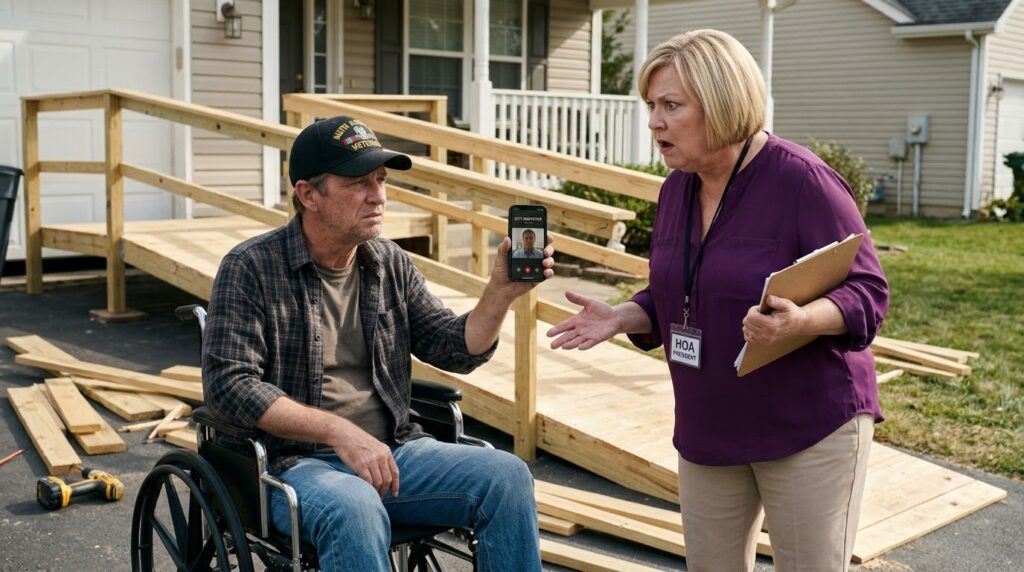
One photograph showed Patricia standing in the driveway, pointing angrily at a stack of lumber.
Another showed a bright orange stop-work notice attached to the porch railing.
Rebecca examined the notice.
It looked official.
Across the top were the words WILLOW CREEK ARCHITECTURAL ENFORCEMENT.
At the bottom was Patricia’s signature.
But there was no reference to a board vote, a hearing, or an appeal process.
Rebecca’s next call was to Daniel Mercer.
The inspector confirmed that Thomas’s ramp had received the required city approval for the work described in the plans.
He explained that city permits and HOA approvals were separate matters, but the HOA’s objections did not give its president permission to interfere physically with construction or harm a homeowner.
Daniel had already provided Officer Whitcomb with a witness statement.
He also told Rebecca something she hadn’t expected.
Thomas wasn’t the first Willow Creek resident to encounter unusual resistance to accessibility improvements.
Several months earlier, Daniel had spoken with another homeowner whose request for a wheelchair lift had stalled after repeated HOA objections.
He couldn’t discuss that person’s private information.
But he encouraged Rebecca to review the association’s governing documents and seek qualified legal advice.
That afternoon, Rebecca visited Margaret Ellis.
Margaret welcomed her into a living room filled with books, family photographs, and carefully maintained antique furniture.
On the mantel stood a framed photograph of Margaret’s late husband, a former postal worker who had died six years earlier.
The two women had known each other casually for years.
Now they sat together at Margaret’s dining table, surrounded by HOA newsletters.
Margaret had kept every newsletter since moving into Willow Creek.
She also possessed something Rebecca desperately needed.
The minutes from the March board meeting.
Or rather, the notice announcing its cancellation.
Margaret had been secretary of the HOA board until the previous year.
She had resigned after repeated disagreements with Patricia about transparency.
According to Margaret, Patricia had gradually concentrated more authority in her own hands.
Board members who questioned her were excluded from informal discussions.
Homeowners who challenged fines received additional warnings.
Requests for financial records were delayed.
“Most people just wanted peace,” Margaret said. “Patricia understood that.”
Rebecca studied the March documents.
The policy revision bore a date when no meeting had taken place.
Margaret confirmed that she had never seen the revision presented to the full board.
That didn’t automatically prove fraud. There might have been another authorized process, a later vote, or records Margaret hadn’t seen.
But it raised serious questions.
Margaret then opened a folder containing letters from other homeowners.
One came from Harold and June Peterson, an elderly couple whose request for a front-entry handrail had been rejected.
Another came from a widow who had been fined for installing a small portable ramp during her recovery from hip surgery.
A third described a homeowner who had abandoned plans for an accessible entrance after receiving threats of escalating penalties.
Rebecca felt her anger deepen.
Her father wasn’t simply the victim of one explosive confrontation.
He might be part of a pattern.
That evening, Thomas returned home from the hospital.
Rebecca had arranged for a temporary accessible entry solution with Luis’s help, subject to the necessary safety checks, so her father wouldn’t have to struggle with the porch steps.
Thomas was exhausted.
His injured leg ached, and the humiliation of the previous afternoon still weighed on him.
Rebecca showed him the March policy.
He studied it carefully.
Then he looked at Eleanor’s photograph on the mantel.
“I just wanted to get into my house without being afraid of falling,” he said.
Rebecca sat beside him.
“I know.”
Thomas was quiet for a long time.
Finally, he asked, “How many other people did she do this to?”
Rebecca didn’t have an answer.
But she intended to find out.
The following morning, a certified letter arrived from the HOA.
It demanded that Thomas remove the unfinished ramp within seventy-two hours.
Failure to comply, the letter warned, could result in daily fines and legal action.
It was signed by Patricia Caldwell.
Even after the police report, the hospital visit, and the inspector’s statement, Patricia was still trying to make Thomas surrender.