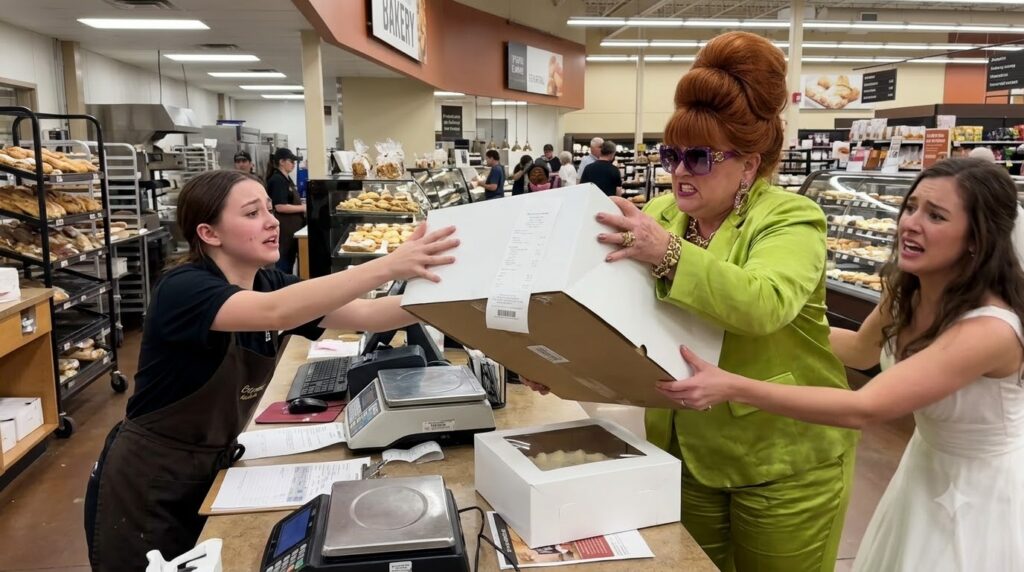
Chapter 4: The Woman Who Saw Everything
Saturday morning arrived with clear skies and the kind of warm Tennessee sunshine Linda Bennett had always loved.
At Cedar Hollow Gardens, workers arranged white folding chairs beneath a grove of old oak trees.
Florists carried buckets of ivory roses into the reception pavilion.
A string quartet rehearsed near the ceremony lawn.
Sarah should have been thinking about her vows.
Instead, she was checking her phone every few minutes.
At 8:15, Margaret Collins called from the bakery.
The repairs were nearly complete.
She had rebuilt the damaged middle tier, reinforced the supports, and replaced the broken sugar flowers.
But one detail had required special attention.
The top tier had originally featured a delicate cluster of ivory roses based on Linda’s wedding bouquet.
The flowers had been crushed during the struggle.
Margaret had stayed late Friday evening to recreate them.
She told Sarah that the new arrangement was even closer to the photograph than the original.
Sarah cried quietly after ending the call.
It was the first time she had cried that morning.
Across town, Thomas Reed was reviewing the bakery’s security footage.
He had promised Sarah a copy of the incident report, but he wanted to understand exactly what had happened.
The first camera showed Karen entering the bakery at 2:41 Friday afternoon.
She approached the counter carrying her small birthday-cake receipt.
The employee pointed toward the smaller box.
Karen looked at it.
Then she looked toward the large wedding-cake box waiting for pickup.
Thomas watched her examine the attached receipt.
She leaned close enough to read it.
Then she turned the box so the label faced away from the counter.
Thomas replayed the moment.
Karen had not mistaken one cake for another.
She had deliberately selected the more expensive cake after seeing the name on the receipt.
The next camera showed the confrontation.
Karen shoved the small box.
Emily caught it.
Karen grabbed the wedding cake.
Sarah arrived.
The struggle followed.
Thomas saved both recordings.
Then he noticed something else.
A third camera, positioned near the bakery entrance, showed Karen speaking with another woman shortly before approaching the counter.
The second woman wore a navy cardigan and carried a canvas shopping bag.
Thomas recognized her.
It was Helen Morris, a longtime supermarket customer who came in every Saturday morning for fresh bread.
Helen was seventy-three, a retired school librarian, and one of the most observant people Thomas had ever met.
She had once spotted a pricing error on a shelf label that three employees had overlooked.
Thomas called her.
Helen answered on the fourth ring.
When he explained why he was calling, she sighed.
“I was wondering when somebody would ask.”
Helen also lived in Willow Creek.
She had known Robert and Linda Bennett for years.
On Friday afternoon, she had stopped at the bakery to collect a loaf of sourdough bread.
Karen had approached her near the refrigerated display.
According to Helen, Karen was furious that the bakery had refused to substitute a larger cake for her daughter’s birthday party.
Then she noticed Sarah’s wedding cake.
Helen remembered Karen reading the label.
She also remembered the remark Karen made afterward.
“Robert Bennett’s daughter,” Karen had muttered. “Well, isn’t that convenient.”
Helen had warned her not to interfere.
Karen ignored her.
When Thomas asked whether Helen would provide a written statement, she agreed immediately.
But she wanted to speak with Robert first.
That afternoon, while Sarah prepared for her ceremony, Helen visited Robert’s house.
She found him standing beside Linda’s rose trellis.
The flowers were blooming.
Helen told him what she had witnessed.
Robert listened without interrupting.
When she finished, he asked whether Karen had mentioned his HOA fines.
Helen hesitated.
“Not at the bakery.”
Robert waited.
“But she did mention you at the last board meeting.”
He turned toward her.
Helen explained that Karen had privately discussed making an example of residents who challenged association authority.
Robert’s name had come up repeatedly.
Helen had once served on the HOA board herself, long before Karen became president.
She knew the association’s procedures.
And she knew that several recent decisions had not been properly documented.
Robert looked toward his house.
“What are you telling me?”
Helen opened her shopping bag.
Inside was a thick folder.
“I think it’s time we looked at what Karen has actually been doing.”