Chapter 10: The Roses That Stayed
By the following spring, Willow Creek looked much as it always had.
The lawns were green.
The sidewalks were clean.
Children rode bicycles beneath the maple trees.
Neighbors stopped to talk beside their mailboxes.
But something important had changed.
The community no longer treated questions as acts of disobedience.
Board meeting agendas were posted in advance.
Financial summaries were available for review.
Residents who received violation notices were given clear explanations and a fair opportunity to respond.
Disagreements still occurred.
They always would.
One homeowner wanted taller privacy fencing.
Another disliked the new landscaping schedule.
A third complained that the clubhouse parking lot needed repairs.
But the conversations were ordinary neighborhood disagreements rather than personal battles.
Robert noticed the difference most on Saturday mornings.
He had started walking regularly with Frank Dawson and Helen Morris.
They met near the community pond, followed the shaded sidewalk past the clubhouse, and stopped for coffee afterward.
Sometimes Patricia Ellis joined them.
Their conversations ranged from gardening to grandchildren to the rising cost of groceries.
They rarely mentioned Karen.
She still owned her house in Willow Creek, but she no longer served on the board.
She had become a quieter presence in the neighborhood.
Robert did not seek her out.
He also did not avoid the sidewalk when he saw her approaching.
He had learned that dignity did not require winning every argument.
Sometimes it simply meant refusing to be intimidated.
At home, Linda’s rose trellis remained beside the walkway.
The association had confirmed that it complied with the applicable landscaping rules.
Robert had repaired a loose wooden support and added fresh mulch beneath the flowers.
That spring, the roses bloomed more heavily than they had in years.
One Saturday afternoon, Sarah and Michael visited.
Sarah carried a small cardboard box.
Robert raised an eyebrow when he saw it.
“Please tell me that’s not another cake.”
She laughed.
“It is, actually.”
Inside was a modest vanilla cake decorated with three ivory buttercream roses.
Margaret Collins had made it.
She was retiring again, this time permanently, and had sent the cake as a gift.
Alongside it was a handwritten note.
For the Bennett family. May every celebration from here on be a peaceful one.
Robert smiled.
They carried the cake onto the back porch.
Michael made coffee.
Sarah cut three slices.
For a while, they sat together listening to birds in the trees.
Then Sarah reached into her purse.
“I have something else.”
She handed Robert a small envelope.
Inside was a photograph from her wedding.
It showed him walking her down the aisle.
His face was turned toward her, and she was smiling at something he had just whispered.
On the back, Sarah had written:
You taught me that standing up for what’s right doesn’t mean losing your kindness. I love you, Dad.
Robert read the words slowly.
He took off his glasses.
Sarah pretended not to notice his tears.
A few minutes later, Michael asked whether Robert wanted help fixing the old wooden garden bench.
Robert said he did.
The two men went into the yard while Sarah stayed on the porch, watching them.
She thought about how close the wedding had come to being overshadowed by one woman’s selfishness.
Karen had tried to take something that did not belong to her.
She had treated a stranger’s wedding as less important than her own convenience.
And when challenged, she had attempted to use her position in the neighborhood to punish the bride’s father.
But the attempt had failed.
Not because someone shouted louder.
Not because Robert had more influence.
It failed because ordinary people refused to ignore what they had seen.
Emily protected the cake.
Thomas preserved the evidence.
Margaret repaired the damage.
Helen spoke the truth.
Denise insisted on proper procedures.
And neighbors who had spent too long remaining silent finally began asking questions.
Sarah looked toward the garden.
Her father and Michael were laughing over a stubborn screw in the bench.
The afternoon sunlight caught the pale pink roses climbing over Linda’s trellis.
Sarah remembered something her mother had told her years earlier.
A home wasn’t defined by the fence around it or the rules printed in a handbook.
It was defined by the people who made you feel safe inside it.
Robert finished tightening the screw.
Michael tested the bench.
It held.
The two men sat down together, looking pleased with themselves.
Sarah carried the remaining cake outside.
They ate beneath the roses.
There was no argument.
No clipboard.
No violation notice waiting in the mailbox.
Just a family enjoying an ordinary afternoon.
Later, after Sarah and Michael drove away, Robert stood beside the trellis and gently touched one of the flowers.
He thought about Linda.
He thought about the wedding.
And he thought about the strange chain of events that had begun with a woman trying to steal a cake.
He had never wanted a fight.
He had only wanted to protect his home and his daughter’s happiness.
In the end, he had helped protect something larger.
A community where people could disagree without being threatened.
A neighborhood where rules applied fairly.
A place where respect mattered more than titles.
Robert went inside as the evening light softened over Willow Creek.
On the kitchen counter sat the photograph of Sarah’s wedding.
Beside it was a small vase holding three freshly cut roses.
For the first time in a long while, his house felt peaceful again.
And this time, the peace did not depend on keeping quiet.
It came from knowing that no one person, no matter how important they believed themselves to be, had the right to take away another family’s dignity.
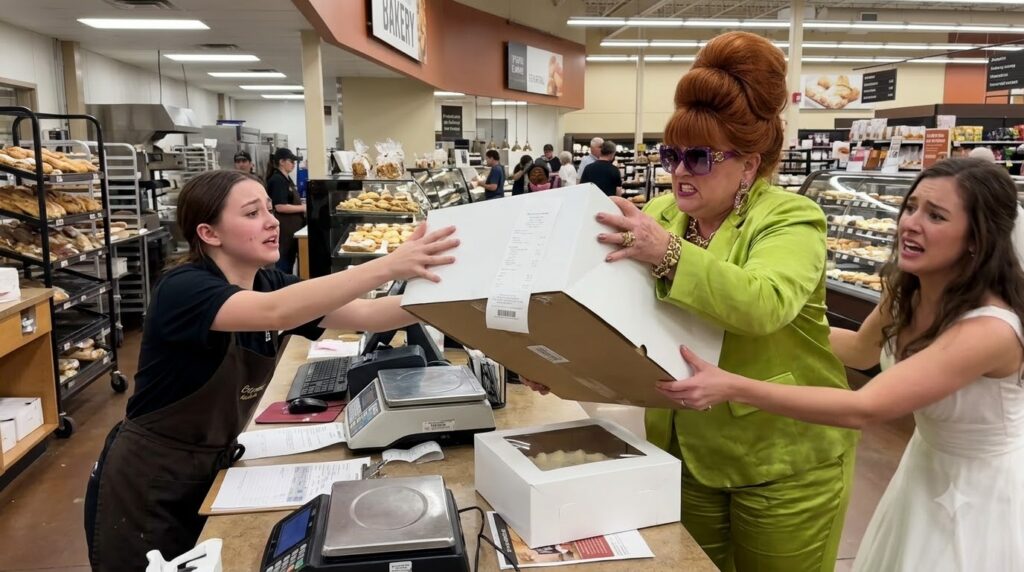
Suggested next step for website publication: Pair the story with a dramatic cover image of Karen grabbing the wedding-cake box while the bride and bakery employee struggle to save it.