Chapter 9: A Second Bloom for Everyone
By the following spring, the Willow Creek Farmers’ Market looked much as it always had.
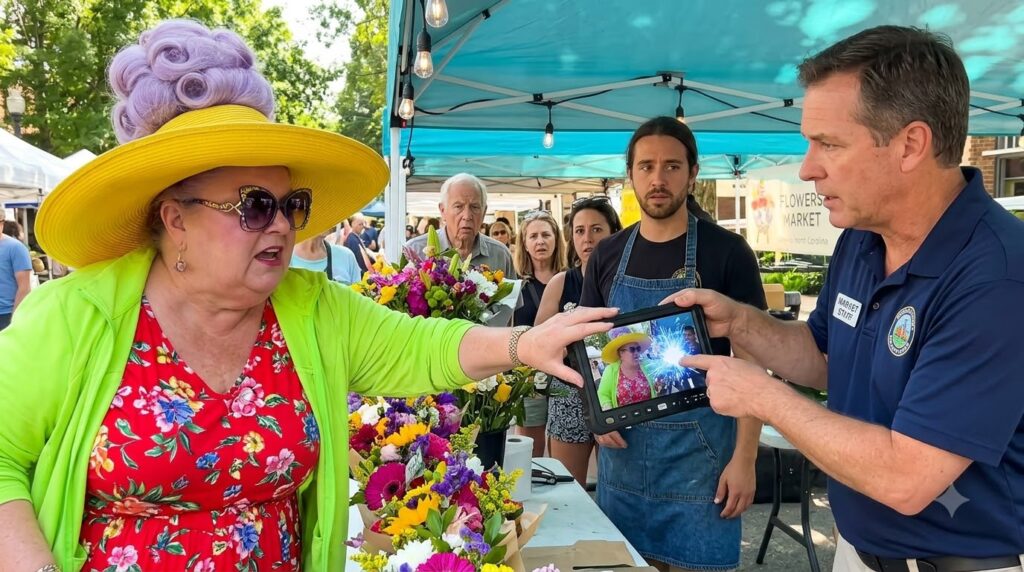
The turquoise flower canopy stood near the center of the village square.
Farmers arranged baskets of tomatoes and fresh greens.
A baker displayed cinnamon rolls beneath a striped awning.
Children wandered between stalls holding lemonade and homemade cookies.
Older residents gathered on benches, discussing grandchildren, gardening, and the weather.
The market had returned to its familiar rhythm.
But beneath the surface, something had changed.
Residents attended HOA meetings more regularly.
Board minutes were easier to access.
Financial reports were presented in plain language.
Homeowners asked questions without fearing retaliation.
The association still enforced legitimate rules.
Lawns still needed maintenance.
Shared spaces still required care.
Budgets still demanded difficult decisions.
But those responsibilities were now handled with greater transparency.
The community had learned that order and intimidation were not the same thing.
Emily’s business had grown.
Second Bloom Flowers now supplied arrangements for several small restaurants, a local church, and a senior living community.
She had hired a part-time assistant named Grace, a college student studying horticulture.
Grace helped with deliveries and managed online orders during busy weekends.
The additional income allowed Emily to reduce some of the financial pressure on her mother.
Susan’s health remained a daily concern, but she was doing well.
She attended physical therapy, enjoyed short walks when the weather permitted, and still insisted on helping Emily choose flowers for special arrangements.
On Saturday mornings, Susan often sat beneath the turquoise canopy with a cup of coffee.
She greeted customers, offered unsolicited gardening advice, and occasionally corrected Emily’s prices when she thought her daughter was being too generous.
Emily pretended to be annoyed.
In truth, those mornings were among the happiest hours of her week.
One Saturday in April, Thomas approached the stall carrying a small wooden plaque.
He had been working with the market vendors on a project to recognize local businesses that contributed to the community.
The plaque read:
SECOND BLOOM FLOWERS
For kindness, service, and the spirit of neighborliness.
Emily laughed when she saw it.
She insisted she hadn’t done anything extraordinary.
Thomas disagreed.
He reminded her of the bouquets she had delivered to homebound residents, the flowers she had donated after funerals, and the care she had shown customers who could afford only a few stems.
“People remember how you treat them,” he said.
Emily accepted the plaque.
She placed it beside the register, where the approved market permit had once been hidden beneath Karen’s display board.
The symbolism was not lost on her.
Later that morning, Margaret stopped by.
She had completed her service as treasurer and was enjoying retirement from HOA responsibilities.
She looked more relaxed than Emily had seen her in years.
Margaret bought a bouquet of yellow roses.
Then she glanced toward the electrical control box.
It had been repaired, inspected, and secured.
A small protective barrier separated it from public access.
The new arrangement was unremarkable.
Exactly as it should be.
Margaret smiled.
“Hard to believe how much trouble started right there.”
Emily followed her gaze.
For a moment, she remembered the sparks.
The sound.
The fear.
The humiliation of watching her business go dark while someone with a title insisted she had done something wrong.
She remembered the weeks of uncertainty.
The paperwork.
The public meeting.
The long wait for a resolution.
But she also remembered Helen’s handwritten sign.
The customers standing in line.
Her mother’s hand reaching across the kitchen table.
And the neighbors who had finally decided that fairness was worth defending.
“It wasn’t really about electricity,” Emily said.
Margaret nodded.
They both understood.
It had been about power.
Not the kind flowing through wires.
The kind people hold over one another.
The kind that can be used to protect a community or make its members feel small.
Karen Whitmore had confused authority with ownership.
She had believed that being HOA president meant she could decide who belonged, whose business deserved to succeed, and whose voice mattered.
But Willow Creek belonged to its residents.
Its streets, homes, traditions, and shared spaces were sustained by the people who lived and worked there.
No single person could claim them as a personal kingdom.
Near noon, Susan called Emily over.
A young girl stood beside her grandmother, holding three crumpled dollar bills.
She wanted to buy flowers for her mother’s birthday.
Emily helped her choose a small bunch of pink carnations and wrapped them in brown paper.
The girl counted her money carefully.
Emily accepted the payment and added a yellow daisy.
“That one’s from me.”
The child smiled and hurried away.
Susan watched her go.
“Your father would have loved this place,” she said.
Emily looked around the market.
At Thomas helping a vendor carry boxes.
At Margaret chatting with neighbors.
At Helen examining tomato seedlings.
At Grace laughing with a customer.
At the ordinary, imperfect, generous life continuing around them.
“I think he would,” Emily answered.
A breeze moved through the square, stirring the flower petals and lifting the edge of the turquoise canopy.
The string lights above the stall remained steady.
The payment terminal worked.
Customers came and went.
And the little security camera still watched quietly from its place overhead.
Emily had considered removing it after everything was settled.
But she decided to keep it.
Not because she expected another confrontation.
And not because she wanted to live in fear.
It was simply a sensible precaution for a small business.
The market had become a place where people felt welcome again, and she intended to help keep it that way.
As the afternoon sunlight settled across the square, Emily stepped back to admire the flowers arranged along her counter.
Roses, daisies, lilies, and sunflowers filled the display with color.
Some were expensive.
Others cost only a few dollars.
Every bouquet had a place.
That, Emily thought, was what a good community should be like.
Not everyone had the same income, the same house, the same opinions, or the same dreams.
But everyone deserved to be treated with dignity.
The trouble at Willow Creek had begun when one woman pulled a switch because she believed she had the right to decide whose light stayed on.
It ended when the neighbors discovered that their community worked better when no one person controlled that switch.
And on a beautiful spring afternoon in Asheville, Second Bloom Flowers was open for business.
The lights were shining.
The flowers were blooming.
And nobody needed permission to belong.
The End.