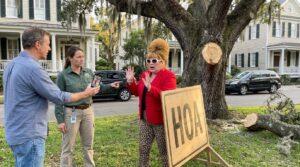
Chapter 8: The Price of Crossing the Line
Removing Karen from the board did not erase what had happened.
The electrical equipment had required repairs.
The market had incurred inspection expenses.
Emily had lost inventory and sales.
Her payment terminal had been damaged, and several customers had canceled orders after hearing the false allegations.
The property manager and association’s insurer reviewed the relevant claims under their respective procedures.
The HOA’s attorney advised the new board to keep the association’s responsibilities separate from Karen’s individual actions.
The homeowners should not automatically be made to bear the cost of conduct that had not been authorized.
Meanwhile, the local authorities reviewed the evidence relating to the electrical incident.
The investigation included the surveillance footage, the inspection findings, witness statements, and records showing that Karen had been warned not to interfere with the equipment.
The review took time.
Emily found the waiting frustrating.
She had imagined that once the video surfaced, everything would be resolved quickly.
Instead, there were forms, interviews, estimates, and questions about what could be proved.
Thomas reminded her that a careful process was better than a rushed one.
Eventually, Karen faced a misdemeanor property-damage charge connected to the incident.
Through her attorney, she agreed to a negotiated resolution that included restitution for documented damage and expenses, subject to the court’s approval.
She did not admit every accusation that had circulated through the neighborhood.
The court’s resolution addressed the charged conduct, not every rumor.
The financial review of the proposed consulting arrangement reached a separate conclusion.
No association funds had been paid to Blue Ridge Property Standards.
The invoice was canceled.
The review found that Karen had attempted to move forward with an unauthorized consulting proposal involving a family connection, but it did not establish that money had been stolen.
The new board documented the conflict-of-interest concerns and adopted stricter purchasing controls.
For Emily, the most important result was practical.
Her documented losses were addressed through the agreed restitution and applicable claim payments.
The property manager issued a written statement confirming that Second Bloom Flowers had been an authorized market participant and that no electrical violation had been attributed to Emily’s business.
The statement was distributed to residents and posted through the market’s regular communication channels.
Emily kept a copy in her office.
Not because she wanted to remember the conflict.
Because she wanted a record of the truth.
Karen’s departure from HOA leadership also created an unexpected opportunity.
The board appointed an interim president and began a broader review of community procedures.
Margaret agreed to continue serving as treasurer until the next regular election, but she announced that she would not seek another term afterward.
She believed new voices were needed.
Frank helped establish a financial oversight committee.
The board adopted clearer rules requiring documented authorization for vendor changes, formal disclosure of conflicts of interest, and recorded votes for significant expenditures.
It also created a straightforward process for residents to appeal disputed compliance notices.
Most importantly, the association clarified the boundaries between HOA governance and the independently managed market.
No individual board member could shut down a business or interfere with shared utility equipment simply by claiming authority.
Those decisions required the appropriate legal and contractual authority, established procedures, and qualified personnel where safety was involved.
The changes were not glamorous.
There were no dramatic speeches.
No television cameras.
No cheering crowds.
Just revised documents, transparent meetings, and residents willing to participate.
But those ordinary improvements mattered.
They made it harder for another Karen Whitmore to dominate the community through intimidation.
One afternoon, Margaret visited Emily’s stall.
She purchased a small bouquet of white daisies.
Emily recognized the flowers immediately.
They had been Margaret’s late husband’s favorites.
As Emily wrapped them, Margaret hesitated.
“I should have spoken up sooner.”
Emily looked at her.
Margaret’s regret was genuine.
For a moment, Emily considered all the months of warnings, inspections, and unnecessary anxiety.
Then she thought about the petition, the meeting, and the people who had finally taken action.
“You spoke up when it mattered,” Emily said.
Margaret shook her head gently.
“Next time, I hope I recognize when it matters a little earlier.”
Emily understood.
That was probably the most important lesson Willow Creek could carry forward.
Not that bad leadership could eventually be removed.
But that it should never be allowed to grow unchecked in the first place.