Chapter 3: What the Electrician Found
By noon, the flower stall had been surrounded by temporary safety barriers.
The market property manager, Daniel Brooks, arrived with a licensed electrician named Robert Hayes.
Robert was sixty-two, broad-shouldered, silver-haired, and known throughout the county for his careful work.
He had spent nearly four decades maintaining electrical systems in schools, small businesses, and residential developments.
He did not appreciate people treating electrical equipment like toys.
After verifying that the supply was isolated, Robert examined the exterior of the control box.
The damaged seam immediately concerned him.
“This didn’t happen because somebody sold flowers,” he told Daniel.
He took photographs before beginning his inspection.
The enclosure showed signs of recent interference. A cover fastener was loose, and there were marks around an area that should not have been accessible during ordinary market operations.
Robert did not attempt to guess who had caused the damage.
He documented what he found and recommended that the equipment remain out of service until the affected components could be safely evaluated and repaired.
His preliminary conclusion was that the box had likely been compromised before Karen operated the switch.
That mattered.
The sparks were not merely an unfortunate consequence of an ordinary shutdown.
Something had already been wrong.
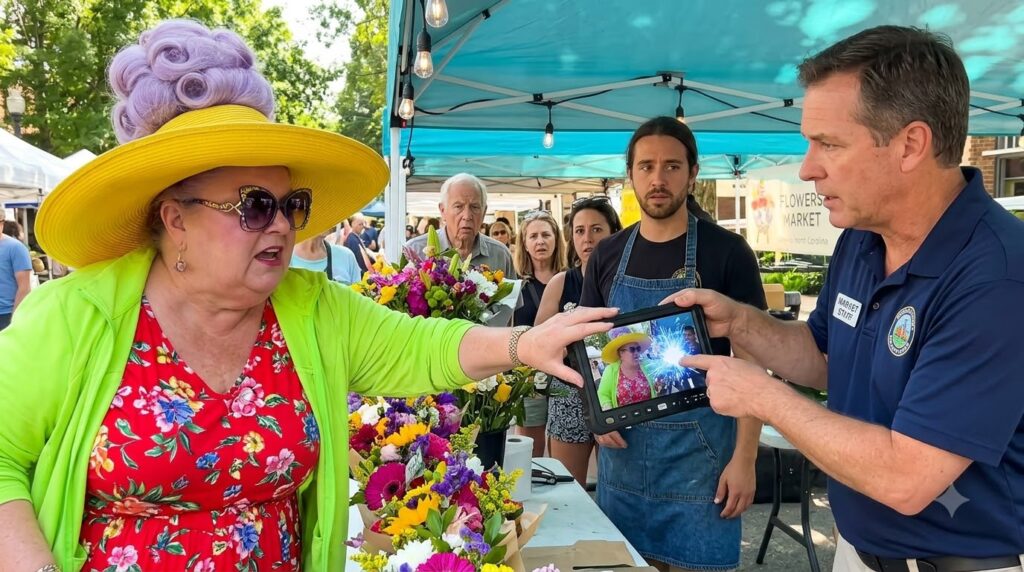
Thomas provided Robert and Daniel with a copy of the security recording.
They watched Karen crouching beside the box.
Daniel’s face tightened.
He had managed Willow Creek’s shared commercial spaces for six years.
He knew the difference between HOA oversight and property management authority.
Karen had been warned repeatedly that the association could not interfere with approved market operations.
Now the market faced a potentially dangerous electrical incident.
Daniel contacted the property owner’s insurance representative and arranged for an independent inspection.
He also told Thomas to preserve the original recording.
Meanwhile, Karen was busy constructing a different version of events.
She had retreated to the HOA office, where she called two board members and claimed that Emily’s stall had caused a dangerous electrical malfunction.
According to Karen, she had heroically disconnected the power to protect shoppers.
The sparks, she insisted, proved that the vendor had been operating unsafe equipment.
She described the surveillance video as misleading.
She claimed Thomas had publicly humiliated her.
And she demanded an emergency board meeting.
Margaret Ellis listened to the story over the phone.
She had been standing ten feet away when Karen pulled the lever.
She had also watched the replay.
“Patricia,” Margaret said, “I saw what happened.”
Karen responded by accusing Margaret of disloyalty.
That was when Margaret made a decision she had been postponing for months.
She would no longer protect the board president from the consequences of her behavior.
For years, Margaret had believed that internal disagreements should remain private.
She had tolerated Karen’s temper because she thought the association could still function.
But this was different.
People could have been injured.
A woman’s livelihood had been interrupted.
And the HOA president was attempting to blame the person she had targeted.
Margaret began reviewing the association’s records.
As treasurer, she had access to approved budgets, vendor payments, and financial reports.
She started with the market’s operating expenses.
Then she examined the invoices Karen had submitted over the previous six months.
One item caught her attention.
It was a payment request for $1,850.
The description read: Community Compliance Consulting.
The vendor was a company called Blue Ridge Property Standards.
Margaret had never heard of it.
The payment had not yet been released because the invoice lacked the supporting approval required by the association’s financial procedures.
She searched the board minutes.
There was no recorded vote authorizing the expense.
She checked the vendor information.
The listed business address was a private mailbox.
And the contact telephone number matched a number Margaret recognized from an earlier conversation.
It belonged to Karen’s niece.
Margaret sat back in her chair.
The electrical incident was troubling enough.
But the paperwork suggested another problem.
Karen had been trying to spend association money on an outside compliance service that the board had never approved.
Margaret gathered the documents into a folder.
Then she called the association’s independent bookkeeper.
She did not accuse anyone of theft.
She asked for a complete review of the proposed payment and any related invoices.
By late afternoon, the bookkeeper had found something else.
The consulting invoice referred to a project called the Village Square Vendor Transition.
Margaret had never heard that phrase at a board meeting.
But she had a strong suspicion what it meant.
And when she found the attached proposal, Emily Carter’s flower stall was specifically named.