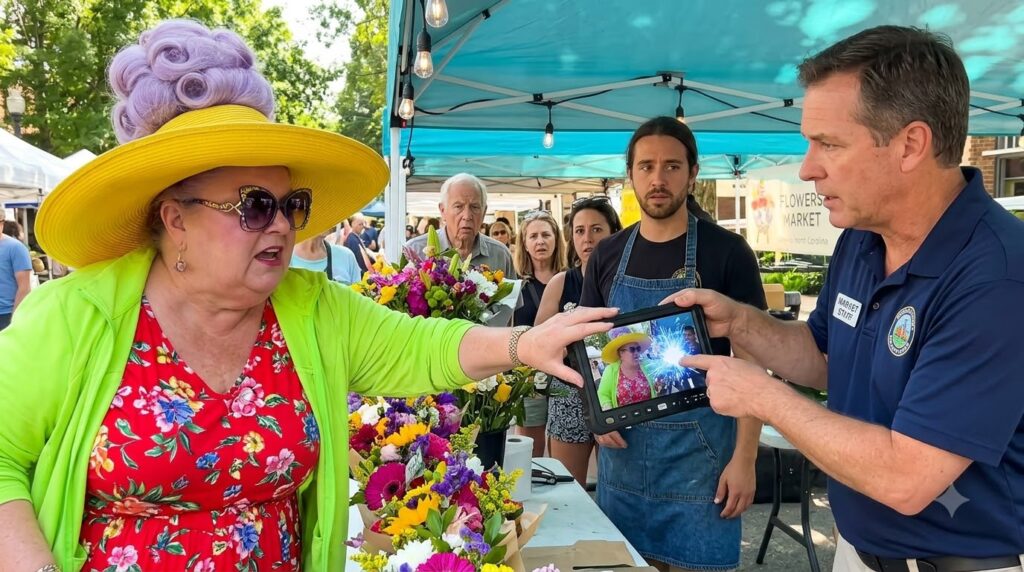
Chapter 4: The Plan Behind the Shutdown
The document was only four pages long.
Its implications were enormous.
The Village Square Vendor Transition proposal described a plan to replace several independent market stalls with a more exclusive collection of approved commercial partners.
The language sounded harmless.
It promised improved presentation, consistent branding, and enhanced community value.
But the details told a different story.
Under the proposed arrangement, long-standing local vendors would be required to reapply for their spaces.
New participation fees would be introduced.
Preferred vendors would receive priority placement.
And certain businesses, including Second Bloom Flowers, were identified as unsuitable for the market’s future direction.
Margaret read the document twice.
Then she examined the final page.
The proposed replacement floral vendor was Magnolia Events & Design.
The company’s owner was Karen’s niece, Vanessa Whitmore.
Vanessa was forty-one and operated an event-decorating business in a neighboring county.
Margaret had met her at a holiday party.
She remembered Karen praising Vanessa’s expensive wedding arrangements and complaining that Willow Creek’s market looked too ordinary.
At the time, Margaret had thought little of it.
Now the connection was impossible to ignore.
Karen had been attempting to remove Emily from the market while promoting a business owned by a relative.
The proposal did not prove that Vanessa knew about the electrical shutdown.
Nor did it establish that any money had been improperly paid.
But it raised serious questions about conflicts of interest, unauthorized planning, and the use of HOA authority for personal purposes.
Margaret forwarded the documents to the association’s attorney and requested that the proposed consulting payment remain on hold pending review.
She also contacted the other board members.
By Sunday afternoon, the situation had begun to unravel.
Two directors admitted that Karen had mentioned replacing some market vendors.
Neither recalled approving a formal transition plan.
A third director remembered being told that the changes were necessary because several vendors had failed safety inspections.
But no inspection reports had been provided.
Margaret asked the property manager for copies of any documented violations involving Second Bloom Flowers.
Daniel found none.
He did find an email Karen had sent three weeks earlier.
In it, she requested permission to disconnect Emily’s stall from the market’s electrical supply.
Daniel’s response had been explicit.
No HOA representative was authorized to operate or interfere with the market’s electrical equipment.
Any safety concern was to be reported to property management for evaluation by qualified personnel.
Karen had received the warning.
She had ignored it.
Meanwhile, Emily was dealing with the immediate consequences.
The market had reopened after the affected electrical connection was isolated, but her stall remained without normal power.
The damaged payment terminal would need replacement.
Several delicate arrangements had been lost.
And she had missed a significant portion of Saturday’s sales.
Worse, rumors were spreading.
Some residents had heard Karen’s claim that the stall was unsafe.
A few customers canceled orders.
One woman asked whether Emily had been using illegal wiring.
Emily answered patiently, but each question hurt.
She had built her business on trust.
It was painful to watch that trust become uncertain because someone in authority had made an accusation.
On Sunday evening, Susan found her daughter sitting at the kitchen table, surrounded by invoices.
Emily had been trying to calculate how much the shutdown would cost.
Susan lowered herself into the chair opposite her.
“You’re thinking about quitting.”
Emily looked up.
“I don’t know how much more of this I can take.”
Susan reached across the table.
Her hand was weaker than it had once been, but her grip was steady.
“Your father used to say that doing the right thing doesn’t guarantee an easy day.”
Emily smiled sadly.
“He also said some people enjoy making easy things difficult.”
Susan laughed.
For a moment, the tension eased.
Then Susan became serious.
“Don’t let that woman decide what kind of life you get to have.”
Emily looked toward the window.
Outside, the neighborhood was peaceful.
Porch lights glowed along the sidewalk.
A retired couple walked their dog.
Somewhere nearby, a sprinkler clicked across a lawn.
She had grown up believing Willow Creek was a place where neighbors looked after one another.
She wanted to believe it still was.
The following morning, Thomas called.
The market property manager had arranged a temporary, professionally approved power connection for Emily’s stall.
She could return the next Saturday.
But Thomas had another reason for calling.
A customer had contacted him with a recording from the morning of the shutdown.
The customer had been filming a short video of the flower displays.
Her phone had captured Karen speaking to someone just before she approached the electrical box.
And the conversation offered a new clue about why Karen had chosen that particular morning.