Chapter 8: What Justice Looked Like in Spring
The consequences did not end with Karen’s removal.
The independent audit continued through February and March.
The accountants reconstructed the special assessment collections, reviewed vendor payments, and compared invoices with documented services.
Their final report identified a substantial amount of spending that lacked adequate authorization or supporting documentation.
Some charges were eventually verified.
Others were not.
The association’s attorney pursued repayment of unsupported expenditures and referred the relevant records to authorities for review.
Karen and her nephew disputed portions of the findings.
Through counsel, they maintained that legitimate consulting services had been provided.
The matter moved into formal proceedings.
There were no instant confessions or dramatic arrests at the clubhouse.
The legal process took time.
Documents had to be examined.
Witnesses had to be interviewed.
Financial records had to be reconciled.
For Daniel, that was frustrating but necessary.
He did not want Karen punished because the neighborhood disliked her.
He wanted the truth established and the community’s money protected.
Eventually, the civil dispute produced a settlement under which funds were returned to the association and certain disputed charges were waived. The agreement did not resolve every question about Karen’s conduct, and the separate official review followed its own course.
The association used the recovered money to rebuild the water infrastructure reserve and reduce the amount residents needed to contribute toward approved future repairs.
The board also adopted several reforms.
Special assessments would require documented authorization and clear explanations of their purpose.
Residents would receive access to appropriate financial summaries.
Enforcement decisions would be subject to a defined appeal process.
No single board officer could impose extraordinary penalties without the approvals required by the governing documents.
And no HOA representative would be permitted to operate cooperative water equipment without authorization.
The Cedar Point Water Cooperative made its own changes.
Its trustees secured the utility enclosures, established a documented access procedure, and arranged regular inspections with the maintenance contractor.
A clear emergency contact number was distributed to every household.
The goal was not to make essential equipment inaccessible during a genuine emergency.
It was to ensure that trained, authorized people could respond quickly without allowing anyone to use the system as a weapon in a personal dispute.
By April, Cedar Point Shores looked much as it always had.
The lake ice had disappeared.
Fishing boats returned to the water.
Tulips emerged beside front steps.
Neighbors began cleaning docks and preparing gardens.
But the atmosphere had changed.
People stopped to talk again.
Residents attended board meetings without expecting to be shouted down.
Questions were answered with documents rather than threats.
The clubhouse bulletin board displayed meeting minutes, maintenance schedules, and community announcements.
There were still disagreements.
Some homeowners wanted lower dues.
Others believed the aging infrastructure required greater investment.
A few complained about landscaping rules.
But disagreements were no longer treated as acts of rebellion.
The community was learning to govern itself again.
Daniel noticed the difference most clearly one Saturday morning.
He was repairing a loose board on his dock when Robert Gaines walked over carrying two cups of coffee.
They sat facing the lake.
Robert had lived in Cedar Point Shores for seventeen years.
He admitted that he had almost sold his house the previous summer.
The constant fines and threats had made retirement feel like an obligation rather than a reward.
Now he had decided to stay.
His daughter and grandchildren were planning a summer visit.
Daniel smiled.
He understood.
Home was more than a building.
It was the feeling that you could close your front door at night without worrying that someone would invent a reason to punish you tomorrow.
Later that afternoon, Daniel visited Margaret Ellis.
She was planting marigolds beside her porch.
The same flowerpots Karen had once fined her for were lined up along the railing.
This time, nobody had complained.
Margaret invited him inside for lemonade.
Her kitchen faucet worked perfectly.
Daniel noticed how casually she used it.
She filled two glasses, rinsed a spoon, and wiped the counter without a second thought.
Before Thanksgiving, running water had been something nobody in the neighborhood considered remarkable.
After Thanksgiving, it represented something larger.
Security.
Independence.
The right to live peacefully in a home you had worked a lifetime to afford.
Margaret told Daniel that she had recently received a refund for an improperly imposed landscaping fine.
It was not a large amount.
But she had used part of it to buy flowers for Susan’s memorial garden beside Daniel’s house.
He looked at her, surprised.
Margaret smiled.
“Your wife always liked yellow roses.”
Daniel remembered.
Susan had planted yellow roses along the back fence every spring.
After she died, he had struggled to care for them.
Some had not survived the winter.
He thanked Margaret quietly.
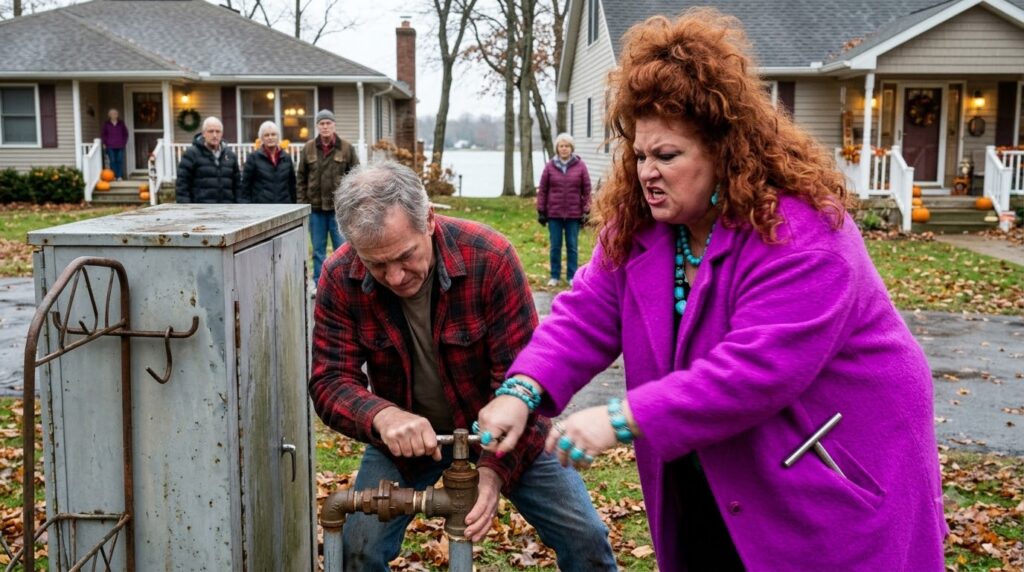
On his way home, he passed the utility enclosure where the Thanksgiving confrontation had begun.
The metal door was closed and properly secured.
A small notice identified the cooperative’s emergency contact information.
There was no trace of Karen’s purple coat, her furious shouting, or the missing valve handle.
Only the ordinary equipment that kept water flowing to twelve homes.
Daniel paused beside it.
He remembered how quickly the situation had escalated.
One person had decided that authority meant the power to make others suffer.
And for years, too many neighbors had accepted that behavior because challenging it seemed harder than paying another fine.
The Thanksgiving shutdown had exposed the danger of that silence.
But the solution had not come from one dramatic confrontation alone.
It had come from Helen gathering statements, Walter preserving records, Patricia telling the truth, George and Linda questioning their president, and ordinary homeowners showing up to vote.
Daniel had reopened a valve.
The neighborhood had done the rest.