Chapter 3: The Man Who Had Asked Too Many Questions
Walter Bennett answered his telephone the next morning.
He was seventy-four, a retired civil engineer with a deliberate manner and a reputation for keeping records long after everyone else had thrown theirs away.
When Daniel described the Thanksgiving incident, Walter remained silent for several seconds.
Then he asked a single question.
“Did she actually remove the handle?”
Daniel confirmed it.
Walter exhaled slowly.
“That woman has no business touching that equipment.”
They met at Walter’s house that afternoon.
The home stood on a wooded lot overlooking a narrow inlet, with a workshop behind the garage and a small American flag beside the front steps.
Walter invited Daniel into his study.
The walls were lined with books, framed engineering certificates, and photographs of the community when it was little more than a collection of summer cottages.
On the desk sat a cardboard box marked WATER SYSTEM.
Walter had been one of the cooperative’s original trustees.
Although he had stepped away from day-to-day operations years earlier, he still possessed copies of its governing documents and historical maintenance records.
He explained that the water system had never been transferred to the HOA.
The cooperative remained a separate organization, with authority over the shared pipes, shutoff assemblies, and contracted maintenance work.
The HOA collected certain approved charges on its behalf, but it could not independently operate the system or impose service disconnections.
Karen had blurred that distinction repeatedly.
At first, Walter believed it was ignorance.
Later, he began to suspect something worse.
He opened a folder containing invoices from the previous year.
The HOA had collected a special water infrastructure assessment of $850 per household.
Residents had been told the money was needed to replace deteriorating underground pipes.
Walter had requested documentation before approving any related expenditure.
The engineering report he eventually received recommended targeted maintenance, not a complete replacement.
The contractor’s estimate was far below the amount collected.
When Walter asked what happened to the difference, Karen accused him of obstructing essential community improvements.
Two months later, she pushed for his removal from the HOA’s finance committee.
Walter resigned rather than continue arguing in public.
But he kept copies of everything he had been legally entitled to receive.
Daniel examined the paperwork.
The numbers were troubling.
Last year’s assessment had brought in approximately $57,800.
The documented repair work appeared to total less than $19,000.
Walter was careful not to jump to conclusions.
There could be additional expenses, reserves, or payments they had not yet seen.
The absence of documents was not proof that money had been stolen.
But it was reason enough to demand a proper accounting.
Daniel showed Walter the Thanksgiving violation notice.
The retired engineer adjusted his reading glasses.
He studied the approval number, then the signature.
“That isn’t right.”
The signature belonged to Patricia Lowell, the HOA treasurer.
Patricia had suffered a serious fall earlier in November and was recovering in a rehabilitation facility.
Walter knew her well.
He doubted she had approved any enforcement action while undergoing treatment.
The document also referred to an emergency board authorization.
Under the association’s bylaws, certain emergency actions could be approved between regular meetings, but they still required proper consent and documentation.
Karen’s notice provided neither.
Walter made a copy.
Then he brought out another folder.
Inside was a letter he had received from the cooperative’s maintenance contractor in September.
The contractor had expressed concern that unauthorized individuals were accessing the utility enclosures.
Two protective locks had been damaged.
A valve handle had disappeared from a storage cabinet.
The contractor recommended restricting access and documenting all future interventions.
Walter had forwarded the warning to the HOA board.
Karen responded that the cooperative was exaggerating minor maintenance concerns.
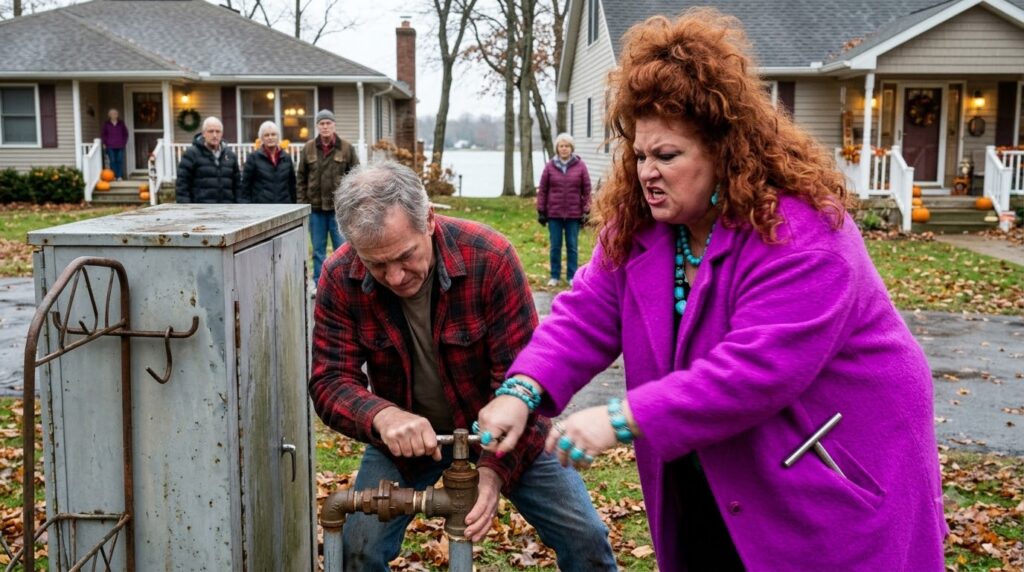
Daniel thought about the handle she had pulled off the valve.
The incident no longer seemed like a spontaneous outburst.
Karen had known where the equipment was.
She had known how to remove the loosened handle.
And she had known that taking it away would prevent an ordinary homeowner from restoring service.
Walter suggested that they contact the cooperative’s current trustees and the utility contractor immediately.
Daniel agreed.
Before leaving, he asked Walter why he had never taken the dispute further.
The older man looked toward the lake.
“Because I thought somebody else would eventually stand up to her.”
His voice carried more regret than anger.
Daniel understood the feeling.
For years, residents had endured Karen’s behavior because challenging her seemed exhausting.
They had tolerated unreasonable fines, humiliating public lectures, and rules that changed depending on whom she disliked.
Each person had assumed the problem belonged to someone else.
Thanksgiving had changed that.
Twelve households had lost water because one woman wanted to prove a point.
Daniel drove home with copies of the cooperative documents.
As he pulled into his driveway, he noticed a fresh envelope wedged between the storm door and the frame.
It was another HOA notice.
This one announced an emergency disciplinary hearing.
The scheduled date was Monday.
The stated purpose was to consider suspending Daniel’s community privileges and imposing additional penalties for his alleged interference with association property.
At the bottom, Karen had added a handwritten sentence.
Failure to appear will be treated as acceptance of the charges.
Daniel stood on his porch for a long moment.
Then he took out his phone and called Rebecca.
He was no longer wondering whether he should challenge Karen.
He was wondering how many other people she had treated this way.