Chapter 9: A Festival Worth Remembering
The following October, Willow Creek held its annual fall festival again.
The weather was beautiful.
Golden sunlight filtered through the trees.
Pumpkins lined the clubhouse steps.
Children ran between hay bales while volunteers arranged pies beneath a white canopy.
A local bluegrass group played near the picnic tables.
And at the entrance stood a freshly painted wooden sign.
WELCOME TO THE WILLOW CREEK FALL FESTIVAL.
FREE FOR ALL RESIDENTS.
This time, the words were not merely decoration.
They reflected a promise the community intended to keep.
Daniel arrived with Sarah and Lily just after noon.
Their daughter was now twenty-two months old.
She had learned to walk, developed a fierce preference for strawberries, and discovered that fallen leaves made a wonderful crunching sound beneath her shoes.
Her stroller was still in use, though Lily now preferred walking whenever possible.
Sarah pushed it along the paved walkway while Daniel held their daughter’s hand.
They stopped beside the pumpkin display.
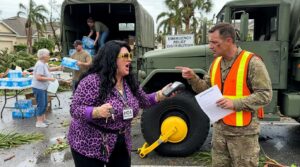
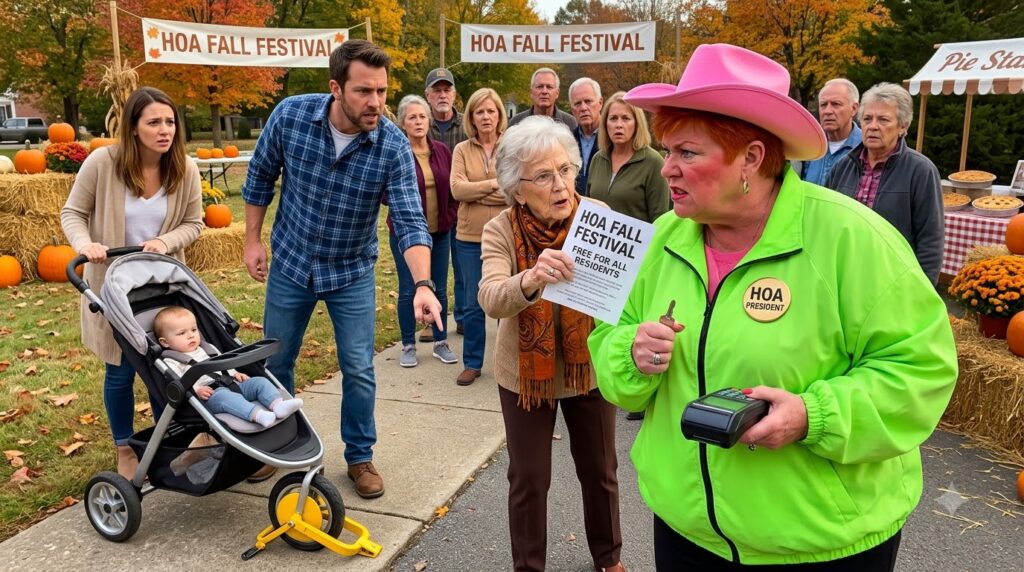
It was the exact place where Brenda had locked the wheel the year before.
Daniel looked down at the stroller.
For a moment, he could almost hear the metallic click.
He remembered Sarah’s worried expression.
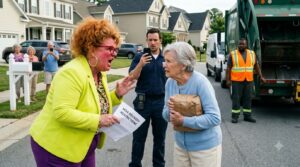
Margaret holding the flyer.
The crowd gathering.
And Brenda’s clenched fist around the key.
Then Lily tugged his hand.
“Daddy! Pumpkin!”
Daniel smiled.
The memory loosened its grip.
He lifted Lily onto a hay bale beside a pumpkin nearly as big as she was.
Sarah took a photograph.
Lily laughed.
Across the festival grounds, Margaret Collins was supervising the pie contest.
She had appointed herself unofficial guardian of the apple pie category, a responsibility she took very seriously.
Thomas Reed sat beneath a canopy, enjoying coffee with two old friends.
Evelyn Parker had contributed three trays of oatmeal cookies.
Harold Bennett moved between the volunteers, making sure everyone had what they needed.
The festival was not extravagant.
There were no expensive attractions.
No elaborate decorations.
No professional event planners.
But people seemed comfortable.
And that was worth more than anyone had expected.
Around two o’clock, Harold approached the Millers.
He had an envelope in his hand.
Inside was a copy of the association’s annual financial summary.
The board had completed its review of the documented disputed charges and published the final accounting of the HOA’s corrective actions.
Refunds and adjustments had been issued where supported.
The remaining questions involving Brenda’s private company had been handled through a settlement and the applicable review processes.
The settlement required repayment of specified disputed amounts and included no admission of criminal wrongdoing. The authorities’ review had not resulted in criminal charges.
Harold explained that the board considered the association’s financial recovery process complete.
The community had also adopted permanent safeguards to reduce the risk of similar problems.
Two authorized people now reviewed outgoing payments.
Residents could inspect approved budgets and meeting minutes through a secure homeowner portal.
Enforcement decisions required written documentation.
Appeals were heard by people who had not made the original decision.
And the president no longer controlled association finances or penalties alone.
Daniel read the summary.
Then he returned it to the envelope.
“Looks like you’ve been busy.”
Harold smiled.
“More paperwork than fishing.”
They laughed.
Nearby, Margaret called for everyone to gather around the pie table.
The contest was about to begin.
Sarah took Lily’s hand.
Daniel followed them through the crowd.
As they passed the entrance, he noticed a small brass plaque mounted beneath the festival sign.
He hadn’t seen it before.
The inscription read:
OUR COMMUNITY BELONGS TO ALL OF US.
RESPECT IS EVERY NEIGHBOR’S RIGHT.
Daniel stood quietly for a moment.
Then Margaret approached.
“Harold insisted on the plaque,” she said.
Daniel smiled.
“It’s a good message.”
Margaret looked toward the children playing in the grass.
“Your little girl helped remind us of it.”
Daniel shook his head gently.
“She didn’t do anything.”
Margaret’s expression softened.
“She didn’t have to.”
Daniel understood.
Sometimes the most important question wasn’t whether someone had broken a complicated rule.
It was whether the people entrusted with enforcing rules had remembered whom those rules were supposed to serve.
He looked at Lily.
She was laughing as Sarah helped her choose a tiny pumpkin.
He thought about how close he had come to paying the hundred dollars simply to avoid a scene.
It would have been easy.
He could have handed Brenda his card, unlocked the stroller, and gone home.
Perhaps nobody would have blamed him.
But the next family might have paid too.
And the next.
And Evelyn might still have believed she owed six hundred dollars.
Thomas might still have felt ashamed of the ramp that allowed him to enter his own home.
Margaret might still have kept her husband’s flag folded inside a drawer.
Daniel hadn’t fixed everything by himself.
He knew that.
Margaret had spoken up.
Harold had preserved his receipts.
Robert had admitted his mistakes.
Linda had followed the evidence.
The board had changed its procedures.
And ordinary neighbors had found the courage to tell the truth.
That was how the community had changed.
Not because one person became more powerful.
Because power was finally shared and held accountable.
Later that afternoon, Lily fell asleep in her stroller after eating half a cookie and enthusiastically inspecting six pumpkins.
Sarah covered her with the same pink blanket she had used the previous year.
Daniel checked the wheels out of habit.
They turned freely.
He smiled at the simple, ordinary sight.
No yellow clamp.
No payment terminal.
No angry voice demanding money.
Just a sleeping child, a beautiful autumn afternoon, and neighbors enjoying a festival that belonged to all of them.
As the sun began to set, Daniel and Sarah headed home.
The sound of laughter followed them down the walkway.
At the entrance, the wooden sign swayed gently in the breeze.
FREE FOR ALL RESIDENTS.
This time, everyone knew exactly what those words meant.
And nobody needed a key to prove it.
THE END