Chapter 3: The Receipt That Changed Everything
Officer James Carter arrived at 2:17 that afternoon.
He was forty-three, broad-shouldered, and calm in the practiced way of someone who had spent years responding to disputes that should never have required police involvement.
Daniel explained what had happened.
He showed the photographs and the video.
Sarah confirmed that the stroller had remained stationary and that Lily had been safely secured throughout.
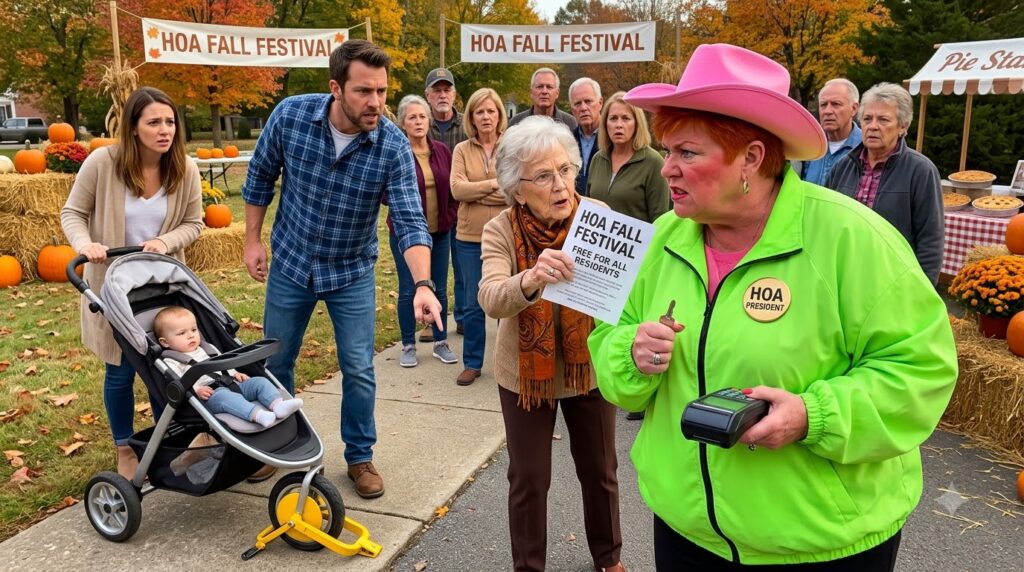
Margaret presented the official festival flyer.
Brenda immediately attempted to take charge of the conversation.
She introduced herself as the HOA president, displayed her badge, and announced that she was enforcing association regulations.
Officer Carter listened without interrupting.
Then he asked to see the written rule authorizing the clamp.
Brenda searched through her purse.
She produced a laminated sheet titled COMMUNITY EVENT ENFORCEMENT POLICY.
The document listed several penalties, including a one-hundred-dollar access fee and a two-hundred-fifty-dollar charge for unauthorized equipment.
Officer Carter examined it.
“Who approved this?”
“The board.”
“When?”
Brenda’s expression tightened.
“At a meeting.”
“Which meeting?”
She hesitated.
Margaret stepped forward.
“I’ve attended every open board meeting this year. I’ve never seen that document.”
Brenda glared at her.
Officer Carter handed the paper back.
“Ma’am, whatever authority the association may have under its governing documents, you need to remove this device from the family’s stroller.”
Brenda started to object.
He remained firm.
The conversation lasted another minute.
Finally, with the crowd watching, Brenda took the key from her pocket.
She crouched beside the stroller, unlocked the yellow clamp, and removed it.
Daniel inspected the wheel.
There was a shallow scratch on the metal housing, but the stroller appeared otherwise undamaged.
He carefully tested the wheel while the stroller remained parked.
It turned freely.
Sarah exhaled.
For the first time in nearly an hour, she smiled.
Lily reached toward her mother’s face, and Sarah kissed her tiny fingers.
Officer Carter documented the incident and gave Daniel an incident number. He explained that questions about criminal conduct, unauthorized fees, and potential financial wrongdoing would require additional review.
He did not pretend to settle the entire HOA dispute on the spot.
But he made one thing clear.
Brenda could not simply declare herself entitled to interfere with a family’s belongings.
As the officer prepared to leave, Harold approached Daniel.
“I think you should see this.”
He held out a printed credit card statement.
Harold had gone home briefly to retrieve it.
The statement showed a two-hundred-dollar payment to Whitmore Community Services.
Beneath it was another charge from the previous year.
Fifty dollars.
Same merchant.
Harold had forgotten about it.
That charge had been for a holiday decoration permit.
Daniel photographed both entries.
Then he asked Margaret whether she had receipts from her own payments.
She did.
So did three other residents who had overheard the conversation.
By late afternoon, Daniel had copies of seven transactions.
The charges were for different reasons.
Parking permits.
Pool access.
Holiday decorations.
Landscaping inspections.
But every receipt showed the same merchant name.
Whitmore Community Services.
That evening, Daniel sat at his kitchen table while Sarah fed Lily mashed sweet potatoes.
The house smelled of cinnamon and the pumpkin bread Sarah had purchased at the festival.
Ordinarily, it would have been a peaceful family evening.
Instead, Daniel was studying HOA documents on his laptop.
He found the association’s bylaws in a folder from their home purchase.
The governing documents gave the board authority to adopt reasonable rules, subject to proper procedures and applicable law.
They did not give the president unlimited personal power.
They also required association funds to be handled through approved financial accounts.
Daniel opened the most recent financial statement distributed to homeowners.
He searched for festival access fees.
Nothing.
Pool guest assessments.
Nothing.
Special equipment enforcement charges.
Nothing.
He looked at the seven receipts again.
Then he noticed something else.
The transaction dates stretched back nearly eighteen months.
Brenda’s behavior at the festival hadn’t been a sudden outburst.
It appeared to be part of a pattern.
Sarah brought Lily into the room, now dressed in her pajamas.
Daniel closed his laptop.
He didn’t want their daughter’s bedtime overshadowed by the day’s ugliness.
They read her favorite picture book, tucked her into her crib, and watched until her eyes closed.
Only then did Daniel return to the kitchen.
Sarah sat beside him.
“What are you thinking?”
He looked at the receipts.
“I’m thinking somebody needs to find out how many people have been paying her.”
Sarah rested her hand over his.
“Then we do it carefully.”
Daniel nodded.
He wasn’t interested in revenge.
He wanted answers.
And if Brenda had taken advantage of neighbors who trusted the HOA’s authority, those people deserved their money back.
Before going to bed, Daniel sent a short email to the board’s official address.
He requested copies of the association’s approved fee schedule, financial reports, and meeting minutes.
He also asked for a formal review of the stroller incident.
At 11:43 p.m., his phone vibrated.
A reply had arrived.
It came directly from Brenda Whitmore.
The subject line read:
NOTICE OF DISCIPLINARY ACTION.
Daniel opened it.
His family had been assessed a five-hundred-dollar fine for “harassment of an HOA official and interference with authorized community enforcement.”
He stared at the screen.
Then he saved the email.
Brenda had just given him another piece of evidence.