Chapter 5: The Widow on Maple Lane
Evelyn Parker lived in a modest brick house at the end of Maple Lane.
She was eighty-one, with silver hair, gentle blue eyes, and hands that still carried the faint stains of gardening.
Her husband, George, had died nine years earlier.
They had purchased the house when Willow Creek was little more than a handful of streets surrounded by farmland.
Evelyn had no intention of leaving.
Her roses grew along the front fence.
A wooden swing hung from the porch.
Inside, photographs of children and grandchildren covered nearly every available shelf.
When Daniel and Margaret visited, Evelyn welcomed them with iced tea and homemade oatmeal cookies.
At first, she was reluctant to discuss Brenda.
She seemed embarrassed.
Finally, she retrieved a yellow envelope from a kitchen drawer.
Inside was a printed warning bearing the HOA logo.
It claimed Evelyn had accumulated landscaping penalties and administrative charges totaling six hundred dollars.
The letter demanded immediate payment and warned of possible collection action.
Evelyn had received it three days before Christmas.
She had been preparing to visit her daughter in Kentucky.
The thought of legal trouble frightened her.
“I didn’t understand all the language,” she admitted. “I just knew it sounded serious.”
She had called Brenda.
According to Evelyn, Brenda offered to resolve the matter immediately if Evelyn paid by card.
Evelyn had done so.
Daniel examined the receipt.
Whitmore Community Services.
Again.
He looked at the original notice.
There was no itemized history of violations.
No record of prior hearings.
No explanation of how the amount had been calculated.
Most troubling, the notice suggested serious collection consequences without identifying the procedures that would have to be followed.
Daniel was careful not to offer legal conclusions.
But he knew enough to recognize that Evelyn deserved a proper review.
“Did you ever receive a confirmation from the HOA?” he asked.
Evelyn shook her head.
“Brenda said it was settled.”
Margaret gently asked whether she would be willing to share copies of the documents with the board’s independent reviewer.
Evelyn looked uncertain.
“Will Brenda know?”
Daniel answered carefully.
“The board may need to examine the transaction. We won’t promise something we can’t control. But we can ask that your personal information be handled respectfully.”
Evelyn studied him.
Then she nodded.
“I don’t want trouble. I just want to know if I really owed that money.”
On the drive home, Margaret was unusually quiet.
Finally, she said, “George Parker helped build the first community playground.”
Daniel glanced at her.
“He did?”
“He donated the lumber. Worked every Saturday for two months.”
She looked out the window.
“That family gave so much to this neighborhood.”
Daniel thought of Evelyn sitting alone at her kitchen table, frightened by a letter that arrived just before Christmas.
The incident felt different from the festival confrontation.
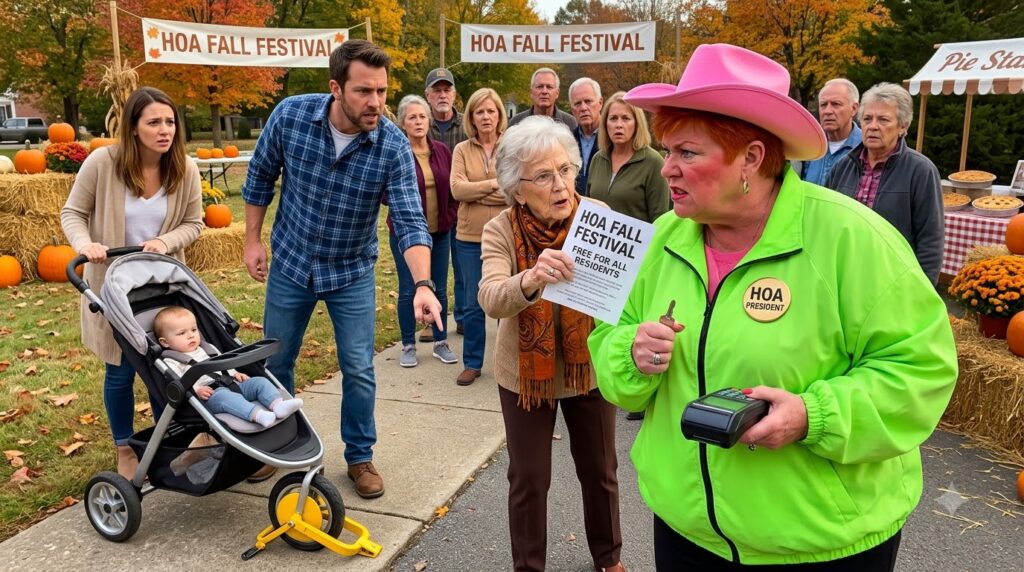
Brenda’s behavior toward the Millers had been public, loud, and humiliating.
What happened to Evelyn had been private.
And privacy, Daniel realized, could make intimidation much harder to recognize.
That evening, Robert Hayes called.
The emergency board meeting had taken place.
Brenda denied wrongdoing.
She claimed Whitmore Community Services was a legitimate administrative contractor used for special assessments.
But she had not provided a contract.
Nor had she produced board minutes approving the arrangement.
The other directors voted to suspend her authority to issue new fees or enforcement notices while the matter was reviewed.
They also authorized an independent accountant to examine the relevant records.
Brenda had opposed the vote.
Then she walked out.
Robert sounded exhausted.
“We should have asked more questions,” he admitted.
Daniel didn’t disagree.
But he also knew that regret wouldn’t help the residents recover their money.
“What happens next?”
“The accountant starts Monday.”
Robert paused.
“And there’s something else. Brenda has the only complete copy of several enforcement files.”
Daniel frowned.
“Why?”
“She moved them out of the clubhouse office last year. Said she needed to organize them.”
“Where are they?”
“Apparently, at her house.”
Daniel looked toward the stack of documents on his table.
Brenda had been collecting money, issuing penalties, and keeping important records under her personal control.
Now the board had finally begun asking questions.
But nobody knew whether she would cooperate.