Chapter 8: The Cost of Authority
The weeks after the meeting were not simple.
There was no dramatic moment when every problem disappeared.
The association still had bills to pay.
Landscaping contracts still needed supervision.
The clubhouse roof needed repairs.
And the financial investigation continued.
But the board began making changes.
The management company was instructed to handle all association payments through approved accounts.
Residents received a written fee schedule.
Every enforcement notice had to identify the relevant rule, explain the appeal process, and provide official contact information.
No individual board member could impose new fees without proper authorization.
The board also established a process for reviewing disputed past charges.
These changes sounded ordinary.
That was precisely the point.
A functioning neighborhood association was supposed to be ordinary.
It was supposed to maintain shared property, resolve legitimate concerns, and help residents live together peacefully.
It was not supposed to make people afraid.
In January, the special election took place.
Under the association’s governing procedures, homeowners voted to replace Brenda on the board.
Margaret Collins declined suggestions that she become president.
At seventy-four, she had no desire to spend her retirement supervising contractors and reviewing landscaping proposals.
But she agreed to serve on a temporary homeowner advisory committee.
Robert remained treasurer while new directors were appointed to the appropriate positions.
The new board selected Harold Bennett as president.
Harold accepted reluctantly.
He had spent thirty-eight years as a school principal and had hoped his retirement would involve fishing, gardening, and visits from his grandchildren.
But he understood something important.
Leadership was not the same as control.
He promised to serve one term and help establish a more transparent system.
Meanwhile, the investigation into Whitmore Community Services moved beyond the HOA.
The association provided its documented findings to the appropriate authorities, who reviewed whether any laws had been violated.
Brenda’s attorney continued to dispute portions of the allegations.
The matter would take time.
Daniel learned that accountability rarely followed the neat schedule people expected.
There were records to verify, explanations to consider, and legal procedures to respect.
But the association did not need to wait for every outside question to be resolved before correcting its own mistakes.
The board formally canceled the five-hundred-dollar fine issued against the Millers.
It also confirmed that the one-hundred-dollar festival access charge had never been approved.
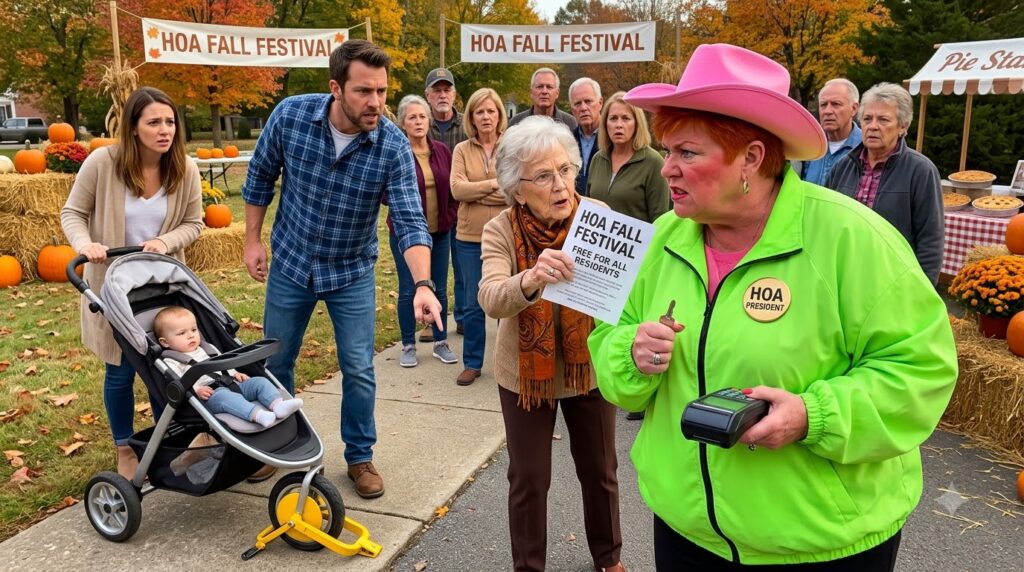
A stroller repair shop inspected Lily’s stroller.
The yellow clamp had left a small scratch and damaged part of the wheel housing.
The association reimbursed the documented repair cost while reserving its rights concerning responsibility for the expense.
Daniel accepted the reimbursement.
He had never wanted a windfall.
He wanted his family’s property respected.
For Evelyn Parker, the resolution took longer.
Her six-hundred-dollar payment was among the transactions reviewed by the accountant.
The association confirmed that no valid HOA balance supported the demand described in her notice.
Through a negotiated repayment arrangement connected to the broader financial dispute, Evelyn received her six hundred dollars back.
When the check arrived, she sat at her kitchen table and cried.
Not because she desperately needed the money.
Though it certainly helped.
She cried because someone had finally listened.
Thomas Reed’s wheelchair ramp violation was also withdrawn after a proper review.
Margaret’s flag-related fine was canceled and refunded.
Other residents received corrections or refunds where the records supported them.
The association published a summary of the process without exposing unnecessary personal information.
For the first time in years, neighbors could see how decisions were being made.
One afternoon in February, Daniel saw Brenda outside the grocery store.
She was loading bags into the trunk of her car.
Her copper-red hair had grown longer.
She wore a plain gray sweater.
Without the neon jacket, cowboy hat, and enormous badge, she looked like an ordinary woman approaching sixty.
For a moment, Daniel considered walking past.
But Brenda noticed him.
Their eyes met.
She looked away first.
Then she spoke quietly.
“I never meant for all this to happen.”
Daniel stopped.
He wasn’t sure what she expected him to say.
Perhaps she wanted sympathy.
Perhaps she wanted to explain.
Perhaps she simply wanted the uncomfortable moment to end.
Daniel thought of Evelyn.
Thomas.
Margaret.
And Lily asleep in her stroller beneath the autumn leaves.
“Whatever you intended,” he said, “people were hurt.”
Brenda looked down at her grocery bags.
She didn’t argue.
Daniel wished her a good afternoon and walked away.
He felt no triumph.
Only relief that he no longer had to persuade her to respect a boundary.
The neighborhood had finally established one.