Chapter 6: The Records Behind the Locked Door
The independent accountant, Linda Foster, arrived at the Willow Creek clubhouse on a cold Monday morning.
She was sixty-two, with thirty-five years of experience examining nonprofit and small-organization finances.
Linda had no interest in neighborhood gossip.
She wanted records.
Bank statements.
Invoices.
Board resolutions.
Contracts.
Payment histories.
And documentation supporting every disputed charge.
Robert provided everything in the association’s official files.
The management company supplied additional records.
The residents contributed copies of their receipts and notices.
Brenda provided very little.
Through an attorney, she claimed that Whitmore Community Services had performed legitimate administrative work for the association.
She also maintained that some documents contained private homeowner information and should not be distributed without safeguards.
Linda agreed that privacy mattered.
But privacy did not eliminate the need for an authorized review.
The board’s attorney arranged a controlled process for obtaining relevant records, with access limited to those who needed them.
The dispute continued for several weeks.
During that time, Willow Creek began to change.
Without Brenda issuing new warnings, residents noticed how quiet the neighborhood felt.
Children rode bicycles past the clubhouse without being questioned about sidewalk rules.
Families decorated their porches for Thanksgiving.
Thomas Reed’s daughter helped him repaint his wheelchair ramp.
Margaret raised her American flag each morning.
Nobody sent her a violation notice.
But the calm was fragile.
Brenda still lived in the neighborhood.
She attended social gatherings and told anyone willing to listen that the investigation was a personal attack.
Some residents believed her.
They remembered years when she had organized landscaping projects, negotiated with contractors, and volunteered during storms.
They argued that Brenda could be abrasive without being dishonest.
Daniel understood that distinction.
He didn’t want the community to punish someone merely for being unpleasant.
He wanted the evidence examined fairly.
That was why he refused to participate when an angry resident suggested posting Brenda’s home address and personal telephone number on a neighborhood social media page.
“That’s not what we’re trying to do,” Daniel said.
“We want accountability, not harassment.”
Margaret agreed.
The investigation had to be better than the behavior it was examining.
In early December, Linda presented her preliminary findings to the board in a closed session with legal counsel.
The results were troubling.
Over a twenty-month period, residents had documented more than twelve thousand dollars in payments to Whitmore Community Services associated with HOA-related demands.
Some transactions were small.
Twenty-five dollars for decoration reviews.
Fifty dollars for parking permits.
Others were much larger.
Several hundred dollars for alleged violations or emergency administrative charges.
Linda found no approved contract authorizing Brenda’s company to collect those payments on behalf of the association.
Nor did the official HOA records contain corresponding revenue entries for many of the charges.
The accountant was careful.
She did not claim that every dollar represented theft.
Some payments might have involved services or transactions requiring further examination.
But the lack of documentation, authorization, and proper accounting was serious.
The board’s attorney advised preserving the evidence and referring the financial concerns to appropriate authorities for independent assessment.
Meanwhile, the directors began preparing a homeowner meeting.
They would present the verified findings, explain the limits of what was known, and propose corrective measures.
Brenda would be given an opportunity to respond through the proper process.
Daniel received a call from Robert that evening.
“The board has another problem,” Robert said.
“What kind?”
“The management company found a second version of the enforcement policy.”
Daniel sat upright.
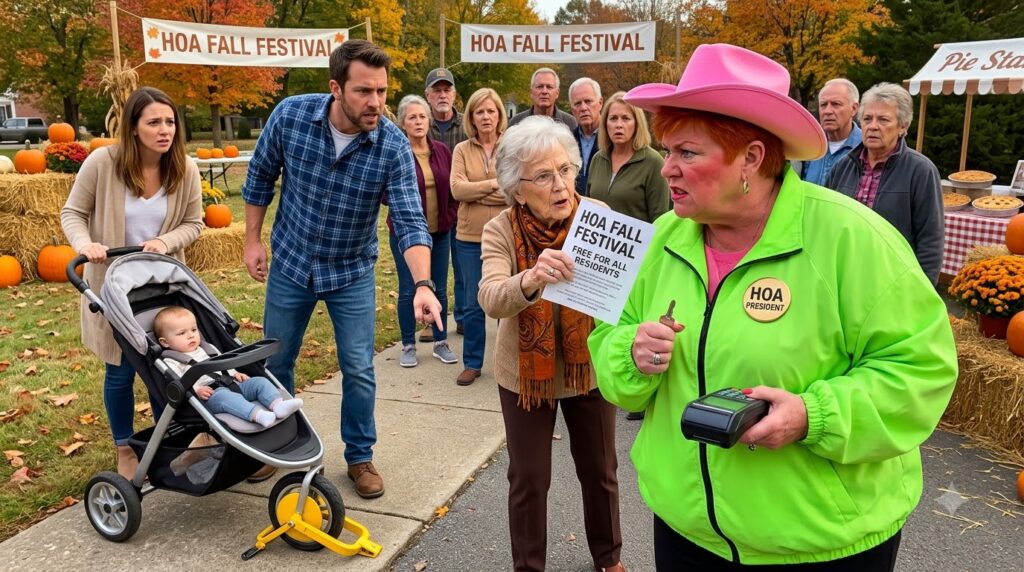
The version Brenda had shown Officer Carter at the festival contained the one-hundred-dollar event access fee.
But the version stored in the association’s official records contained no such provision.
Both documents carried the same effective date.
Both displayed the HOA logo.
Only one had ever been approved.
Robert explained that the board was examining how the altered version had been created and distributed.
Daniel remembered the confidence with which Brenda had presented the laminated sheet.
She hadn’t behaved like someone improvising a demand.
She had behaved like someone who expected a document with an official-looking title to end every argument.
Now the board had evidence that the paperwork itself might be part of the problem.
And the upcoming homeowner meeting would force the entire neighborhood to confront what had happened.