Chapter 6: The Night Willow Creek Took Back Its Voice
The special meeting took place on a warm Thursday evening.
By seven o’clock, the clubhouse was nearly full.
Residents who rarely attended association meetings had made arrangements to be there.
Some arrived with walkers. Others brought folding cushions for the uncomfortable chairs.
Several homeowners submitted authorized proxies because medical appointments or family responsibilities prevented them from attending.
The board had consulted its attorney to ensure the meeting and removal vote followed the association’s governing documents and applicable requirements.
Karen arrived wearing a carefully styled blonde wig, a dark blue dress, and understated jewelry.
Gone were the bright colors and theatrical confidence that had marked the cupcake confrontation.
She carried a folder containing a prepared statement.
Charles opened the meeting by summarizing the independent financial review.
He explained which discrepancies had been resolved and which remained unsupported.
He described the unauthorized permit charges, inadequate documentation, and improper use of association equipment.
The report did not speculate about Karen’s motives.
It documented what could be established.
Karen was given an opportunity to respond.
She spoke for nearly fifteen minutes.
She reminded residents of her years of volunteer work. She described the pressure of managing complaints and claimed that her administrative responsibilities had become overwhelming.
Some of what she said was probably true.
Serving on a homeowners association board could be demanding.
Volunteers often dealt with complicated maintenance problems, disagreements, and financial decisions.
But difficult responsibilities did not excuse destroying personal property or collecting unauthorized fees.
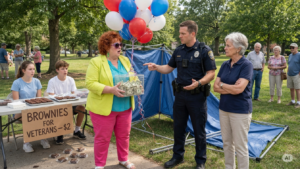
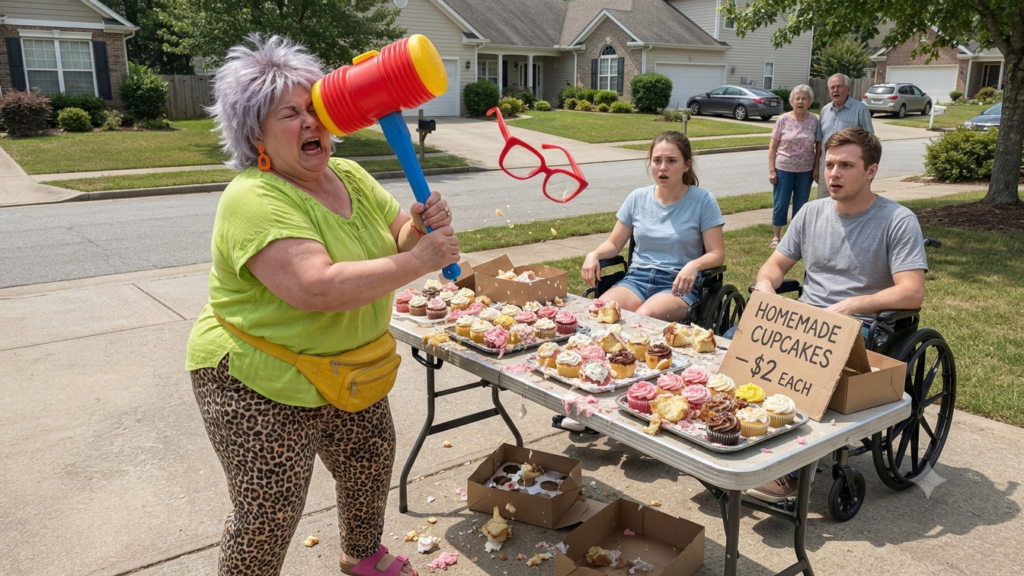
Karen eventually addressed the cupcake incident.
She described it as an unfortunate misunderstanding that had been exaggerated by social media.
Emily looked down at her hands.
Daniel shook his head.
Margaret stood and requested permission to speak.
She had prepared no statement.
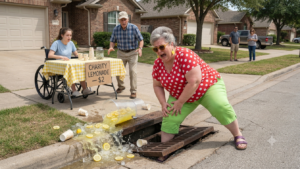
She simply described the Saturday morning when she had watched two young neighbors lose something they had worked hard to create.
She explained that she had initially laughed when Karen’s wig flew away.
But after seeing Emily’s face, she had stopped laughing.
What remained with her wasn’t the wig.
It was the cruelty.
Margaret then spoke about the other homeowners who had been afraid to question Karen.
She acknowledged her own silence and said she no longer wanted to live in a neighborhood where people feared the person elected to represent them.
Frank Miller spoke next.
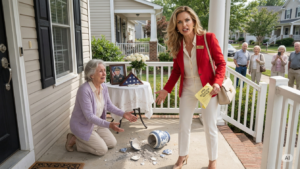
He brought a photograph of his late wife sitting on their wooden bench.
He explained that the bench had never been about decoration.
It was a connection to someone he had loved for fifty-three years.
When he finished, he returned quietly to his seat.
Karen looked away.
The meeting proceeded to the removal vote.
Ballots were distributed and collected according to the established procedure.
Independent volunteers counted them in view of designated observers.
The result was decisive.
Karen Whitmore was removed from the board.
There was no cheering.
Instead, a collective sense of relief settled over the room.
Several residents exchanged quiet smiles.
Others simply closed their folders.
Karen remained seated for a moment, staring at the table.
Then she collected her belongings and left.
Charles reminded everyone that removing one person was only part of the solution.
The association needed better safeguards to prevent similar problems in the future.
The board committed to publishing regular financial summaries, documenting expenditures, maintaining accessible complaint procedures, and reviewing enforcement practices.
Residents would receive clear information about their rights and responsibilities.
The board also established a process for identifying and refunding unauthorized permit payments.
As for the unresolved financial discrepancies, the association’s attorney continued pursuing a formal resolution.
The following morning, Susan received written confirmation that the $750 fine against her household had been withdrawn.
The board acknowledged that the enforcement process had not been followed and that Karen’s actions had not been authorized.
The association also issued a public apology to Emily and Daniel.
Several weeks later, Karen entered a written settlement resolving the association’s financial recovery claims.
Under its terms, she agreed to repay the unsupported amounts established through the final review, cover the cost of the damaged cupcake merchandise and supplies, and return all association property remaining in her possession.
The settlement did not require Emily or Daniel to forgive her.
It did require accountability.
Susan felt relieved when the reimbursement arrived.
She offered the money to Emily.
Emily accepted it, then placed it in the small business account she and Daniel had opened.
They had already decided what to do with it.
They would purchase equipment that made their baking operation more accessible and efficient.
The money would help build something instead of destroying something.
That Saturday, Frank Miller carried his wife’s wooden bench out of the garage.
Robert helped him position it on the front porch.
Margaret brought a cushion.
Frank sat down, looked across the street, and remained there for nearly an hour.
For the first time in a long while, Willow Creek felt like his home again.