Chapter 2: A Fine for Fighting Back
On Monday morning, Susan found a white envelope taped to her front door.
The letter inside carried the official Willow Creek HOA letterhead and Karen Whitmore’s signature.
It accused the Parker household of operating an unauthorized commercial enterprise, creating neighborhood litter, obstructing community harmony, and behaving disrespectfully toward an association officer.
The proposed fine was $750.
Susan read the letter twice.
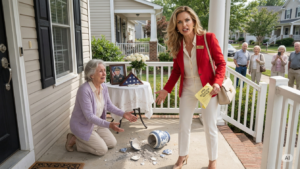
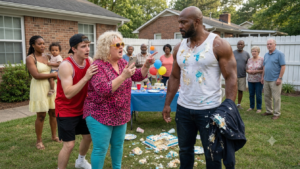
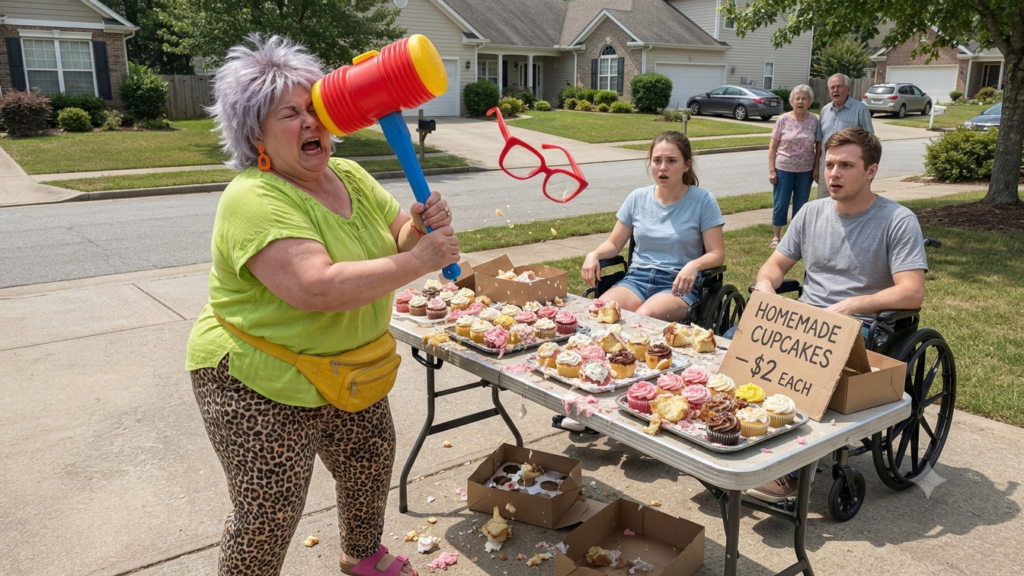
Karen had destroyed the cupcakes, scattered the litter, and caused the confrontation. Yet she was attempting to punish the people whose property she had damaged.
The notice also threatened additional penalties if payment was not received within ten days.
Susan placed the letter on the kitchen table.
Emily looked at it and immediately offered to pay.
She had saved a little money from occasional freelance design work. She didn’t want her mother facing financial problems because of the cupcake stand.
Susan refused.
Her daughter had already spent too many years apologizing for circumstances beyond her control. She wasn’t going to let her apologize for trying to earn an honest living.
That afternoon, Daniel arrived with his father, Robert Brooks, a retired electrical technician.
Robert examined the notice carefully.
He had served on a neighborhood association board in another community years earlier. He knew that presidents generally could not invent penalties whenever they became angry.
He suggested requesting the exact rules Emily and Daniel had supposedly violated, along with the records showing that the board had authorized the fine.
Susan submitted the request in writing.
Karen responded within an hour.
She claimed that her authority as president allowed her to take immediate action against activities that threatened property values.
She provided no specific rule.
Robert downloaded the association’s governing documents from its website and spent the evening reviewing them.
There were restrictions on permanent commercial operations, excessive traffic, and business-related disturbances.
There was nothing specifically prohibiting an occasional driveway bake sale.
More importantly, there was a procedure for imposing fines, including notice and an opportunity for a hearing.
Nothing in the documents authorized an association president to destroy a resident’s belongings.
Robert printed the relevant sections and placed them in a folder.
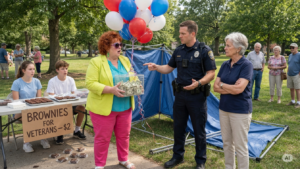
Meanwhile, Margaret had shared the video with several neighbors.
By Tuesday evening, it had traveled well beyond Willow Creek.
Former residents contacted Margaret. Friends forwarded the recording to relatives. A local community Facebook group began discussing the incident.
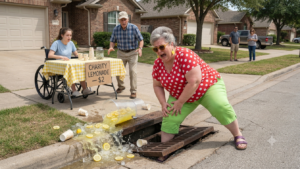
Most people initially focused on Karen’s flying wig and scattered money.
But the comments gradually changed.
People began noticing Emily’s expression after the cupcakes fell. They noticed Daniel sitting quietly beside her. They asked why two young adults trying to build a business had been treated so cruelly.
Emily found the attention uncomfortable.
She didn’t want strangers feeling sorry for her.
She certainly didn’t want to become known simply as the young woman in a wheelchair whose cupcakes had been destroyed.
She wanted customers.
Daniel understood.
He suggested they prepare another batch of cupcakes, even if they had to give them away.
Emily wasn’t ready.
Every time she looked at the folding table in the garage, she remembered Karen’s voice and the sound of the vacuum.
The experience had awakened an old fear.
After her accident, she had spent months learning to perform ordinary tasks differently. People frequently offered help before asking whether she needed it. Some spoke to her mother instead of addressing her directly.
Starting the cupcake business had been a way of reclaiming control.
Karen had made her feel powerless again.
On Wednesday, Margaret invited Susan and Robert to her house.
She had something she wanted them to see.
Spread across Margaret’s dining room table were several envelopes, handwritten receipts, and printed emails.
Over the previous three years, Karen had collected money from residents for activities she claimed required special HOA approval.
Margaret had paid $50 to host a small retirement gathering in her backyard.
A widow down the street had paid $100 to hold an estate sale.
Another homeowner had paid $75 for a family reunion.
There were charges for driveway sales, holiday decorations, temporary signs, and even a neighborhood book exchange.
Most residents had paid because the amounts seemed too small to justify a fight.
Karen had often requested cash.
Margaret admitted that she had been embarrassed to question the charges.
At seventy-one, she lived on a fixed income. She worried about receiving additional fines or being dragged into a legal dispute.
Susan looked at the receipts.
They resembled the one found among Karen’s scattered dollar bills.
Robert asked whether the payments appeared on the association’s financial statements.
Margaret didn’t know.
Nobody had received a detailed financial statement in nearly two years.
Karen usually presented a brief summary at the annual meeting and discouraged questions by claiming that financial matters were too complicated for ordinary residents.
Robert leaned back in his chair.
The cupcake incident was no longer simply a disagreement about neighborhood rules.
There was now a legitimate question about where residents’ money had been going.
Before leaving Margaret’s house, Susan made copies of every receipt.
That evening, she submitted a formal request for association financial records.
She also asked for documentation of every community event permit issued during Karen’s presidency.
The next morning, the association’s website was suddenly unavailable.
By lunchtime, residents had received an email announcing that all requests for financial information were temporarily suspended.
Karen blamed a computer problem.
Robert had worked with enough complicated electrical systems to recognize the difference between a malfunction and somebody deliberately turning off a switch.
He suspected Willow Creek had just experienced the second kind.