Chapter 3: The Neighbors Who Had Stayed Silent
For years, Willow Creek had looked like the kind of neighborhood people dreamed about retiring in.
The lawns were neatly maintained. American flags hung from front porches. Neighbors waved during evening walks, and children visited their grandparents during summer vacations.
Behind that peaceful appearance, however, many residents had learned to avoid Karen Whitmore.
She had become HOA president five years earlier, promising to protect property values and improve community standards.
Initially, her enthusiasm had seemed helpful.
She organized landscaping projects, arranged neighborhood cleanups, and persuaded the board to repair the entrance sign.
Over time, her enthusiasm became something different.
She began photographing trash cans that remained outside too long. She criticized porch furniture, flower arrangements, and parked vehicles.
She sent warnings at unusual hours and frequently threatened fines before checking the governing documents.
Most homeowners responded by keeping their heads down.
They were busy raising families, managing medical appointments, caring for spouses, or enjoying retirement.
Nobody wanted another problem.
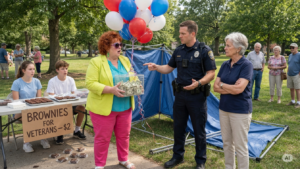
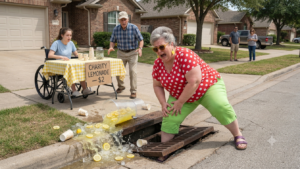
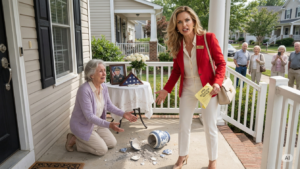
The video of the cupcake stand changed that.
On Friday afternoon, Margaret hosted an informal gathering in her living room.
She expected perhaps six people.
Twenty-three arrived.
Among them was seventy-eight-year-old Frank Miller, a retired Army mechanic who walked with a cane.
Frank brought a folder containing photographs of his front porch.
Karen had ordered him to remove a sturdy wooden bench because its appearance supposedly violated community standards.
The bench had belonged to his late wife.
It was where she had enjoyed her morning coffee during the final years of her life.
Frank had moved it into his garage after receiving repeated warnings.
He hadn’t sat on it since.
Another resident, sixty-seven-year-old Linda Foster, described being charged for allowing her visiting daughter to park overnight in the driveway.
A retired schoolteacher named Patricia explained that Karen had demanded a cash payment before permitting her to organize a small charity book sale.
One by one, neighbors produced documents.
Susan listened as people described years of anxiety over things that should never have caused them fear.
What struck her most was how often they blamed themselves.
They wondered whether they should have read the rules more carefully or handled the situations differently.
Karen had convinced them that questioning her authority was the same as being a bad neighbor.
Robert collected copies of the documents and organized them by date.
Among the attendees was Helen Dawson, the association’s former treasurer.
Helen had resigned eighteen months earlier, officially because of family commitments.
She had never publicly explained the circumstances surrounding her departure.
When Robert mentioned the cash permits, Helen became visibly uncomfortable.
She asked to speak with him and Susan privately.
After the gathering ended, the three sat at Margaret’s kitchen table.
Helen explained that she had discovered several payments recorded in Karen’s handwritten notes that did not appear in the association’s bank deposits.
At first, she assumed Karen had simply forgotten to submit the money.
When she asked about the discrepancies, Karen insisted that the cash had been used for miscellaneous neighborhood expenses.
Helen requested receipts.
Karen became angry and accused her of undermining the board.
Over the following weeks, Helen found herself excluded from financial discussions. Karen persuaded other board members that Helen was difficult to work with.
Eventually, Helen resigned.
She regretted leaving without telling the homeowners what she had discovered.
But she had been caring for her husband during his cancer treatment, and she had lacked the energy for a prolonged fight.
Susan understood.
Sometimes people remained silent not because they approved of wrongdoing, but because life had already demanded everything they could give.
Helen opened her handbag.
Inside was a flash drive containing copies of financial records from her time as treasurer.
She had retained them because she was uncomfortable with the explanations Karen had provided.
Robert accepted the drive.
They agreed to have the documents reviewed by someone qualified before making accusations.
That evening, Susan contacted a local attorney who handled property and association disputes.
His name was Thomas Reed.
At sixty-four, Thomas had spent much of his career helping homeowners resolve disagreements without unnecessary litigation.
After reviewing the violation notice and the available governing documents, he advised Susan to preserve the video, photographs, receipts, and correspondence.
He also recommended documenting the actual financial loss from the cupcake incident.
The cost of ingredients and supplies amounted to $186. The damaged display materials added another $42.
It wasn’t a fortune.
But the principle mattered.
Thomas explained that the financial concerns should be investigated separately and carefully. Suspicious records were grounds for questions, not automatic proof of theft.
He wanted an independent review.
While the adults gathered evidence, Daniel visited Emily.
He brought a small cardboard box containing six cupcakes.
They weren’t particularly attractive. The frosting leaned sideways, and one had a cracked top.
He had baked them himself.
Emily laughed for the first time since the confrontation.
They spent the afternoon discussing recipes.
Before Daniel left, Emily retrieved their original business cards from a kitchen drawer.
Their dream still existed.
Karen had damaged their first attempt, but she hadn’t erased their abilities.
That night, Emily opened her laptop and began designing a new cupcake menu.
She had no idea where they would sell their next batch.
But she knew she wasn’t finished.