
Chapter 9: The Photograph Beside the Window
Six months after Patricia Whitcomb entered Daniel Mercer’s home, Desert Palms looked much the same as it always had.
The lawns were trimmed.
The palm trees swayed in the dry Arizona breeze.
Children rode bicycles along quiet streets.
Neighbors collected their mail, watered their gardens, and complained about the summer heat.
From the outside, nothing appeared particularly different.
But the atmosphere had changed.
Residents were more willing to attend meetings.
Board decisions were easier to review.
Homeowners who received violation notices were given clearer explanations and opportunities to respond.
The association still enforced its legitimate rules.
Trash cans still had to be stored properly.
Exterior renovations still required approval when the governing documents called for it.
The community pool still closed at its posted hour.
But residents no longer felt that every disagreement was a personal challenge to the president’s authority.
Linda Foster had remained in the leadership role after the board completed its regular selection process.
She approached the position differently.
She listened more than she spoke.
She documented decisions.
And when she did not know whether the association had authority to do something, she asked before acting.
Patricia remained a resident of Desert Palms.
She eventually left the board after her term ended.
Daniel occasionally saw her driving through the neighborhood or collecting mail.
They did not become friends.
There was no dramatic reconciliation.
Patricia never delivered the heartfelt apology Daniel had once hoped to hear.
But she stopped contacting him directly about association matters.
She stopped sending accusatory notices.
And she never entered his property again.
For Daniel, that was enough.
He had learned that closure did not always require the person who caused harm to become a better person.
Sometimes closure meant establishing a boundary and knowing it would be respected.
The most important change, however, happened inside his own home.
Sophie gradually stopped checking the front window whenever the doorbell rang.
She invited friends over again.
She returned to doing homework at the coffee table, surrounded by notebooks, colored pens, and half-finished snacks.
On weekends, she and Daniel resumed their tradition of making pancakes together.
Emily had started that tradition when Sophie was little.
She used to make the pancakes in uneven shapes and claim they represented different animals.
Daniel’s attempts were usually worse.
Sophie found that hilarious.
One Saturday morning, Daniel discovered an old recipe card tucked inside Emily’s favorite cookbook.
Across the top, in her handwriting, were the words:
Saturday Pancakes — Extra Chocolate Chips for Sophie.
Daniel held the card for a long moment.
Then he called Sophie into the kitchen.
They made the pancakes exactly as Emily had written.
The first batch burned slightly.
The second turned out better.
By the third, Sophie was laughing so hard that she nearly spilled the batter.
Later, they carried their plates into the living room.
The restored photograph stood beside the sofa, exactly where it belonged.
Its new frame was slightly darker than the original.
The glass no longer carried the fracture that had crossed Emily’s face.
Daniel had kept a small piece of the old wooden frame in a box with other family keepsakes.
Not because he wanted to remember Patricia’s behavior.
Because the broken frame had become part of their family’s history.
It reminded him of the day he had been forced to defend something that should never have needed defending.
His family’s memories.
His daughter’s sense of security.
The right to decide who entered his home.
Sophie noticed him looking at the photograph.
“Dad?”
“Yeah?”
“Can we go to Sedona again sometime?”
Daniel smiled.
They had avoided returning since Emily’s death.
The memories had felt too painful.
But perhaps enough time had passed.
“I think we can.”
“Maybe we could take another picture in the same place.”
Daniel looked at the photograph.
Emily stood beneath the red rocks, laughing in the bright sunshine.
Sophie had been so small then.
Her hair was tied in two uneven ponytails.
Daniel remembered the warmth of Emily’s hand against his back.
He knew they could never recreate that moment.
And they did not need to.
They could make a new memory beside the old one.
“That sounds like a good idea,” he said.
A month later, they returned to Sedona.
They visited the overlook where the original photograph had been taken.
The red cliffs rose against a cloudless blue sky.
The air smelled faintly of dust and juniper.
Sophie stood beside Daniel, taller now, with Emily’s eyes and the same crooked smile.
A passing tourist offered to take their picture.
Daniel handed over his phone.
He put his arm around Sophie.
She leaned against him.
For a moment, he felt the familiar ache of Emily’s absence.
But it was accompanied by something gentler.
Gratitude.
They had lost someone they loved.
They had endured years of grief.
They had faced an unnecessary invasion of their privacy and the exhausting struggle that followed.
Yet they were still standing together.
Still laughing.
Still building a life.
When they returned to Phoenix, Daniel printed the new photograph.
He placed it in a matching wooden frame.
Then he set it beside the restored picture of Emily.
Two photographs.
One from the past.
One from the present.
Neither replaced the other.
Both belonged.
That evening, Daniel stood in his living room as the last sunlight spread across the cream-colored rug.
The beige sectional sofa was exactly where it had always been.
The coffee table bore a few ordinary scratches.
The family photographs rested beside the window.
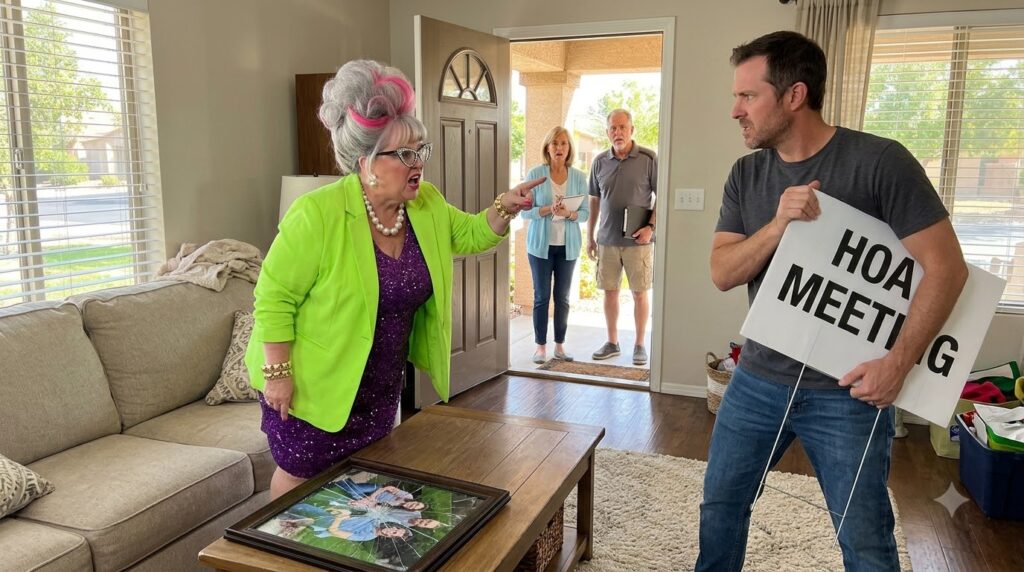
There was no HOA sign.
No angry president.
No stranger claiming authority over his family’s belongings.
Just a home.
A place where memories were protected, where grief could soften into love, and where a father and daughter could live without asking permission to cherish what mattered most.
Daniel turned off the living room lamp and headed toward the kitchen, where Sophie was already asking what they were having for dinner.
Before leaving, he glanced once more at the photographs.
He finally understood something that had taken him months to put into words.
A house could be measured in square feet, appraised in dollars, and governed by neighborhood restrictions.
But a home was something different.
It was built from the lives lived inside it.
From ordinary mornings, family traditions, shared laughter, and the memories of people who were no longer there.
No association president could claim ownership of those things.
No official-looking sign could replace them.
And no one, regardless of title or position, had the right to walk through another person’s door and decide that their memories did not matter.
Daniel smiled at Emily’s photograph.
Then he went to make dinner with his daughter.
For the first time in a long while, the house felt entirely peaceful.
And this time, the peace belonged to them.








