Chapter 4: The Neighbors Who Had Stayed Quiet
The first person Daniel contacted was Harold Bennett.
Harold was seventy-three, a retired electrician who lived three streets away with his wife, June.
They had been residents of Desert Palms for almost twenty years.
Daniel knew Harold casually.
He was the kind of neighbor who waved from his driveway, returned borrowed tools promptly, and always seemed to be repairing something.
When Daniel called, Harold listened without interruption.
Then he gave a weary sigh.
“Patricia did something similar to us.”
Daniel drove over the following afternoon.
Harold welcomed him into a neat living room filled with books, family photographs, and furniture that had clearly been chosen for comfort rather than fashion.
June brought iced tea.
Their story began two years earlier.
The HOA had organized a neighborhood holiday decoration contest.
Patricia had decided that Harold and June’s front yard would be an ideal location for the official judging display.
Without obtaining written permission, she arranged for volunteers to install decorative lighting and a large wooden sign near their walkway.
The volunteers had been told the Bennetts had agreed.
They had not.
When Harold objected, Patricia accused him of embarrassing the association.
She later issued a violation notice concerning the condition of his front landscaping.
Harold had challenged it successfully.
But the experience had exhausted him.
“I spent forty years working,” he told Daniel. “I didn’t retire so someone could tell me what belongs in my own yard.”
June nodded.
“We stopped going to meetings after that.”
The second homeowner was Evelyn Brooks, a sixty-eight-year-old widow who lived near the community pool.
She described an incident involving a temporary storage cabinet placed beside her garage.
Patricia had told a maintenance contractor that the space was available for association supplies.
Evelyn returned from visiting her grandchildren to discover equipment stacked against her exterior wall.
When she demanded its removal, Patricia insisted it was temporary.
The supplies remained for nearly three weeks.
Evelyn had photographs and emails.
She had eventually contacted the management company, which arranged for the cabinet to be removed.
The incident had never appeared in the board’s official minutes.
Daniel found that detail particularly troubling.
Patricia’s conduct had been treated as an isolated misunderstanding each time.
No one had connected the incidents.
No one had examined the pattern.
And because each homeowner wanted peace, most had eventually stopped pursuing the matter.
Daniel understood why.
Legal disputes were expensive.
HOA conflicts could make daily life miserable.
Neighbors had to continue living beside one another long after an argument ended.
For older residents, especially those living alone, the prospect of being targeted by an aggressive association president could be intimidating.
But Daniel’s situation had gone further.
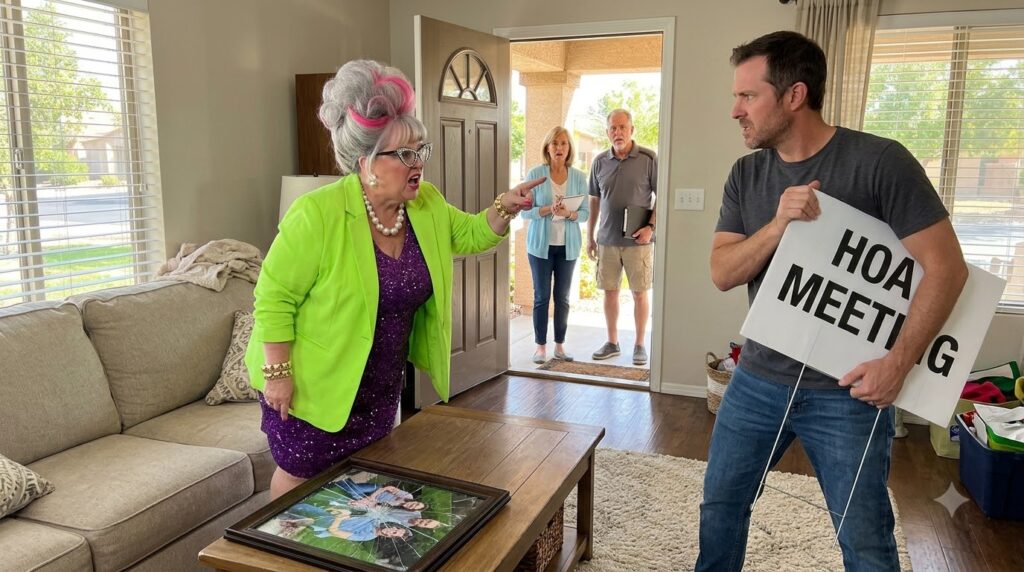
Patricia had entered his home and damaged something irreplaceable.
By Wednesday, he had spoken with five residents.
Three had documents describing questionable use of private property.
Two reported retaliatory violation notices after disagreeing with Patricia.
Not every complaint involved a clear rule violation, and Daniel was careful not to treat every disagreement as proof of misconduct.
Still, the similarities were difficult to ignore.
He organized the records by date.
Rebecca reviewed them and cautioned that each incident would need to be evaluated separately.
But she agreed that the history could help the board understand why stronger oversight was necessary.
Meanwhile, Linda and Robert were examining the association’s financial records.
The clubhouse renovation had become an increasingly sensitive subject.
The original plumbing repair estimate had been approximately $18,000.
Three weeks later, the projected cost had climbed above $42,000.
Patricia had repeatedly described the increase as unavoidable.
But Robert, who had worked in commercial insurance, noticed something unusual.
Several invoices had been submitted by a company called Sonoran Community Improvements.
The company was not listed among the association’s regular contractors.
Its invoices contained vague descriptions such as facility preparation, administrative coordination, and temporary operations support.
Robert asked Michael Trent for the supporting contracts.
Michael could not immediately locate them.
That raised another concern.
The management company handled routine payments, but Patricia had personally directed several emergency expenditures during the clubhouse closure.
Linda requested a complete accounting.
Patricia responded angrily.
She accused Linda of undermining leadership during a difficult period.
Then she called an emergency board meeting.
This time, she scheduled it at a local hotel conference room.
The agenda included a motion to remove Linda from her committee responsibilities.
It also included a proposal to impose a $500 fine on Daniel for interfering with HOA operations.
Daniel received notice through Rebecca.
He stared at the document.
Patricia was no longer merely defending what she had done.
She was trying to turn the association against anyone who questioned her.
That evening, Daniel found Sophie sitting at the kitchen table with the damaged photograph.
She had placed the original print inside a new temporary frame.
It was inexpensive and slightly too small.
But Emily’s face was visible again.
Sophie looked up.
“Are we going to have to move?”
The question hit Daniel harder than Patricia’s threats.
“No, sweetheart.”
“Because of that lady?”
Daniel sat beside her.
“We’re not leaving our home because somebody forgot how to respect it.”
Sophie nodded, but he could see she was still worried.
After she went to bed, Daniel returned to the dining table and opened the folder of evidence.
He had initially wanted only an apology and a repaired photograph.
Now he realized the dispute concerned something larger.
If Patricia could punish him for refusing to surrender his living room, she could do the same to anyone in Desert Palms.
And unless someone challenged her authority, she probably would.