
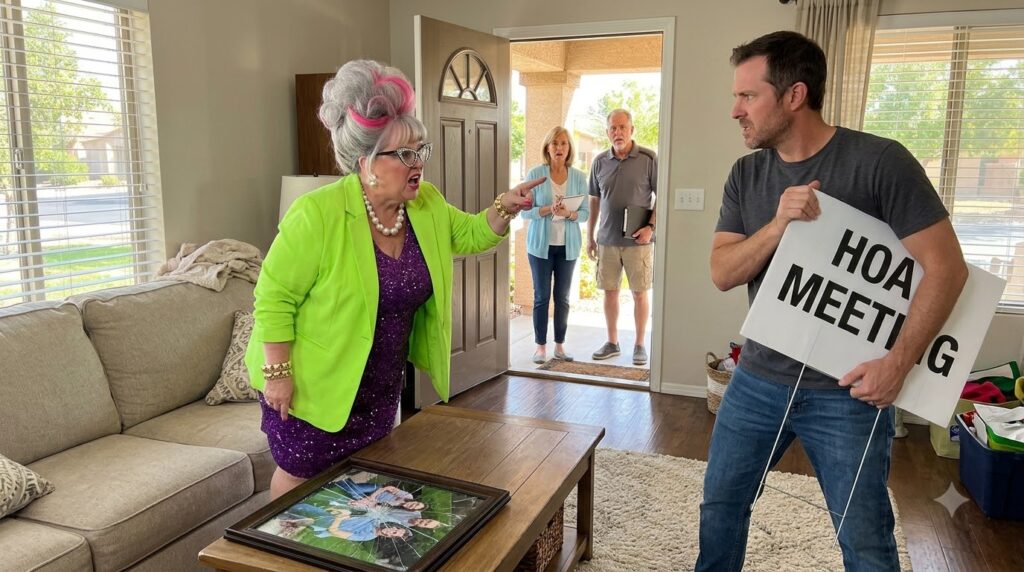
Chapter 2: The Meeting That Never Had Permission
By four o’clock that afternoon, Daniel had learned two things.
First, Patricia Whitcomb had sent an email to the entire HOA board announcing that the monthly meeting would take place at his address.
Second, she had sent it nearly three hours before entering his home.
The email described the Mercer residence as a “temporary community meeting facility.”
There was no mention of permission.
There was no rental agreement, no homeowner consent, and no explanation of how Patricia had obtained the authority to designate a private residence for association business.
Linda forwarded the message to Daniel after leaving his house.
Her accompanying note was short.
I did not know you hadn’t agreed. I am very sorry about what happened.
Daniel read it twice.
He sat at his kitchen table with the broken photograph beside him. The cracked glass had been carefully removed, and the original print was tucked inside a clean envelope.
Sophie would be home from school in less than an hour.
He needed to decide what to tell her.
The house was a four-bedroom property in an established Phoenix suburb, purchased by Daniel and Emily twelve years earlier.
They had chosen Desert Palms because of its quiet streets, mature landscaping, and family-friendly atmosphere.
Emily loved the large front window.
She said the afternoon sunlight made the living room feel welcoming, even during the hottest Arizona summers.
When they moved in, the HOA had seemed like a minor inconvenience.
There were modest annual dues, landscaping rules, and occasional neighborhood meetings.
The clubhouse, a small stucco building near the community pool, served as the center of association activity.
Two months earlier, a plumbing failure had forced its closure.
The association had announced repairs, but the reopening date kept slipping.
Patricia had complained repeatedly that the temporary closure was interfering with her responsibilities.
Apparently, she had decided Daniel’s house was the solution.
At 4:18 p.m., another email arrived.
This one came directly from Patricia.
Its subject line read:
NOTICE OF HOMEOWNER NONCOOPERATION
Daniel opened it.
The message accused him of disrupting a scheduled HOA meeting, interfering with association operations, and displaying aggressive behavior toward its president.
It also stated that the board would review possible disciplinary action.
Daniel read the message slowly.
He had been in his own house.
She had entered without permission.
She had broken a treasured family photograph.
And now she was threatening to punish him.
He saved the email.
Then he opened the security application connected to his front-door camera.
The footage showed Patricia arriving at 2:06 p.m.
She walked up the driveway carrying a large meeting sign, a handbag, and a rolled-up document.
She rang the doorbell once.
Daniel had been working in his office with headphones on.
After waiting less than twenty seconds, Patricia tried the front door.
It opened.
Daniel remembered leaving it unlocked after bringing in groceries earlier that afternoon.
The camera recorded Patricia looking briefly over her shoulder before stepping inside.
No invitation.
No permission.
No emergency.
She simply entered.
Daniel replayed the footage.
At 2:11 p.m., Linda and Robert appeared at the end of the driveway.
That matched the timing of the confrontation.
The video did not show the damage inside, but it established how Patricia had entered.
Daniel downloaded the recording and saved copies to two separate locations.
Then he called the Phoenix Police Department’s nonemergency number.
An officer arrived later that afternoon, listened to Daniel’s account, reviewed the available footage, and documented the reported unauthorized entry and property damage.
The officer explained that the report would be forwarded for review and that any decision about charges would depend on the evidence and applicable law.
Daniel understood.
He was not expecting anyone to be dragged away in handcuffs.
He wanted a record.
He wanted someone outside the HOA to acknowledge that his home was not community property.
When Sophie returned, she found him sitting on the sofa.
Her backpack slid from her shoulder as she noticed the empty place where the photograph usually stood.
“Dad? Where’s Mom’s picture?”
Daniel felt his throat tighten.
He showed her the photograph, now protected inside its envelope.
He explained that someone had knocked it down and damaged the frame.
He did not immediately tell her about Patricia’s insult.
Sophie held the envelope in both hands.
“Can we fix it?”
“We’ll try.”
She studied the image through the plastic sleeve.
“Mom liked that picture.”
Daniel nodded.
“I know.”
Sophie sat beside him.
For a while, neither spoke.
Then she asked a question that made him realize how deeply the incident had affected their sense of safety.
“Was that lady inside our house when you weren’t looking?”
Daniel answered truthfully.
“Yes.”
Sophie looked toward the front door.
“Can she come back?”
Daniel put his arm around her.
“No. I’m going to make sure she doesn’t.”
That evening, he changed the door-lock code, checked every window, and ordered a replacement smart lock with automatic locking.
He also contacted a local attorney, Rebecca Shaw, whose practice included property disputes and homeowners association matters.
Rebecca agreed to review the situation the following morning.
Before going to bed, Daniel received one more message.
This time, it came from Robert Ellis.
You need to see what Patricia submitted to the board tonight.
Attached was a PDF.
Daniel opened it.
The document was titled:
EMERGENCY BOARD RESOLUTION — TEMPORARY MEETING FACILITIES
At the bottom was a list of supposed approving board members.
One of the names was Linda Foster.
Another was Robert Ellis.
And beneath them appeared a line claiming that Daniel Mercer had provided homeowner consent.
Daniel stared at the document.
He had never signed anything.








