
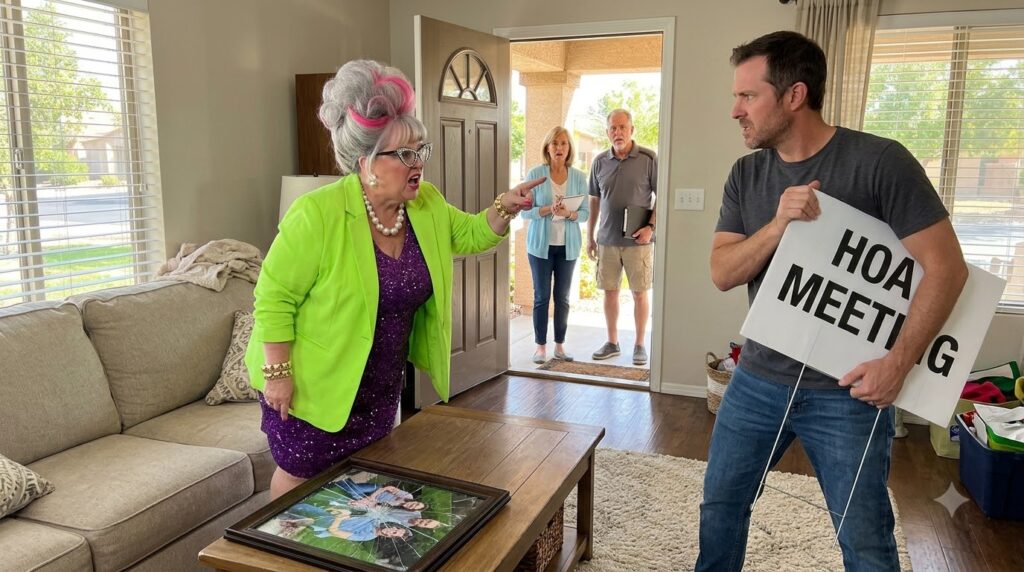
Chapter 3: The Signature That Wasn’t His
Rebecca Shaw’s office occupied the second floor of a modest professional building in central Phoenix.
She was fifty-nine, with short auburn hair, reading glasses, and the patient expression of someone who had spent decades listening to people explain why their disputes were different from everyone else’s.
Daniel arrived carrying a folder.
Inside were the emails, photographs, security footage, police incident number, and the emergency resolution.
Rebecca examined the documents without interrupting.
When she reached the page claiming Daniel had consented to the use of his house, she stopped.
“Where did this come from?”
“An HOA board member sent it to me.”
“Did you sign any agreement?”
“No.”
“Did you authorize anyone to sign for you?”
“Absolutely not.”
Rebecca leaned back.
“Then we need to determine who prepared this document and how it was approved.”
Daniel pointed to the line beneath his name.
It read:
Consent confirmed verbally with homeowner.
There was no signature.
Only a typed statement.
Rebecca studied it.
“That’s not a signature. It’s a claim that someone obtained your consent. We need the records behind that claim.”
Daniel felt both relieved and unsettled.
The document was not proof that he had agreed.
But someone had apparently used his name to justify taking control of his living room.
Rebecca explained that an HOA’s powers generally came from its governing documents and applicable law, not from whatever its president considered convenient.
Even if the association had authority to arrange temporary meeting facilities, that would not ordinarily give its president permission to enter an unwilling homeowner’s residence.
The distinction seemed obvious.
Yet Patricia had behaved as though it did not exist.
Rebecca recommended several immediate steps.
Daniel should preserve every communication, avoid private confrontations with Patricia, request relevant association records, and notify the board formally that he had never authorized use of his property.
She also prepared a written demand instructing Patricia and the association not to enter his home or represent it as an approved meeting location.
The letter requested reimbursement for the damaged frame and written confirmation that no fines or disciplinary action would result from his refusal.
Daniel signed it that afternoon.
Meanwhile, Linda Foster was discovering that her own name had been used without her knowledge.
She had served on the HOA board for nearly four years.
A retired school administrator, Linda believed neighborhood associations could be useful when managed fairly.
She had joined the board to help with landscaping decisions and maintenance planning.
She had not joined to police people’s living rooms.
After receiving the emergency resolution, she searched her email records.
There had been no meeting approving Daniel’s house.
No vote.
No request for homeowner consent.
Patricia had circulated a message about finding temporary space, but Linda had never agreed to the Mercer residence.
Robert confirmed the same.
By Thursday evening, the two board members had compared notes.
They discovered that the resolution had been uploaded to the HOA’s shared document system under Patricia’s account.
The file metadata showed it had been created the morning of the incident.
The supposed board approval had been recorded before either Linda or Robert knew Daniel’s address was being considered.
Linda called the association’s management company.
The property manager, a cautious man named Michael Trent, reviewed the document and sounded increasingly concerned.
He explained that the management company had not prepared it.
More importantly, he could find no record of a properly noticed board vote approving the location.
Patricia had apparently acted alone.
But when Michael contacted her, she insisted that the resolution was valid.
She claimed that Daniel had previously indicated he was willing to help the community.
Her evidence was a conversation from the previous summer.
Daniel remembered it immediately when Rebecca mentioned it.
At a neighborhood barbecue, Patricia had complained that the clubhouse needed repairs.
Daniel had casually remarked that neighbors sometimes hosted small gatherings in their homes.
That was all.
He had never offered his house.
He had never discussed an HOA meeting.
He had certainly never given permission for Patricia to enter and rearrange his furniture.
Rebecca shook her head when he explained.
“A general conversation about neighbors hosting gatherings is not permission to use your property.”
The following day, Patricia escalated matters again.
She sent a community-wide newsletter.
Under the heading Maintaining Community Cooperation, she described an unnamed homeowner who had refused to support essential association operations.
She suggested that selfish behavior was threatening the neighborhood’s property values.
Daniel’s name was not printed.
But the references to the interrupted meeting made the target unmistakable.
By Saturday, neighbors were discussing the incident in the community’s online group.
Some supported Patricia.
They believed homeowners should cooperate with association needs.
Others questioned why any resident should be required to host a meeting.
A few had heard rumors that Daniel had physically threatened Patricia.
That accusation angered him more than he expected.
He had never touched her.
He had removed a sign from his own living room.
Now he was being described as dangerous.
Rebecca advised him not to engage in the online argument.
Instead, she helped him prepare a concise factual statement, supported by the security footage and the written demand.
Daniel sent it privately to the board.
He did not publish the video of Patricia entering his house.
Not yet.
That Sunday afternoon, Linda visited Daniel.
She brought a small cardboard box.
Inside were photocopies of several older HOA records.
“I thought you should see these,” she said.
Daniel opened the box.
The first document concerned a retired couple on Juniper Lane.
The second involved a widowed homeowner near the community pool.
The third was a complaint about a garage that Patricia had allegedly used to store HOA supplies without a clear agreement.
Daniel looked up.
Linda’s expression was grim.
“Your house may not be the first one she’s treated like association property.”








