Chapter 6: The Cost of Control
The independent financial review began the following week.
It was conducted by an outside accounting firm retained by the HOA board.
Daniel was not directly involved in the accounting work.
Rebecca advised him to keep his property dispute separate from the financial investigation.
That distinction mattered.
He wanted accountability, not revenge.
He did not want to make accusations he could not prove.
Still, the investigation changed the atmosphere throughout Desert Palms.
Residents who had previously ignored board meetings began requesting records.
Some asked why the clubhouse repairs had become so expensive.
Others questioned why association decisions were often announced without clear documentation.
A retired accountant named Margaret Hill volunteered to help residents understand the publicly available financial statements.
A former construction supervisor reviewed the original clubhouse repair estimates.
Neighbors began discussing the difference between reasonable HOA oversight and unchecked personal authority.
Patricia responded by sending another newsletter.
She described the investigation as an attack on volunteer leadership.
She claimed that certain residents were attempting to destroy the community’s reputation.
But her message had less effect than before.
People were beginning to ask questions rather than accept her explanations.
At Daniel’s house, the practical consequences continued.
Sophie had become nervous whenever the doorbell rang.
Daniel noticed that she checked the front window before opening the door, even when she expected a friend.
He hated that.
The house had always been her safe place.
Now an adult stranger’s behavior had made her question whether that safety could be trusted.
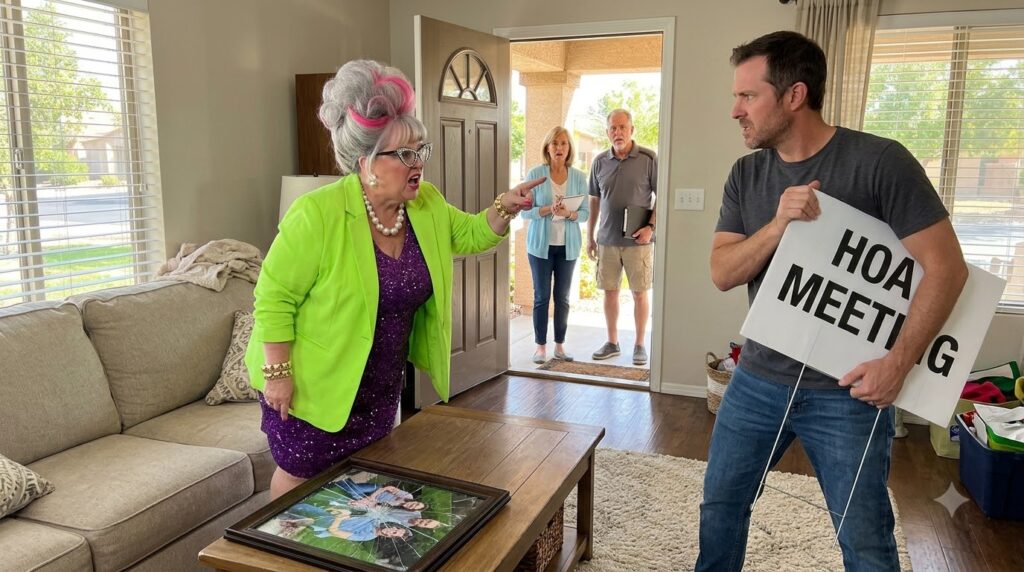
Daniel arranged for the damaged photograph to be professionally restored.
The print itself had suffered only minor scratches.
A local restoration specialist cleaned and repaired it, then placed it behind museum-quality protective glazing in a new wooden frame.
The work cost more than Daniel expected.
He paid without hesitation.
When he brought the photograph home, Sophie held it carefully.
“It looks like before,” she whispered.
Daniel smiled.
“Almost.”
She studied her mother’s face.
“Maybe better.”
They returned the photograph to its original place beside the sofa.
Daniel stood back and looked at it.
The room finally felt right again.
But the dispute was not finished.
Patricia had refused Rebecca’s request for reimbursement.
She also declined to provide a written apology.
Instead, she claimed that any damage had been accidental and that Daniel had contributed to the confrontation by behaving aggressively.
Rebecca prepared a civil claim seeking compensation for the documented property damage and related losses.
She also continued discussions with the association’s attorney about a formal acknowledgment that Daniel’s property had never been an authorized meeting location.
Meanwhile, the accounting review produced its first significant findings.
The clubhouse’s original plumbing repair was legitimate.
A damaged supply line had caused substantial water intrusion, and additional repairs were necessary after hidden moisture damage was discovered.
However, several administrative invoices had been billed through Sonoran Community Improvements without sufficient documentation.
The company was owned by Patricia’s nephew.
The accounting firm found no evidence that the board had been properly informed of that family relationship before the payments were approved.
It also identified duplicate charges and expenses that could not be matched to completed work.
The findings did not establish that every questionable payment was fraudulent.
But they revealed serious weaknesses in the association’s approval process.
Patricia had personally authorized expenditures that should have received additional scrutiny.
When the preliminary report reached the board, Linda requested a special meeting to consider leadership changes.
Robert supported her.
Michael Trent recommended that the association seek legal advice about recovering unsupported payments and strengthening financial controls.
Patricia reacted furiously.
She accused the management company of incompetence.
She threatened to resign.
Then she withdrew the threat when Linda asked whether the board should accept it.
For years, Patricia had relied on the assumption that no one wanted the trouble of challenging her.
Now people were challenging her with documents, votes, and independent reviews.
She was discovering that authority became much less impressive when someone asked to see the rules behind it.
The special meeting was scheduled for the following Thursday.
Daniel did not plan to attend.
He had already provided his evidence.
His daughter needed him more than the association did.
But on Wednesday evening, Linda called.
She explained that Patricia had submitted a new statement to the board.
In it, Patricia claimed Daniel had deliberately staged the confrontation to discredit her.
She suggested that the photograph had already been damaged before she entered.
Daniel closed his eyes.
The accusation was absurd.
But it was also personal.
Patricia was now questioning the truth of what had happened to Emily’s photograph.
Daniel looked across the room at the restored frame.
He had hoped to put the incident behind him.
Instead, he realized he would need to attend one more meeting.
Not to argue.
To make sure the truth was recorded.