
Chapter 8: What a Home Is Worth
The settlement discussions took several weeks.
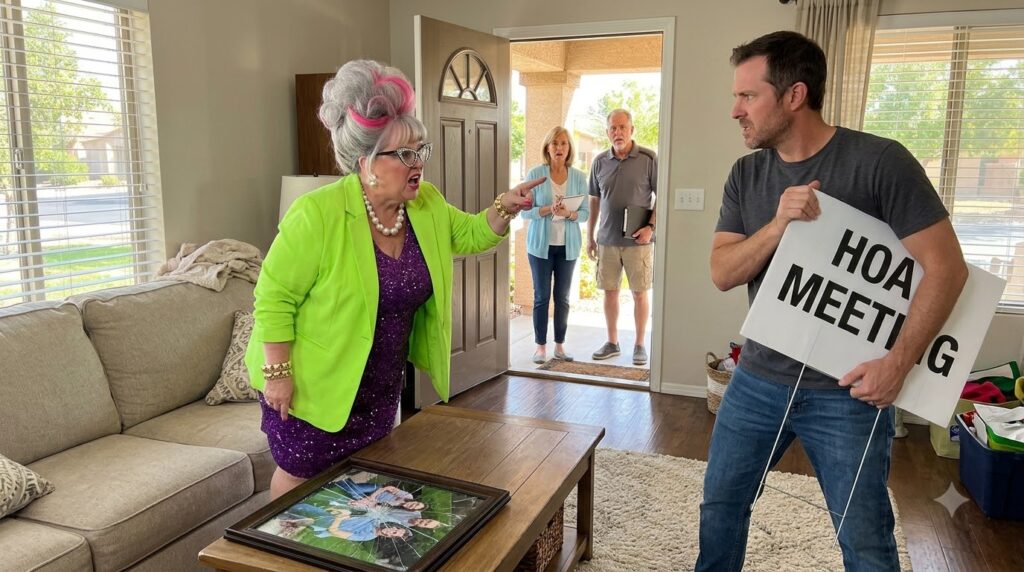
Patricia’s attorney initially proposed paying only the cost of an ordinary replacement picture frame.
Rebecca rejected that approach.
The claim was supported by the restoration invoice, photographs, and other documented expenses.
More importantly, Daniel wanted a written acknowledgment that Patricia had entered without permission and damaged his property.
He was not seeking an enormous payment.
He wanted the record to reflect what had happened.
Eventually, the parties reached an agreement.
Patricia personally reimbursed Daniel for the documented restoration costs and certain related expenses.
She also signed a statement acknowledging that she had entered the Mercer residence without the homeowner’s permission, handled the photograph improperly, and caused damage to its frame.
The agreement did not require her to admit every allegation Daniel had raised.
It did, however, prohibit her from representing that Daniel had authorized the meeting.
Separately, the HOA issued a formal correction to residents.
The notice stated that the Mercer home had never been an approved association meeting location.
It withdrew the accusations of obstruction and confirmed that Daniel had not violated any HOA rule by refusing to host the meeting.
Daniel read the notice at his kitchen table.
It was only a page long.
But it represented something he had spent months trying to obtain.
The truth, stated plainly.
The police report remained part of the documented incident. After reviewing the available evidence, authorities did not pursue criminal charges, and Daniel accepted that the civil resolution addressed his immediate property claim.
The financial investigation continued independently.
The final accounting report found that several charges submitted by Sonoran Community Improvements were unsupported or duplicated.
The association pursued repayment through counsel.
After negotiations, the vendor agreed to return a portion of the disputed funds without admitting intentional wrongdoing.
The board also referred the findings to the appropriate authorities for review.
No criminal conclusion was announced.
The larger lesson was administrative rather than dramatic.
The HOA had allowed too much authority to accumulate in one person’s hands.
There had been insufficient oversight of emergency spending, weak documentation of board decisions, and too much reliance on informal approvals.
The new board introduced stronger controls.
Expenditures above a defined threshold required multiple approvals.
Vendor relationships had to be disclosed.
Meeting minutes were distributed promptly.
Homeowners received clearer instructions for requesting records and challenging violations.
The clubhouse renovation was completed under revised oversight.
By early spring, the building reopened.
It was not especially impressive.
There were fresh walls, repaired plumbing, new flooring, and a modest meeting room with folding chairs.
But it belonged to the association.
That alone made it a better meeting location than Daniel’s living room.
At the reopening, Linda thanked residents for their patience.
She did not mention Patricia by name.
She emphasized that community rules should protect residents rather than intimidate them.
Harold Bennett attended with June.
Evelyn Brooks came too.
For the first time in years, several longtime homeowners felt comfortable participating in association business.
Daniel stood near the back of the room.
He had no desire to run for the board.
He had enough responsibilities raising Sophie and managing his engineering work.
But he was glad to see neighbors speaking freely.
After the event, Harold approached him.
“I should’ve spoken up sooner,” the older man said.
Daniel shook his head.
“You spoke up when it mattered.”
Harold smiled faintly.
“Maybe. But you reminded the rest of us that we still have a say.”
Daniel appreciated the words.
Yet he knew the dispute had not been won by one person.
Linda had questioned the false resolution.
Robert had examined the records.
Michael had insisted on financial documentation.
Rebecca had protected Daniel’s rights through the proper process.
And neighbors who had once remained silent had decided to share their experiences.
It had taken all of them.
A few days later, Daniel received a small package.
There was no return address beyond a Phoenix postmark.
Inside was a handwritten note from a woman named Margaret Hill, the retired accountant who had helped residents understand the HOA’s financial statements.
She thanked Daniel for refusing to be intimidated.
Then she wrote something that stayed with him.
People sometimes forget that a neighborhood is made of homes, not rules. The rules are supposed to serve the people who live there.
Daniel placed the note in his desk drawer.
That evening, he and Sophie sat together on the sofa.
The restored photograph stood beside them.
Sunlight came through the large front window, warming the wooden frame.
Sophie leaned against her father’s shoulder.
“Do you think Mom would be proud of us?”
Daniel looked at Emily’s smile.
He thought about everything that had happened.
The broken glass.
The accusations.
The meetings.
The weeks of uncertainty.
And the way Sophie had remained brave even when she was frightened.
“Yes,” he said softly. “I think she would.”








