CHAPTER 5: THE EYE OF THE CROWD
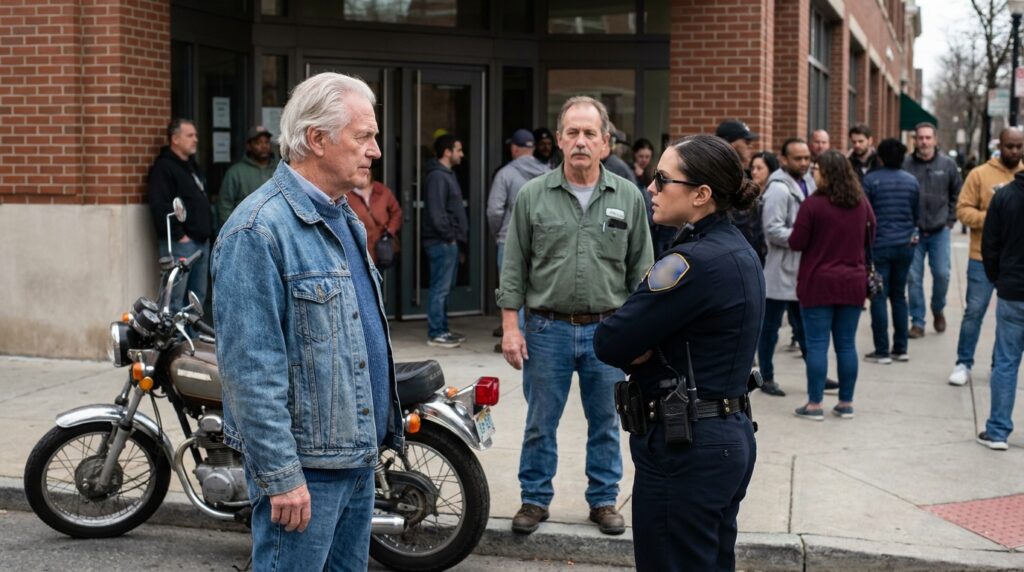
A calloused hand cracked the silence, David Vance’s palm slapping down onto the weathered brown leather of Marcus’s rear fender bag with a dry, coarse thud. He didn’t look at Officer Gomez or the young coordinator whose tailored sleeve was now shaking against his digital slate. David stepped right into the narrow gap between the front tire and the law, his boots grinding a handful of loose granite dust into the gray quartz surface.
“Everyone’s watching now,” David said, his voice dropping into a low, flat warning that wasn’t meant for his brother alone. His mustache was stiff with sweat, his eyes darting across the wider perimeter where the passive circle of onlookers had begun to lock into a rigid, permanent wall. “Let’s keep this under control. Respect goes both ways, that’s all we’re asking today.”
The coordinator didn’t look up from his screen, but his thumb made a sharp, jerky swipe that accidentally cleared his terminal’s active interface. “This isn’t about respect, Vance. It’s an un-indexed asset on an active corporate deployment field. The security algorithms don’t have a variable for sentimentality.”
Marcus didn’t shift his boots from the pegs. He let his fingers loosen from the pitted brass choke knob, his hand coming down to rest flat against his thigh. The metal of the engine continued to tick, a slow, dying pulse that sounded like an old watch spring winding down in an empty room. He looked at the faces behind the velvet ropes—the older men whose caps carried the names of ships that had gone to the scrap yards thirty years ago, the county workers whose lanyards matched his own faded voucher, the kids holding cell phones at chest height, their lenses catching the high noon glare like rows of tiny glass eyes.
The pressure wasn’t moving down from the building anymore; it was rising from the plaza floor. The administrative sterile zone the coordinator had promised his corporate handlers was gone, replaced by a dense, un-moving crowd that smelled of grease, old wool, and damp earth. Every phone that rose into the air became an unmanaged terminal, an open circuit the city’s media team couldn’t clear with a software patch.
Gomez stood her ground, but her chin dropped a quarter-inch, her eyes tracking the precise shift in the crowd’s configuration. She could feel the friction change under her heels. A group of four older veterans in matching blue blazers had moved past the first security marker, their steps slow but deliberate, their eyes fixed on her duty belt. They weren’t making threats; they were simply occupying space, turning the concrete path into a shared trench.
“Officer,” the coordinator hissed, his voice dropping to a sharp whisper as he leaned toward Gomez’s shoulder. “The automated gate report just flagged the Vanguard executive lead. They’re at the lower circle. If this lane isn’t clear when the private convoy hits the steps, the entire municipal tech transition loses its validation status.”
Gomez didn’t acknowledge him. Her hand left her radio casing and came down to her side, her fingers uncurling from the leather loop of her baton. She looked back at Marcus, her sunglasses catching the sharp white line of the building’s cornerstone behind him—the stone that bore the name of the very logistics trust Marcus had claimed five minutes before.
“The registry is accurate, Vance,” she said, her voice carrying a rare, raw grain of hesitation. “But the system won’t let me enter a manual override for a physical asset that isn’t mapped to a digital server node. If I don’t sign the removal log, the automated system defaults to a public hazard alert. The tow trucks are already rolling from the yard.”
Marcus looked down at his jacket lining, his thumb hooking into the split fabric where the serialized iron key was taped. He could feel the cold edge of the metal heating up against his body, a single, hidden piece of evidence that didn’t exist in the coordinator’s cloud network but was currently sending an unmapped signal through the entire history of the valley.
“Then let them roll, Officer,” Marcus said softly. “The steel on this bike has been buried before. It always comes back up.”
Before Gomez could answer, a loud, sharp whine cut through the plaza from the roof of the complex—the sound of the building’s heavy-duty emergency ventilation systems kicking into manual overdrive. The air coming out of the massive stainless steel grates above the doors didn’t smell like offices; it smelled like hot copper, burnt plastic, and the deep, chemical ozone of old storage units being cleared under a midnight deadline.
David’s hand tightened on the leather bag, his knuckles turning white as a sudden, hard shadow fell over the plaza from the grand glass entrance. The heavy double doors didn’t slide open this time; they were thrown back by a pair of active-duty Marines in full dress blues, their polished white belts gleaming against the dark interior wood as an order echoed down the granite steps.