CHAPTER 2: THE GRANITE GATE
“You’re dripping on the sand-blasted quartz, sir. Turn it off or roll it back behind the yellow line.”
The voice didn’t come from a soldier or an officer. It belonged to a kid who looked twenty-four, wearing a tailored navy suit that had never seen a rainstorm and an administrative lanyard that swung like a pendulum against his belt. He was holding a sleek glass tablet, his thumb hovering over a digital field with the casual arrogance of a minor gatekeeper who believed the world was run by permissions.
Marcus Vance didn’t kill the ignition. He kept his boots planted on the pristine granite pavers of the plaza, his knuckles white inside his grease-stained leather gloves as the Shovelhead’s raw idle vibrated through the polished stones beneath them. The exhaust note was thick, laden with the heavy scent of unburned zinc and hot oil, throwing small, gray smoke rings against the glass-fronted facade of the new County Veterans Affairs Complex.
“The card says Lot A,” Marcus said. His voice was lower than the mechanical rattle of the engine, a slow, gravelly rasp that required the kid to lean forward slightly to catch it over the din of the machine. He didn’t offer the card. He held it flat against his thigh, his thumb covering the modern bar code but exposing the faded, stamped signature of the county clerk from three months back.
“Lot A is reserved for the corporate sponsors and the Governor’s logistics team,” the coordinator said, his fingers making a fast, dismissive swipe across the glass screen. He didn’t look at Marcus’s face; he looked at the denim jacket, tracking the gray grease smears along the seam of the arm and the salt-crusted edges of the blue wool sweater underneath. “The vintage vehicles—the exhibition pieces—are supposed to be at the lower staging area near the service road. Two miles down, by the gravel pits. Security won’t clear an unmapped fuel system within forty yards of the podium.”
“This isn’t an exhibition,” Marcus muttered. His right hand remained on the throttle, his index finger tracing the edge of the old rubber grip where the sun had cracked the synthetic compound down to the core iron.
He looked past the kid’s shoulder. The building was massive, a monolithic wedge of tinted glass and white limestone that looked more like an aerospace headquarters than a home for old soldiers. The light off the plaza was blinding, the midday sun reflecting off thousands of square feet of poured concrete and polished granite until the air itself seemed to vibrate with a dry, chemical heat. In the center depth, behind a pair of velvet crowd ropes, a dozen local politicians were already standing in a loose circle, their teeth flashing white in the glare as photographers adjusted lenses on aluminum tripods.
“Look, mister,” the coordinator said, his tone dropping into that specific, practiced patience used by low-level administrators dealing with the non-compliant. “We have three separate defense tech firms arriving in ten minutes. Their security detail is checking the tire treads on every vehicle entering this circle. If I let an oil-leaking Shovelhead sit on the main entrance path, it flags the automated grid. I’m trying to save you a citation.”
Marcus didn’t move. He felt the small, irregular ridge of the challenge coin pressing against his ribs through the internal pocket of his jacket, but it was the other object—the long, cold piece of flat iron he’d discovered behind the lining—that felt heavier now. His brother David’s words from the garage were still ringing in his ears, a low, persistent warning about what happens when an old name gets caught in a new machine.
He looked down at the yellowed cardstock voucher. In the harsh, overhead glare of the July sun, he noticed something he’d missed back in the dim light of his shop. The county clerk’s stamp was there, but beneath the purple ink, embedded directly into the fiber of the paper, was a faint, translucent watermark—an interlocking diamond logo that didn’t belong to any state agency. It was the corporate mark of Vanguard Tactical Solutions, the multi-state contractor that had built the building’s new digital server wing.
The kid stepped closer, his polished leather shoes clicking against the granite with an aggressive, short stride. He reached out an arm, not quite touching Marcus’s handlebars but cutting off the left-hand mirror’s line of sight. “Sir. I’m not asking again. Move the bike to the gravel pits, or I’ll have the municipal tow unit clear it as an abandoned hazard.”
Marcus felt his thumb slide down the clutch lever, his muscles locking into the deliberate, static discipline of a man who had spent three winters holding a mud-filled trench line outside Da Nang while everything around him turned to ash. He didn’t shift into gear. He didn’t turn the wheel. He simply leaned his weight slightly to the left, letting the heavy steel edge of his primary drive cover click against the coordinator’s neat leather shoe line.
“I’ve got the permit,” Marcus said softly. “And the pavement’s wide enough for both of us.”
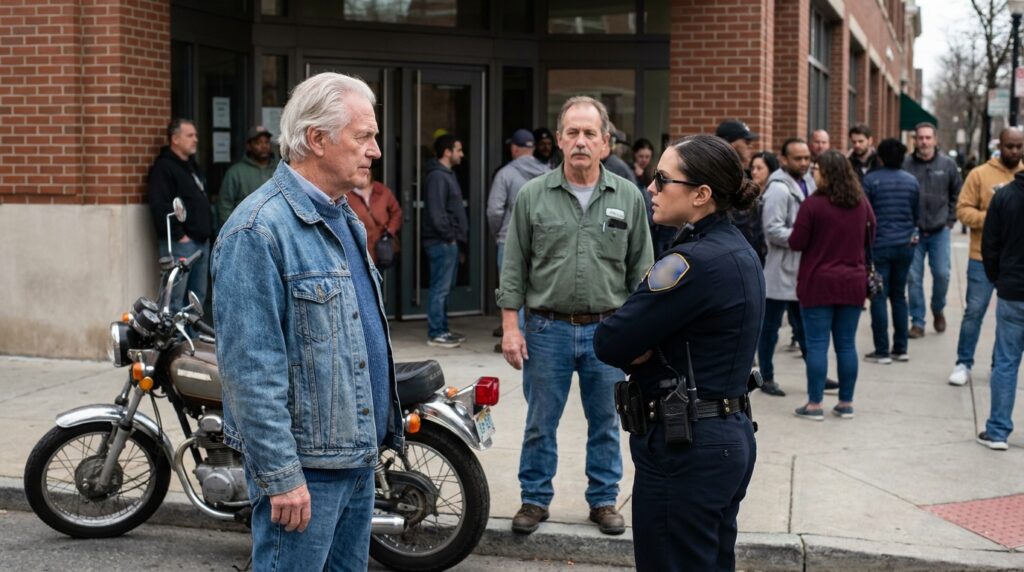
Across the plaza, near the glass double doors that led to the security checkpoint, a dark blue uniform shifted. A female officer, her dark hair pulled into a severe, wind-resistant bun under her campaign hat, turned her head toward the sound of the idling engine. Her sunglasses reflected the white light of the concrete like two black discs as she adjusted the heavy leather utility belt at her waist and began walking toward the curb.