
CHAPTER 9: THE GRAVEL VEIL
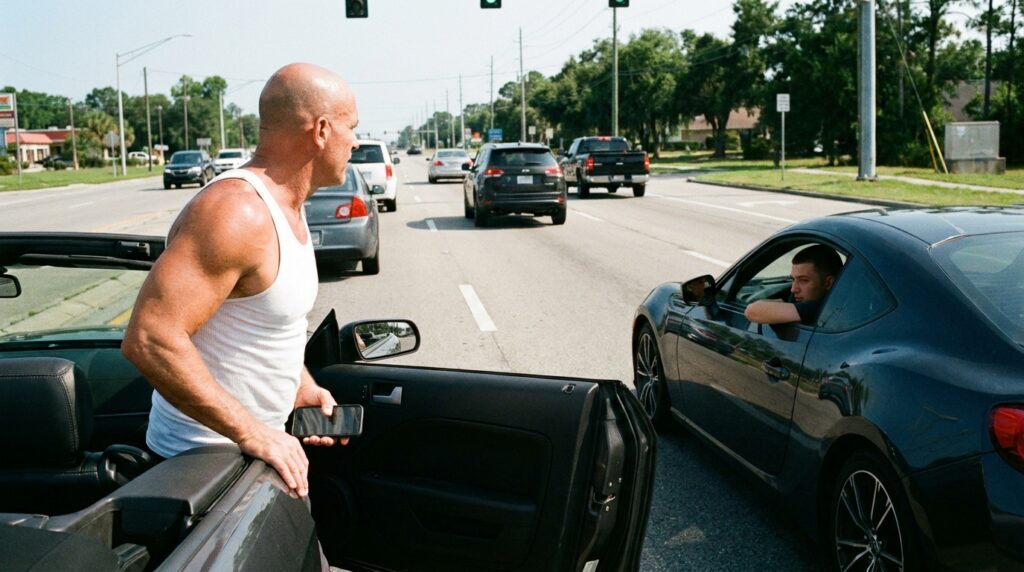
The convertible slammed into the throat of the river basin with a concussive, bone-jarring impact that compressed the heavy front springs down to their rubber bump stops. A massive plume of dry, pulverized gray clay and jagged river stone erupted from beneath the front tires, spraying upward in a violent arc that peppered the unlined interior of the open cabin. Miller didn’t lift his boot from the accelerator. He kept his weight shoved hard against the floorboards, his thick forearms locking into rigid, hydraulic pillars to counteract the violent, erratic kickback of the unassisted steering gear as the car tore through the deep ruts of the access track.
Above him, the sky was a flat, desaturated sheet of midday heat, but the air was no longer empty. A low, persistent acoustic thrumming—like the sound of a high-speed industrial ventilator—echoed down from the upper cloud layer. It was an automated surveillance asset, a medium-altitude domestic drone executing a systematic, tight-grid infrared sweep along the county logistics corridor.
Miller’s eyes shot down to the unbranded terminal wedged into the canvas pouch at his hip. The screen was completely dark, its transmitters silenced by the physical toggle switch he had thrown beneath the dashboard, but the separate, passive radio-frequency sniffer he had hard-wired into the car’s old cigarette lighter was pulsing with a steady, yellow indicator light. The drone wasn’t tracking an electronic signature anymore; it was hunting for a specific thermal silhouette—the massive heat signature of a cast-iron V8 running hot through the open country.
He turned the wheel hard to the right, sending the heavy tail of the convertible sliding across a wide shelf of loose, sun-bleached river gravel. The scent of raw gasoline mixed instantly with the bitter, metallic stench of scorched brake linings as he forced the vehicle into the deep, vertical shadow of a crumbling concrete aggregate retaining wall. The wall was a remnant of a long-abandoned gravel quarry, its surface deeply pitted by decades of frost-wedging and stained with long streaks of orange rust from the exposed rebar within.
Miller cut the magneto switch. The engine didn’t sputter; it died instantly, the heavy pistons seizing in their bores with a dull mechanical click that left only the high-pitched whistle of the cooling radiator cap to break the silence. The sudden absence of the V8’s roar made the acoustic thrum of the drone overhead sound incredibly close, the low-frequency vibrations pressing down against the drums of Miller’s ears like the weight of deep water.
He sat perfectly still behind the wheel, his white tank top already coated in a fine layer of gray road dust that turned the sweat on his shoulders into a thick, grimy paste. His thumb swept across the flat edge of the steel carabiner on his belt. Four strokes. Breathe in. Four strokes. Breathe out. He didn’t look up at the sky. He knew the parameters of the thermal camera above: if he remained motionless within the cool, concrete shadow of the retaining wall, his body heat would blend with the ambient thermal mass of the structure, transforming the vehicle into nothing more than a discarded piece of industrial junk on the sensor array.
The shadow of the aggregate wall was narrow, barely wide enough to cover the long hood of the car. The dry glare of the afternoon sun cooked the exposed gravel less than two feet from his front bumper, creating a shimmering heat haze that distorted the far side of the basin. Miller tracked the acoustic signature of the drone as it passed directly overhead, the mechanical thrum peaking for three agonizing seconds before slowly descending down the valley toward the northern rail spur.
The sniffer light on his dashboard flickered from yellow back to a dim, resting green. The primary sweep had missed the registration. The automated entity running the search grid was operating on rigid, algorithmic tracking loops; it had calculated his speed from the highway intersection and expected him to be five miles further down the main artery, completely failing to account for a manual, high-risk drop into a dead quarry basin. Miller let his breath out slowly, his thick fingers restarting the internal clock. The digital net was still dragging the county, but he had just slipped beneath the bottom wire, and the concrete throat of the old terminal bunker was less than four hundred yards through the brush.








