
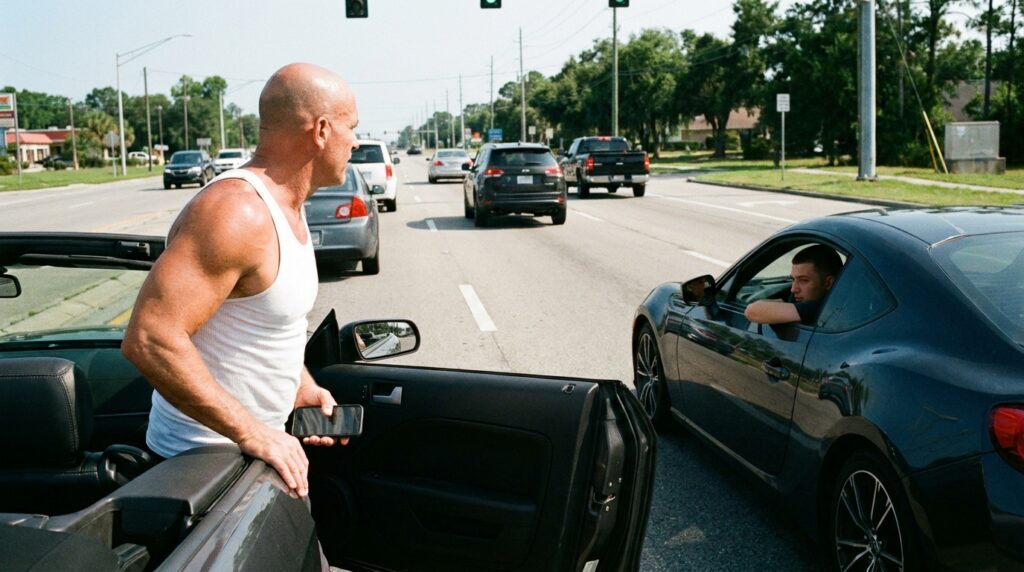
CHAPTER 3: THE SUPERFICIAL SPRINT
The mechanical violence of the sports coupe’s departure left a physical wake. When the green light snapped over the intersection, the dark car didn’t just move—it convulsed, its low-profile rubber shredding against the unevenly laid asphalt of the crossing. A spray of loose roadway grit and pulverized gray gravel peppered the side of Miller’s convertible, the tiny fragments pinging off the faded paint with the rapid, rhythmic click of spent brass hitting a concrete floor. The high-pitched scream of the turbocharger peaked, shifting into a guttural, metallic roar as the electronic traction management clawed for purchase against the heat-softened tar.
Miller didn’t flinch. His right boot remained heavy and immovable on the wide, unyielding brake pedal, holding his own rumbling vehicle back from the line by a matter of fractions. Through the shimmering, oily heat rising from his long hood, he watched the sports car surge ahead, instantly occupying the space Miller had deliberately vacated. The rear end of the coupe broke loose for a split second, fishtailing a half-yard to the left before the onboard computers choked the throttle, snapping the vehicle straight and forcing it forward into a frantic, single-car sprint toward the bottleneck underpass.
Within three seconds, a full car length of empty air had opened between them. To the casual eye—to the commuters idling in the silver and gray sedans behind them—it was a definitive execution. A slow, outdated machine driven by an aging civilian had been comprehensively out-pulled, left behind in a cloud of bitter, blue-white tire smoke that lingered in the heavy midday air. The young driver in the dark top didn’t look back through his rearview mirror immediately; his focus was entirely consumed by the mechanical urgency of catching the next gear, his exhaust throwing out a loud, concussive pop as the automated dual-clutch transmission jammed the next set of gears into place.
Miller let his eyes trace the flight path of the car, but his hands remained relaxed on the wheel. The steering gear gave a small, lazy shake as the engine idled, a constant reminder of the raw, unrefined torque waiting under his foot if he ever chose to drop the hammer. But there was no purpose in a street race. A street race had no parameters, no exit strategy, and no institutional objective. It was simply friction for the sake of noise.
Instead, Miller’s gaze tracked upward, past the disappearing taillights of the coupe, focusing on the gray metal utility box strapped to the vertical pillar of the traffic signal armature. The box was heavily oxidized, its surface pitted by acid rain and coated in a fine layer of post-industrial soot from the nearby rail line. A small, red light on its undercarriage was pulsing at the exact same frequency as the data spikes currently scrolling down his unbranded phone screen. The transmission wasn’t an accident of infrastructure. It was an intercept loop, designed to sweep the unique hardware identification numbers of every vehicle that sat at this specific launch point for more than thirty seconds.
The kid in the sports car hadn’t won a victory; he had simply cleared the net before the perimeter could tighten. His aggressive, frantic driving had carried him out of the primary capture zone while Miller had stayed behind, letting the passive receiver in his console drink down the full architecture of the digital broadcast.
The heat inside the open cabin grew more intense, the smell of burnt rubber mixing with the sour tang of old coolant from the radiator core. Miller felt the skin across his shoulders tighten, the heavy muscle of his upper back flexing slightly against the thin cotton of his white tank top as he eased the brake pressure just enough to let the convertible roll over the white stop line. He didn’t accelerate. He let the vehicle drift forward at a measured walking pace, its massive tires tracking over the fresh black skid marks left by the coupe.
Through the clear plastic screen of his cold-storage terminal, the綠色 code had ceased its erratic movement. It was solidifying into an operational map. The data packet harvested from the kid’s vehicle carried an embedded, high-level routing signature—an old, five-character military handshake protocol that Miller hadn’t seen since the logistical stand-down in Stuttgart nine years ago. It was a ghost identifier, a sequence that belonged to an organization that had been officially defunded, disassembled, and erased from the Department of Defense ledger before the turn of the decade.
He glanced to his left mirror. The gray crossover that had been sitting behind him was now pulling up, its driver staring down at Miller with a mixture of pity and curiosity, assuming the big, bald man in the old car was simply too stunned or too slow to react to the slight. Miller gave the driver no acknowledgment. He kept his eyes on the road ahead, where the sports car was already shrinking into a dark speck against the concrete mouth of the underpass, its exhaust note echoing back through the concrete chamber like a distant, dying machine gun. The trap had been sprung, but the teeth hadn’t caught the target they were looking for. They had caught something much heavier.








