
CHAPTER 5: COMMUTER WITNESS DYNAMICS
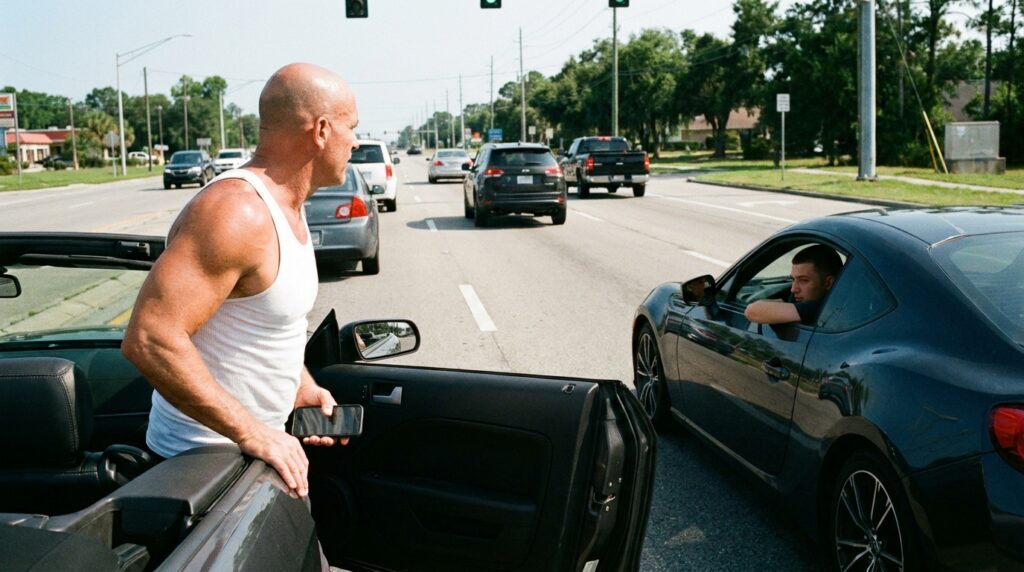
The intersection didn’t dissolve into movement; it dragged itself forward, a sluggish procession of scorched metal, heavy steel, and tired eyes. As the traffic signal above swung slightly on its rusted support wire, the surrounding commuters began to roll through the crossing, their front bumpers crossing the exact path where the sports coupe had shredded its rubber seconds prior. The smell of the pulverized compound hung in the air like a heavy curtain, thick and industrial, settling deep into the unlined interior of Miller’s open convertible.
He didn’t drop his frame back into the driver’s seat immediately. He remained standing by the heavy door, his massive forearms resting across the upper rail of the windshield frame, watching the vehicles roll past with the flat, unblinking glare of a gatekeeper at a checkpoint. To his left, a rusted contractor van with peeling company decals rattled across the white stop line, its transmission whining as the driver stared through the side window. The man’s mouth was slightly open, his eyes taking in the stark, uncompromising mass of Miller’s muscular build, then drifting down to the white tank top and the old, pitted firing pin dangling against his hip. There was a brief, silent hesitation in the van’s acceleration—a subconscious check of authority that civilians often exhibited when encountering something built for a completely different scale of violence.
Miller didn’t return the stare. His focus was three-dimensional, calculating the spatial drift of every chassis within twenty yards. The gray sedan that had occupied the space directly behind him didn’t follow the van. Instead, it pulled up parallel to Miller’s rear bumper, its tires grinding softly against the loose roadside gravel. The windshield was tinted dark enough to obscure the driver’s features, but through the dull, heat-warped glass, Miller caught the tiny, green indicator light of a mobile transmission cradle mounted to the center stack.
The unbranded terminal in his right pocket hummed twice, a pair of sharp, high-velocity vibrations that indicated a hard interrupt sequence. The passive proximity scan hadn’t just isolated the traffic signal’s transmitter; it had just recorded a massive, directional data drop targeting the convertible’s rear quarter panel. The gray sedan wasn’t waiting for the light to clear. It was holding its position, its engine idling with a low, unrefined mechanical clatter that sounded less like a civilian commuter vehicle and more like a high-output utility block.
A second commuter, driving an old utility truck laden with scrap metal, hit his horn—a short, brassy blast that fractured the silence of the intersection. The sound echoed off the concrete underpass down the road, causing a flock of starlings to erupt from the rusted iron trusses of the rail line. The pressure of the public frame was tightening, the natural impatience of the suburban commute shifting from a general collective irritation into a direct focus on the stationary old car and the big man who refused to move it.
Miller slowly lowered himself back behind the wheel, his boots finding the heavy iron footwells with practiced familiarity. The leather of the bucket seat was hot enough to sting through his clothing, but his breathing remained locked into the same four-stroke rhythm he had maintained since leaving the VFW lot. He didn’t put the car into gear. He let the engine idle, feeling the vibration of the crankshaft travel up through the steering column and settle into the palms of his hands.
Through the lower margin of his terminal screen, the hexadecimal logs from the traffic box had ceased their standard loop. A single line of crimson code had overridden the interface, reading: HANDSHAKE TERMINATED – ID: 04-SIG-OMEGA.
The code wasn’t a civilian network error. It was a dead-man patch, a protocol that automatically initiated a full cache wipe the instant an unauthorized scraper—like the terminal in Miller’s pocket—attempted to trace the routing origin back past the local transmitter. The decoy secret was crumbling before he could even extract its full architecture. The sports car hadn’t been the source; it had been the trigger wire, and Miller had just stood over it while the system recorded his precise physical envelope.
He looked back into his side-view mirror, watching the gray sedan shift its front wheels toward the shoulder, its bumper dipping slightly as the driver prepared to slip past his flank. The witness dynamics were changing. The casual commuters were moving on, their vehicles filtering through the narrow mouth of the underpass, leaving a growing pocket of stagnant air around the convertible. Miller’s active agency took over, his fingers closing around the cold iron gear shift lever, his mind already computing the cause-and-effect of the next three hundred yards of pavement. The public pressure framework was dropping away, and the silence that remained was the sharp, metallic quiet that always preceded a target acquisition.








