
CHAPTER 4: THE ANGLE OF ALIGNMENT
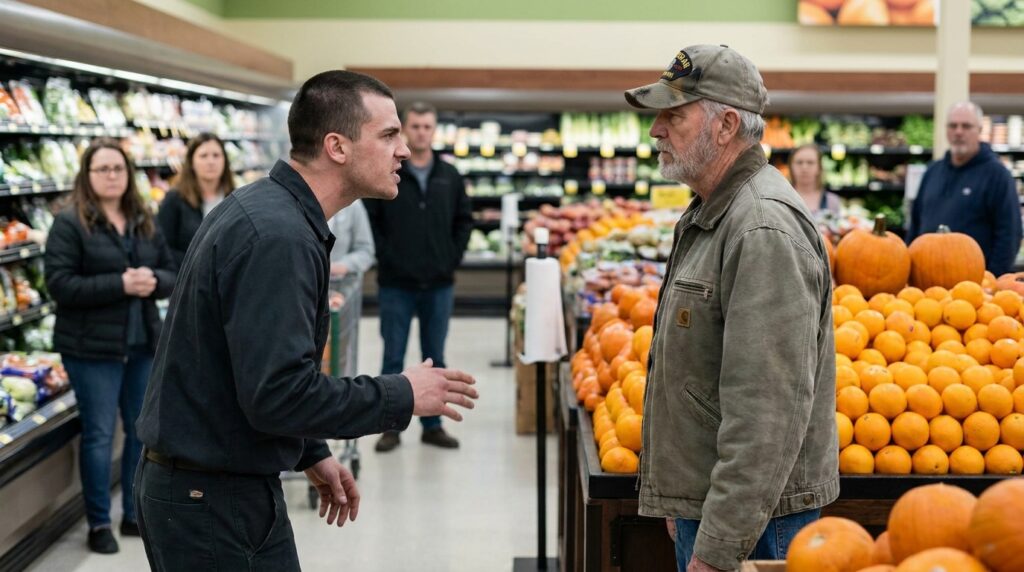
The old man laid his plastic bag of oranges down on the black rubber conveyor belt of the register lane. The belt moved with a jerky, complaining shudder, its internal gears screaming for grease that had dried out a decade ago. The cashier, a girl with tired eyes and a name tag that read Brenda, didn’t look up as she dragged the barcodes across the red laser light. The scanner beeped—a thin, flat sound that cut through the low, ambient murmur of the front end of the store.
“That’ll be four dollars and twelve cents, Mr. Miller,” she said, her voice matching the rhythm of the machine.
He reached into his pocket, his calloused thumb rubbing against the split edge of his knuckle before passing over the crisp, folded stock of the Vance Corporate Holdings summons. He pulled out a worn canvas billfold, its cloth frayed at the seams where his hip pocket had rubbed it bare over twenty years of hard labor. He placed four single dollar bills and two dimes on the plastic divider beside the register. The metal coins slid against the surface, ringed with a small scratch that sounded like iron filings sliding across a workbench.
“He’s been around the north ridge all morning,” Brenda muttered, her fingers pausing over the open till. She didn’t name the young man, but her gaze flicked briefly toward the glass entry doors where the automatic sliders were still settling into their tracks. “My cousin works the fuel truck out by the creek. Said Vance brought three older scrapers out from the county yard last night. Not the new lease units. The heavy ones with the rusted blades.”
Miller adjusted his navy blue veteran cap, the stiff buckram behind the faded gold lettering pressing a cold line into the skin of his forehead. He picked up his bag of citrus, the plastic film crinkling in his fist like dry leaves under a winter boot. “Those scrapers have twelve-foot moldboards?” he asked.
“The big ones,” she nodded, dropping the coins into the register drawer with a sharp metallic clink. “The ones they used to clear the old grade before the county sold off the maintenance lot. They’ve been sitting in the weeds behind the old quarry since ninety-four.”
The old man felt a subtle hitch in his shoulder, the mechanical calculation clicking into place behind his eyes. The scrapers behind the quarry weren’t commercial property. They were surplus—old military-spec diesel rigs left behind when the reserve unit disbanded at the end of the Cold War. If Vance was running those specific machines, they weren’t paying a lease on them, and they weren’t tracking a corporate asset. They were using unrecorded weight to move dirt where the state engineers hadn’t cleared the markers.
“Thanks, Brenda,” he said, taking his bag.
He walked out through the double glass doors, the hot June air hitting his face like the back-draft from an exhaust manifold. The concrete apron of the parking lot was desaturated, the aggregate stone showing through the worn tar in gray patches that resembled salt on wood. His truck, an eighty-two long-bed with primer-gray spots along the wheel wells, sat fifty yards out near the perimeter chain-link fence.
As his boots met the gravel at the edge of the asphalt, he stopped. The young challenger was standing beside a yellow Vance Corporate service truck parked three slots down. The young man’s back was turned, his dark sweatshirt pulled taut across his shoulder blades as he reached into the open utility box on the side of the truck bed. The steel door of the box hung open, its hinges squeaking with a dry, metal-on-metal friction that Miller could hear across the wind.
The young man pulled a heavy grease gun from the tool rack. He didn’t look back toward the store, but his left shoulder was still hitched lower than his right—the physical penalty of his mistake in the aisle still lingering in his muscle memory. He clamped his thumb down on the lever of the pump, forcing a thick, dark bead of lubricant onto the nozzle.
The old man didn’t change his vector. He walked toward his long-bed, his boots kicking up small puffs of limestone dust from the unpaved margin of the lot. His eyes remained locked on the grease gun. The lubricant coming out of the nozzle wasn’t the clean, red lithium grease used by modern corporate fleets. It was black, sulfurous, and thick with the smell of old mineral oil and graphite—the exact surplus compound the old man had used to pack the wheel bearings of his platoon’s transport trucks forty years ago in the mud.
The young man turned suddenly, his boots scuffing the loose gravel as he caught the crunch of Miller’s approach. He didn’t drop the tool. He held the grease gun by the iron barrel like a club, his knuckles turning pale against the greasy metal. The notched steel ring on his thumb was covered in a fresh film of the black graphite, the edges of the notch catching the harsh midday sun.
“You’re still looking for a place to break down, old man?” the challenger said, his voice carrying a defensive rasp that didn’t match the heavy tool in his hand.
Miller stopped ten feet away, his body aligned perfectly with the rear bumper of his own truck. He didn’t look at the iron barrel. He looked at the young man’s wrist, noting the small, white line of a circular scar right below the joint—the kind of mark left by an old military-issue identification tag chain when it gets caught in a steering column.
“That’s a lot of graphite for a modern machine,” Miller said, his voice flat as a dry board. He pointed his chin toward the open utility box. “Vance doesn’t allow that mix in the new cylinders. It scores the chrome rods.”
The young man’s jaw tightened, a muscle jumping along the line of his throat. He lowered the tool an inch, but his fingers didn’t relax. “I told you to stay out of the machinery. The notice is signed. The company has the title from the state.”
“The company has a piece of paper signed by a clerk who never walked the line,” Miller countered. He took one step closer, his boots pressing into the gravel until the stones ground together under his weight. “And you’re using your grandfather’s grease to turn the pins on a blade that doesn’t belong to the corporate office. Who gave you the keys to the quarry lot, son?”
The challenger’s eyes went wide for a micro-second, the dark pupils shrinking under the glare of the sky. The arrogance didn’t leave his face, but the structure of it became brittle, like old iron left out in the rain. He didn’t answer. He turned his back to Miller, slamming the steel door of the utility box shut with a sound that rattled every wrench in the truck bed. The latch caught with a dry, rusted click.
The old man didn’t follow him as the young man climbed into the cab of the yellow truck. He stood in the dust as the diesel engine caught, coughing out a thick plume of gray smoke that smelled of sulfur and old storage tanks. The truck backed out of the slot with a roar of uncalibrated power, its tires throwing a shower of gravel against the chain-link fence as it tore toward the northern exit.
Miller didn’t move until the sound of the engine died away down the county road. He reached into his pocket and pulled out the folded court summons, his gray-bearded chin sinking toward his chest as he unfolded the sheet. He didn’t look at the legal language at the bottom. He looked at the description of the property line—the coordinates that defined his home.
The boundary marker Vance wanted to clear wasn’t the boundary of the farm. It was the old foundation wall where the reserve unit had stored its technical manuals during the transition in ninety-four. The young man wasn’t just clearing land for a developer; he was clearing evidence.
The old man folded the paper back into his pocket, his hand steady but heavy with the weight of labor. He walked to the driver’s side of his long-bed, his hand closing over the rusted iron handle of the door. The friction wasn’t in the supermarket anymore. It was in the dirt under his feet, and the person holding the shovel had the same blood as the man who had ordered him to hold the line forty years ago.
He climbed into the cab, the springs of the vinyl bench seat groaning in familiar protest under his weight. He turned the key, and the old V8 shook the dashboard with a low, metal-on-metal rumble that sounded exactly like the beginning of a long road.








