
CHAPTER 2: THE ANGLE OF REACTION
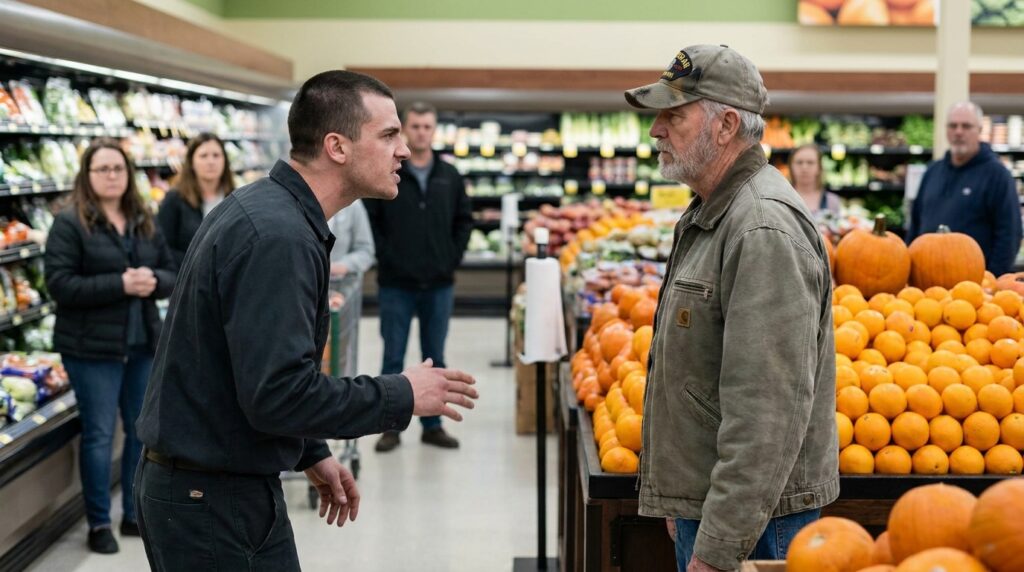
The younger man’s boots shifted on the scuffed floor, the small, sharp screech of rubber against linoleum signaling a transfer of weight. He didn’t drop his hands. Instead, his shoulders squared, blocking out the light from the dairy coolers at the far end of the row. On his right thumb, a thick, notched steel ring caught the cold fluorescent glare. The metal was rough-edged, the grooves packed with the gray, industrial grease of heavy equipment—the same grease currently staining the hydraulic lifters of the earthmovers parked three miles out on the county line.
The old man watched that ring. He didn’t look at the eyes, which were wide and bright with a local, short-fused anger, nor did he look at the chest expanding beneath the dark casual fleece. He looked at the thumb. A notched ring on a right hand meant a man who operated levers, someone who spent ten hours a day dragging a blade through limestone and hard clay until his joints grew thick and his patience ran thin.
“You’re an old man,” the challenger muttered, his voice dropping into a tighter, rougher slot. He didn’t look at the veteran cap; he looked past it, treating the faded gold lettering as nothing more than a piece of discarded cloth. “You’ve got no business standing in the middle of the road when the trucks are running.”
The old man didn’t move his hand from the citrus display. Beneath his fingers, the small, dimpled orange felt solid, cold, a tiny weight that anchored him to the wooden bin. In the small of his back, beneath the stiff canvas of his work jacket, the folded legal summons felt like a patch of dried mud—dry, stiff, and prone to cracking under direct pressure. The developer’s name on that document was Vance Corporate Holdings. The logo on the fleece across from him was the same three-bar Chevron.
“The road’s wide enough for a man who knows how to steer,” the old man said. He didn’t raise his voice. He kept it level with the low hum of the refrigeration units, a sound like gravel rolling through a metal chute.
The young man didn’t answer with words. The space between them, less than two feet of stale air smelling of floor wax and old celery, evaporated as the challenger’s left shoulder dipped. It was a standard, uncalibrated opening—a heavy, forward-leaning crowd designed to force an older body back against the shelving until the spine met metal and the spirit broke under the weight of the audience.
The old man didn’t go back. He rubbed the small, deep-grooved scar on his left thumb against the rough canvas of his pocket, calculating the friction. He knew the structural limits of a frame that had spent forty years under load. If he took the impact full-chested, the grease-stained jacket would split, the papers would scatter, and the small authority of his silence would dissolve into a messy, public scramble on the floor.
From the corner of his eye, he saw the witness layer tighten. The woman with the salad bag had retreated three inches, her shopping cart forming a small, metal bulkhead between her kids and the aisle. The stock boy had lowered the crate of greens, his palms resting on the plastic rim, his eyes fixed on the young man’s forward boot. They weren’t going to help. In this county, a dispute in a store was like a engine fire on the shoulder of the highway—you watched the smoke from your cab, but you didn’t waste your own water.
The young man’s right hand came up, the notched steel ring clearing the line of his hip. It wasn’t a punch; it was a rough, open-palmed push intended to catch the old man by the collar and pull him out of the narrow lane. The movement was fast, but it carried the flaw of all heavy things: it was committed to a single trajectory before it even crossed the centerline of the aisle.
The old man waited until the fingernails of the young man’s hand were six inches from the weathered canvas of his lapel. Then, with a motion so small it looked like a man shifting his feet to avoid a puddle, he dropped his right heel back two inches and let his weight settle onto his hip. He didn’t swing. He didn’t raise his arms to block. He simply altered the angle of resistance by the width of a standard nut.
The young man’s palm struck nothing but air, his fingers brushing the coarse, oil-scented fabric of the jacket without finding purchase. His own momentum—the three hundred pounds of force he’d generated by throwing his chest into the lunge—carried him past the old man’s shoulder. His left work boot skidded on a patch of wet linoleum near the lettuce misting racks, the tread losing its grip with a sharp, wet hiss.
The old man didn’t watch him go. He kept his eyes on the citrus bin, his hand still resting on the orange he had chosen three minutes ago. He heard the sudden, heavy crunch of a body hitting timber before he saw it—the dull, flat sound of a shoulder meeting the structural corner of the main orange display. The wood didn’t break, but the impact sent a shudder through the entire tier of stacked fruit.
The top row of oranges, balanced in neat, concentric pyramids, began to roll. First two, then a dozen, then a whole cascade of bright orange spheres dropped from the upper shelves, hitting the floor with a rhythmic, hollow rattling that sounded like large hail falling on an old tin roof. They bounced off the young man’s boots, rolled into the dark corners beneath the vegetable racks, and scattered across the wide white lane, filling the small space with the sudden, sharp scent of ruptured citrus skin.
The young man lay across the edge of the bin, his dark sweatshirt dusted with dry splinters from the rough wood, his right hand still extended toward the empty air where the old man had been standing a micro-second before. His breath came out in a short, ragged grunt, the sound of a man who had hit the earth harder than he’d ever intended.
The silence returned, heavier this time, thick with the smell of iron and crushed fruit. The stock boy hadn’t moved. The woman with the cart had stopped her retreat, her eyes fixed on the scattered oranges that were now resting against her shoes. The young man stayed pinned against the timber for three full seconds, his face darkening as the realization of the room’s total attention settled into his neck.
The old man slowly turned his head to look down at him. He didn’t smile, and he didn’t offer a hand. He just stood there, upright beneath his faded cap, his boots planted firmly between two rolling oranges that had stopped against his leather toes.
“You’re dropping your shoulder on the turn,” the old man said, his voice flat, the tone completely devoid of malice or triumph. “You’ll ruin the machinery that way.”
The young man’s fingers twitched against the wood, the notched steel ring scraping against the grain, leaving a small, raw line in the softwood of the display.








